With Jeonse Loan Restrictions, More Flock to Low-Interest Credit Loans
June Balance Hits 117 Trillion Won... Record Increase
Big Five Banks See Larger Decline in Time Deposits
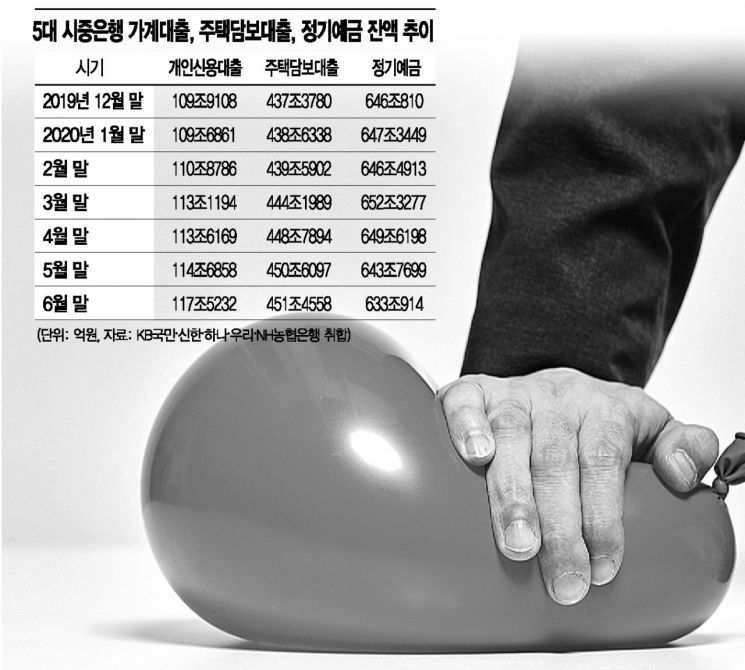
[Asia Economy Reporter Jo Gang-wook] The scale of personal unsecured loans issued by the five major domestic banks surged by nearly 3 trillion won last month, setting an all-time record. In contrast, the growth of mortgage loans slowed down. This is interpreted as a result of the government's successive high-intensity real estate loan regulations, which have ultimately dampened demand for mortgage loans. Additionally, with restrictions on jeonse deposit loans, analysts say the demand has shifted to unsecured loans, realizing a 'balloon effect.'
According to the financial sector on the 2nd, the outstanding balance of personal unsecured loans at KB Kookmin, Shinhan, Hana, Woori, and NH Nonghyup Banks stood at 117.5232 trillion won as of the end of last month. This marked a sharp increase of 2.8374 trillion won compared to the end of the previous month, surpassing the record increase of 2.2409 trillion won in March. The increase in personal unsecured loans at the five major banks slowed to 500 billion won in April but rose again to 1 trillion won in May and 2.8 trillion won in June. Over the first six months of this year, the increase in unsecured loans from major banks reached a staggering 7.6 trillion won, more than eight times the approximately 900 billion won increase during the same period last year.
On the other hand, the outstanding balance of mortgage loans last month was 451.4558 trillion won, up 84.61 billion won from the previous month. The increase in March and April totaled 4.6 trillion won, but it shrank to 1.8 trillion won in May and further contracted to 800 billion won in June.
The general view is that the slowdown in mortgage loan growth and the unusual surge in unsecured loans are due to the impact of stringent real estate policies. The balloon effect, where tightly restricted mortgage loan demand shifts to unsecured loans due to the government's continuous tightening of real estate loan regulations, has become a reality. Some forecasts even suggest that mortgage loans may decrease further this month while unsecured loans could exceed June's increase.
Another factor is that borrowers who find it difficult to obtain mortgage or jeonse deposit loans are flocking to unsecured loans as their interest rates have decreased. As of last month, the average interest rate on overdraft (credit limit) loans at the five major banks ranged from 2.72% to 3.28% per annum, down 0.55 percentage points from 3.27% to 3.83% in December last year. The lowered threshold for unsecured loans due to low interest rates, combined with the prolonged COVID-19 pandemic, is believed to have further increased demand.
There is also analysis that high-credit borrowers, relatively unaffected by the COVID-19 damage, have taken out unsecured loans for stock investment purposes, contributing to the record surge. This year, the number of individual accounts and net purchase amounts in the stock market have continued to increase at record levels.
Conversely, the low interest rate environment has led to a significant decrease in bank time deposits. Over 10 trillion won was withdrawn from time deposits at the five major commercial banks in June alone. Since reaching 652.3277 trillion won in March, the balance of time deposits at these banks has declined for three consecutive months. The month-on-month decrease was 2.7079 trillion won in April and 5.8499 trillion won in May, showing a sharp increase.
With time deposit interest rates plummeting to the 0% range, investment attractiveness has also diminished, and it is analyzed that it will be difficult for deposits, which serve as surplus or investment funds, to increase amid the COVID-19 impact.
A financial sector official said, "If the balloon effect of mortgage loan demand shifting to unsecured loans continues to grow due to government real estate regulations, adjustments to limits or interest rates may be implemented in the future," adding, "While some customers affected by COVID-19 cannot even resolve urgent cash needs, others are taking out unsecured loans without burden in the low-interest environment to invest in stocks."
© The Asia Business Daily(www.asiae.co.kr). All rights reserved.
![Clutching a Stolen Dior Bag, Saying "I Hate Being Poor but Real"... The Grotesque Con of a "Human Knockoff" [Slate]](https://cwcontent.asiae.co.kr/asiaresize/183/2026021902243444107_1771435474.jpg)















