Our Country's First Self-Closing Type Najeonhap
Abalone Shells Shine Radiantly, Sea Turtle Shell Colors Are Warm
Diverse Pattern Elements Harmoniously and Elegantly Combined
Unveiled at the December National Museum of Korea Special Exhibition 'Colors of Antiquity, Lacquer'
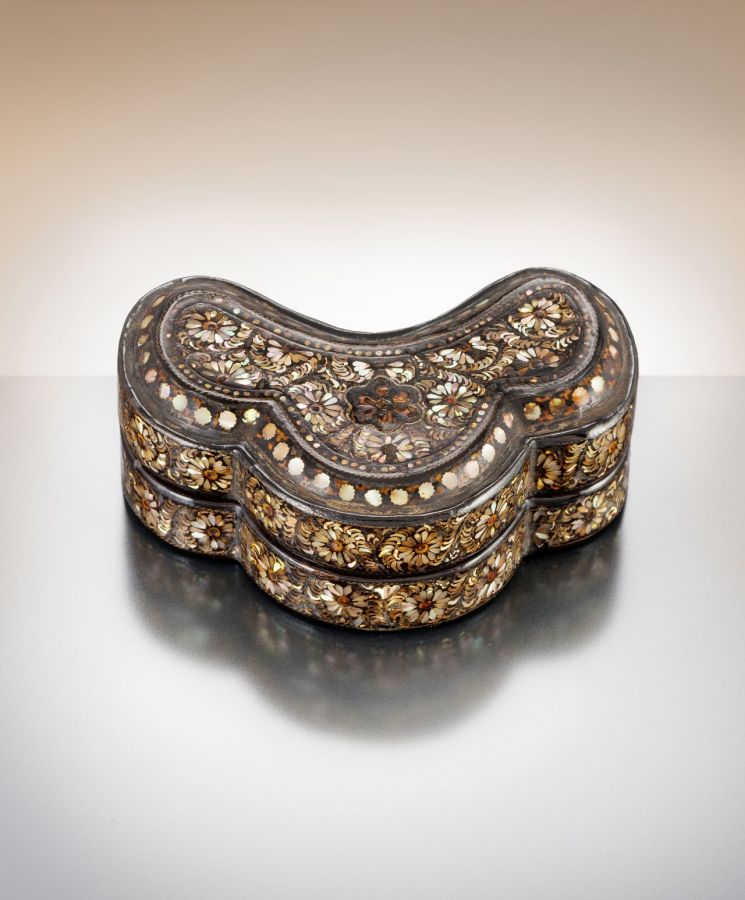
The 'Najeon Gukhwa Neongkulmunui Hap (Najeon Hap)', a lacquerware piece inlaid with mother-of-pearl that embodies the craftsmanship of the Goryeo Dynasty, has returned to its homeland and will be publicly exhibited.
The Cultural Heritage Administration first revealed this cultural asset, which arrived from Japan last December, to the press on the 2nd. It is one of the child boxes (jahap) from a mother-child box set (mojahap)?a large box containing several smaller boxes?previously displayed at the 2006 National Museum of Korea special exhibition "Najeon Chilgi ? The Light Continued for a Thousand Years." Among only three intact examples worldwide, this was the only privately owned piece available for purchase. The Overseas Korean Cultural Heritage Foundation negotiated directly with the owner to bring it back. A Cultural Heritage Administration official stated, "This is the first time that Korea, the original producer of Goryeo Najeon Chilgi, has acquired a child box type Najeon Hap."
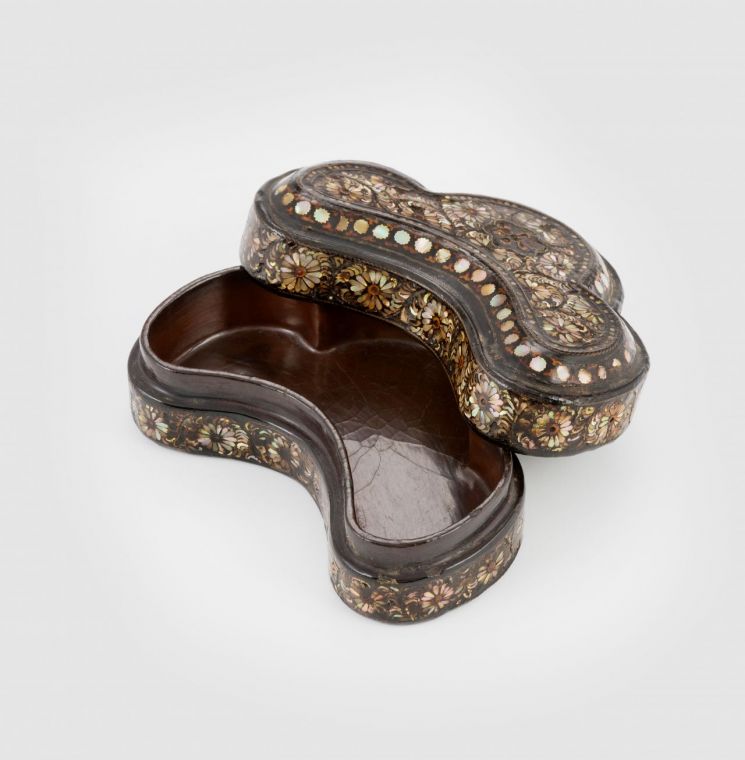
The Najeon Hap measures 10 cm in length and weighs 50 g. The abalone shell shines iridescently, while the tortoiseshell (daemo, 玳瑁) displays a gentle hue. The decoration is meticulously crafted with metal lines, reflecting the refined beauty characteristic of Goryeo Najeon Chilgi. The main repeated motifs on the lid and body are chrysanthemums and vines. The mother-of-pearl pieces are cut so finely that they are difficult to pick up with fingertips and are densely arranged to create elegant patterns.
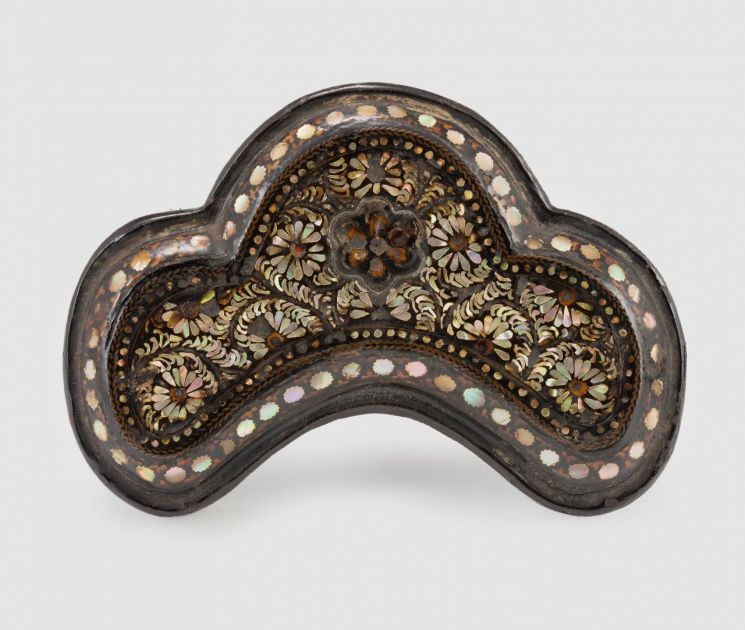
The large floral pattern at the center of the lid and the chrysanthemum stamens feature the daemo bokchae technique (玳瑁伏彩法), a hallmark of Goryeo Najeon Chilgi. Thinly shaved tortoiseshell is applied with red coloring on the back, causing a reddish glow to appear on the surface. The lid’s edge is densely decorated with a yeonjumu pattern (連珠文), a motif resembling beads strung together with dots or small circles. Various design elements harmonize with dignity, such as metal lines depicting vine stems and twisted double lines outlining the object’s contours.
Goryeo Najeon Chilgi is regarded as one of the representative art crafts of Goryeo beauty, alongside Goryeo celadon and Buddhist paintings. Seo Geung, a Song Dynasty envoy who visited Goryeo in the mid-Goryeo period, wrote in the "Goryeodogyeong (高麗圖經)" that it was "exquisitely delicate (極精巧)" and "so finely crafted as to be precious (細密可貴)." Today, only about twenty pieces of Goryeo Najeon Chilgi survive worldwide, mostly housed in museums in the United States and Japan. With this repatriation, Korea will now possess three pieces, including the Najeon Daemo Chil Gukhwa Neongkulmunui Bulja (拂子) and a Buddhist scripture box.
The National Research Institute of Cultural Heritage conducted a bi-photonic analysis of the Najeon Hap from January to March to understand its production methods and materials. The results confirmed the use of typical techniques and materials, revealing that it is a mokshim chilgi (wood-core lacquerware) made by shaping wood, covering it with cloth, and then lacquering it. They also identified that the curved body was formed by making incisions at regular intervals on the inner surface of the panel and bending it smoothly, and that the body was constructed by attaching side walls after making the bottom and top panels. The National Museum of Korea will exhibit this Najeon Hap in December at the special exhibition "Colors of Antiquity, Lacquer" for the first time in 14 years. A comprehensive research report will also be published alongside the exhibition.
© The Asia Business Daily(www.asiae.co.kr). All rights reserved.
![Clutching a Stolen Dior Bag, Saying "I Hate Being Poor but Real"... The Grotesque Con of a "Human Knockoff" [Slate]](https://cwcontent.asiae.co.kr/asiaresize/183/2026021902243444107_1771435474.jpg)

















