'Dual Taxation' Outrage
If This Continues, Individual Investors May Pay Up to 8 Trillion KRW in Securities Transaction Tax This Year
Even with a 0.1%p Cut in 2023
Annual Tax Revenue Could Reach 5 Trillion KRW
[Asia Economy Reporter Oh Ju-yeon] Individual investors are estimated to have paid more than 4 trillion won in securities transaction tax in the first half of this year alone. This is the largest amount ever, comparable to the annual securities transaction tax in previous years. If the current trading volume is maintained, the securities transaction tax collected from Donghak Ants alone this year is expected to reach 8 trillion won, setting a record high.
This is attributed to the active stock trading by individual investors, known as 'Donghak Ants,' who entered the stock market following the COVID-19 pandemic. If this trend continues, even if the government lowers the securities transaction tax by 0.1 percentage points according to the 'Financial Tax Reform Plan' announced last month, nearly 5 trillion won will still be collected in securities transaction tax. Investors complain, saying, "They only raise capital gains tax but still collect as much securities transaction tax as before," calling it "essentially a tax increase."
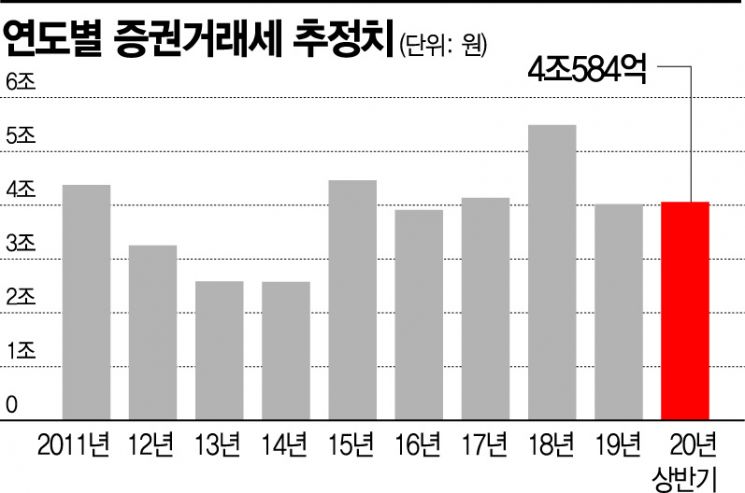
On the 2nd, Asia Economy Newspaper, in collaboration with the Korea Exchange, analyzed the selling amounts of individual investors in the KOSPI and KOSDAQ markets from 2008 to June 30, 2020, to estimate the securities transaction tax. It was analyzed that about 1.7621 trillion won was collected in the KOSPI market and about 2.2963 trillion won in the KOSDAQ market in the first half of this year, totaling approximately 4.0584 trillion won. This is similar in scale to the annual securities transaction tax in previous years.
The securities transaction tax, which was around 1.74 trillion won during the 2008 financial crisis, surged to 3 to 4 trillion won after 2009 as individual stock trading became more active. In 2018, it is estimated that 5.4889 trillion won was collected, with 2.4541 trillion won from the KOSPI market and 3.0348 trillion won from the KOSDAQ market. At that time, the stock market had plummeted due to the US-China trade dispute that began in July. Since then, voices demanding the abolition of the securities transaction tax have grown, especially from the securities and asset management industries, arguing that the tax violates the principle of taxation that "taxes should be levied where income exists." Eventually, the securities transaction tax rate was lowered from 0.30% to 0.25% on June 3 last year.
From January 1 to June 2 last year, a 0.30% securities transaction tax was applied, collecting 779.3 billion won from the KOSPI market and 1.0728 trillion won from the KOSDAQ market. From June 3 to December 31, a 0.25% tax rate was applied, collecting 823.7 billion won and 1.3435 trillion won respectively. The total securities transaction tax for last year is estimated at 4.0193 trillion won. This year, individuals have already paid more taxes in half a year than last year's securities transaction tax.
The problem is that the burden of the securities transaction tax falls on individual investors. Especially in the KOSDAQ market, most of the securities transaction tax is borne by individuals. While individual selling accounts for 59% of total investors in the KOSPI market, it accounts for 87% in the KOSDAQ market.
The government proposed a reform plan to reduce the securities transaction tax rate by 0.02% to 0.22% by 2022 and further reduce it by 0.08% to maintain a final rate of 0.15% in 2023. The government is sticking to a 'gradual reduction' rather than 'abolition' of the securities transaction tax. The government claims that lowering the securities transaction tax will reduce the burden on investors, but if the stock trading volume continues as it is this year, the securities transaction tax will reach 4.8 trillion won in 2023. Moreover, once taxation on capital gains begins, the government is expected to collect much more tax than now.
Resistance from individual investors and other market participants is also growing. Lee Hyo-seop, Senior Research Fellow at the Korea Capital Market Institute, pointed out, "Although the securities transaction tax was lowered, it may seem like it is not a tax increase at first glance, but since a previously nonexistent capital gains tax has been introduced, the actual amount paid by individual investors has increased significantly," adding, "The reason for maintaining the securities transaction tax is said to be to suppress market instability factors such as high-frequency trading, but this argument is not very convincing."
© The Asia Business Daily(www.asiae.co.kr). All rights reserved.
![Clutching a Stolen Dior Bag, Saying "I Hate Being Poor but Real"... The Grotesque Con of a "Human Knockoff" [Slate]](https://cwcontent.asiae.co.kr/asiaresize/183/2026021902243444107_1771435474.jpg)















