2022 Financial Tax Reform Introduced
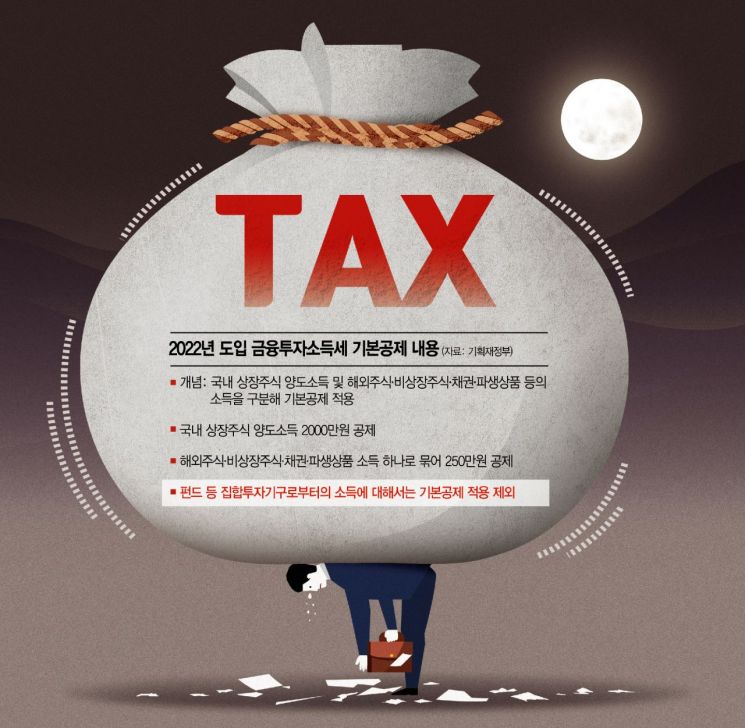
KRW 20 Million Deduction for Domestic Stock Income
KRW 2.5 Million Deduction for Overseas Stocks
Exclusion of Deduction for Fund Income
Investors Withdraw Money from Funds
Forced to Buy Individual Stocks
Stock Funds and ETF Markets Expected to Suffer Most
Ministry of Economy and Finance: "Funds Managed by Asset Managers Differ from Direct Investment, Deduction Difficult"
Political Circles Agree on Need for Improvement
[Asia Economy Reporter Park Ji-hwan] As the government pushes to tax capital gains from stocks and funds starting in 2022, concerns are rising that investing in funds (collective investment schemes) is at a tax disadvantage compared to direct stock investments. While direct stock investors receive tax deduction benefits such as a basic exemption, no separate deduction system has been established for fund investors, sparking controversy over reverse discrimination. With political circles also expressing concerns about this issue, attention is focused on whether the government will prepare a revised plan in the future.
According to the "Direction for Advancing Financial Taxation" announced by the Ministry of Economy and Finance on the 25th of last month, from 2022, taxes will be imposed on all income generated from listed stock capital gains as well as from funds. Previously, capital gains from listed stocks were non-taxable, and for funds, only interest, dividends, and redemption gains were subject to a 15.4% dividend income tax.
The problem lies in the difference in basic exemption benefits applied when calculating the taxable base for capital gains tax by investment type. Domestic listed stock capital gains receive a 20 million KRW exemption, while overseas stocks, unlisted stocks, bonds, and derivatives are grouped together and receive a 2.5 million KRW exemption. However, no exemption benefits are provided for funds during taxation. Since overseas stocks and derivatives also receive a 2.5 million KRW basic exemption, funds have been pointed out as the biggest losers in this reform plan.
If an investor earns 20 million KRW annually through direct stock investment, they receive a 20 million KRW basic exemption, resulting in no tax liability. In contrast, if the same amount is earned through investment in an equity fund, the entire 20 million KRW is taxable. Applying a tax rate of 22%, including local income tax, means paying 4.4 million KRW in financial investment income tax.
Experts argue that it is reverse discrimination to pay higher taxes simply because stocks are held within a fund, despite no economic difference in substance. Investors are thus forced to withdraw money from funds to buy individual stocks. The financial investment industry expects that equity funds and index funds such as Exchange-Traded Funds (ETFs) will suffer the most damage. These products offer the advantage of easy indirect investment without the investor having to select individual stocks one by one.
A representative from the Korea Financial Investment Association said, "According to the government’s plan, investing in equity funds that hold Samsung Group stocks will become less attractive tax-wise compared to directly investing in individual stocks like Samsung Electronics or Samsung SDI, significantly reducing incentives to subscribe to fund products."
Hwang Se-woon, a research fellow at the Korea Capital Market Institute, pointed out, "It is necessary to create a new category that groups stocks, funds, and bonds together to allow for loss offsetting and carryforward deductions among them. The basic exemption should also be applied within this category at 20 million KRW."
The Ministry of Economy and Finance maintains that fund investments fundamentally differ in nature from direct stock investments, making uniform application of exemptions difficult. Direct stock investment requires investors to make decisions when selling stocks, justifying a basic exemption as a necessary expense. Conversely, indirect investments are managed entirely by asset managers, so they should not be treated the same. A ministry official explained, "There is currently no income deduction system for collective investment scheme profits. However, with this system, issues such as taxation on fund losses have been resolved by introducing loss offsetting and carryforward deduction systems, so even without a basic exemption, there are many other benefits."
Political circles have also raised their voices, calling for improvement in the government's plan not to apply tax deductions to funds. The domestic stock market has a disproportionately large share of individual investors engaging in direct investment compared to overseas markets, so it is desirable to promote indirect investment through funds.
Kim Byung-wook, a member of the Democratic Party of Korea, emphasized, "Providing different benefits to stocks and funds seems to be a policy that goes against the need to promote indirect investment. Funds should also be included in the basic exemption, and additional measures such as extending the three-year loss carryforward period and support for long-term holders should be considered."
The government plans to establish a financial investment income taxation enforcement system in the first half of next year and proceed with legislative procedures in the second half to address necessary improvements to this year’s revised tax law.
© The Asia Business Daily(www.asiae.co.kr). All rights reserved.

















