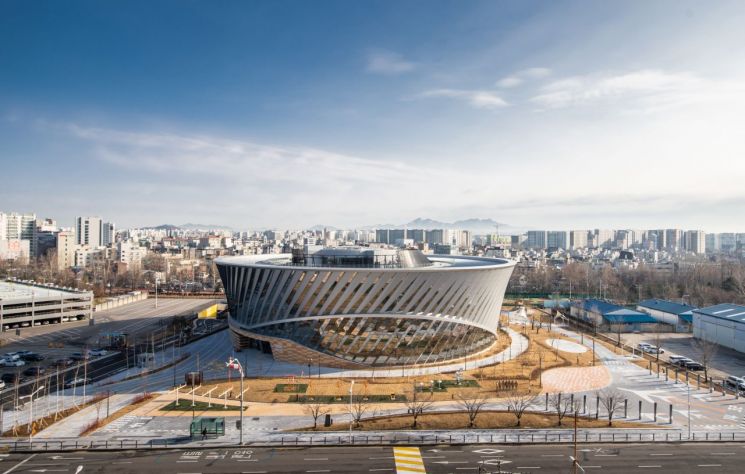
[Asia Economy Reporter Lee Chun-hee] A museum where visitors can experience the history, present, and future of the Korean aviation industry all in one place, aiming to be "the place where the highest dreams are met the closest," is set to open.
The Ministry of Land, Infrastructure and Transport announced on the 2nd that the National Aviation Museum, established as a special corporation under its jurisdiction, will open on the 5th. The opening date was chosen to commemorate the 100th anniversary of the establishment of the Korean Provisional Government’s Korean Aviation School in Willows, California, USA, on July 5, 1920.
Before the official opening, an opening ceremony will be held on the 3rd. The ceremony will be attended by Son Myeong-su, 2nd Vice Minister of the Ministry of Land, Infrastructure and Transport; Choi Jeong-ho, Director of the National Aviation Museum; Jin Seong-jun, member of the Democratic Party of Korea (Seoul Gangseo-eul); Bae Gi-dong, Director of the National Museum of Korea; aviation industry workers; and some local residents to celebrate the establishment of the National Aviation Museum.
The opening ceremony will be conducted with a minimal number of attendees to prevent the spread of COVID-19. The program will begin with congratulatory videos from various figures, followed by the declaration of the opening, a report on the museum’s progress, and a vision proclamation ceremony. In particular, to commemorate the history of Korean aviation that began with the aviation independence movement, a statue unveiling ceremony of aviation independence activists including No Baek-rin, Oh Rim-ha, Lee Yong-seon, Lee Cho, Han Jang-ho, Lee Yong-geun, and Jang Byeong-ho will be held with the participation of their bereaved families and memorial associations.
The National Aviation Museum will introduce Korea’s aviation history and industry under the slogan "the place where the highest dreams are met the closest." On the first floor, the "Aviation History Hall" will showcase the past history; on the second floor, the "Aviation Industry Hall" will present the development of the currently growing Korean aviation industry; and on the third floor, the "Aviation Life Hall" will exhibit changes in future life themed around future aviation.
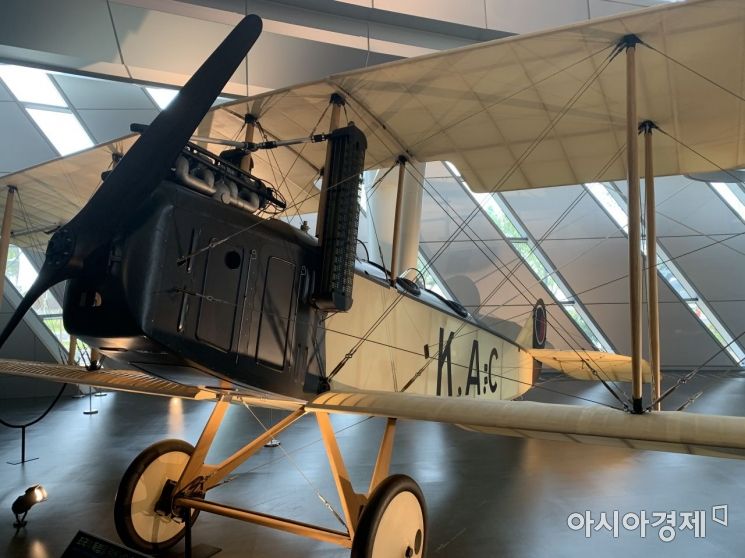 Restored 'Standard J-1' aircraft displayed at the National Aviation Museum in Gangseo-gu, Seoul. (Photo by Lee Chunhee)
The museum’s most representative exhibits are the 'Geumgangho' airplane by An Chang-nam and the 'Standard J-1' used as a training aircraft at the Korean Provisional Government’s Korean Aviation School. Both airplanes have been restored to their actual size.
The Geumgangho is the airplane personally piloted by An Chang-nam, the first Korean to fly in the skies over the Korean Peninsula. It is a biplane of the Nieuport-17 type, decorated with a map of the Korean Peninsula and An’s name in Chinese characters. In 1922, An flew this airplane for the first demonstration flight in Korea, awakening national pride and dignity among Koreans who had lost their homeland at the time.
The Standard J-1 is a two-seater biplane with the Taegeuk symbol engraved on its vertical stabilizer and the letters "KAC" (Korean Aviation Corps) on its side, clearly marking it as the Korean Aviation School’s aircraft.
In addition, the museum exhibits various real aircraft such as the ‘KC-100 Naraon,’ Korea’s first domestically developed civil aircraft, and the ‘T-50B Golden Eagle,’ a modified domestic supersonic trainer used by the Air Force’s special flight team ‘Black Eagles’ for aerobatics. There are also exhibits designed to stimulate children’s curiosity, including a cross-section of a Boeing B747 fuselage and engines.
The National Aviation Museum plans to hold various special exhibitions. The first special exhibition after the opening will focus on Gimpo Airport. Starting as a military runway during the Japanese colonial period, Gimpo Airport served as Korea’s main civilian airport and gateway until the opening of Incheon International Airport in 2001. The exhibition will showcase the airport’s transformation from its beginnings as the Gimpo runway to its future as a city-type smart airport, capturing the traces of life of passengers, workers, and local residents throughout its history.
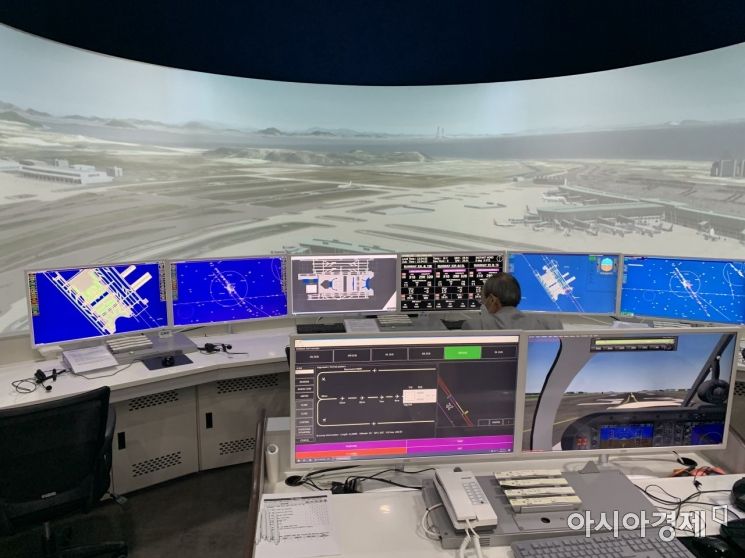 Air Traffic Control Experience Facility set up at the National Aviation Museum in Gangseo-gu, Seoul (Photo by Lee Chunhee)
Additionally, various experiential education spaces will be provided. Through Korea’s only integrated pilot and air traffic control system, there will be experience zones for B-747 pilots and Incheon Airport air traffic controllers, as well as an in-flight training experience space where visitors can participate in safety training that is usually only heard through in-flight announcements. Furthermore, there will be spaces to experience various aviation sports such as light aircraft simulators, drone racing, paragliding, and hang gliding VR (virtual reality).
However, due to COVID-19, even though the museum opens on the 5th, educational and cultural services will be replaced by online and small-group exhibition-linked programs for the time being. The museum plans to provide various content on YouTube for visitors who cannot come in person.
Director Choi Jeong-ho said, "We expect the National Aviation Museum to systematically manage our aviation cultural heritage and to activate research, exhibitions, and education, becoming a space that nurtures dreams and hopes for children and the public. With storytelling-style aviation cultural heritage exhibits and new, future-oriented aviation cultural content based on digital and virtual reality experience spaces, the museum is differentiated from existing museums. We hope the public will take an interest and visit frequently so that it can grow into a world-class aviation museum."
© The Asia Business Daily(www.asiae.co.kr). All rights reserved.
![Clutching a Stolen Dior Bag, Saying "I Hate Being Poor but Real"... The Grotesque Con of a "Human Knockoff" [Slate]](https://cwcontent.asiae.co.kr/asiaresize/183/2026021902243444107_1771435474.jpg)

















