Prime Minister Jeong Sye-kyun Emphasizes Proactive Preparation for Post-COVID-19
Detailed Plans to Be Announced Sequentially in the Second Half Based on Confirmed Policy Framework
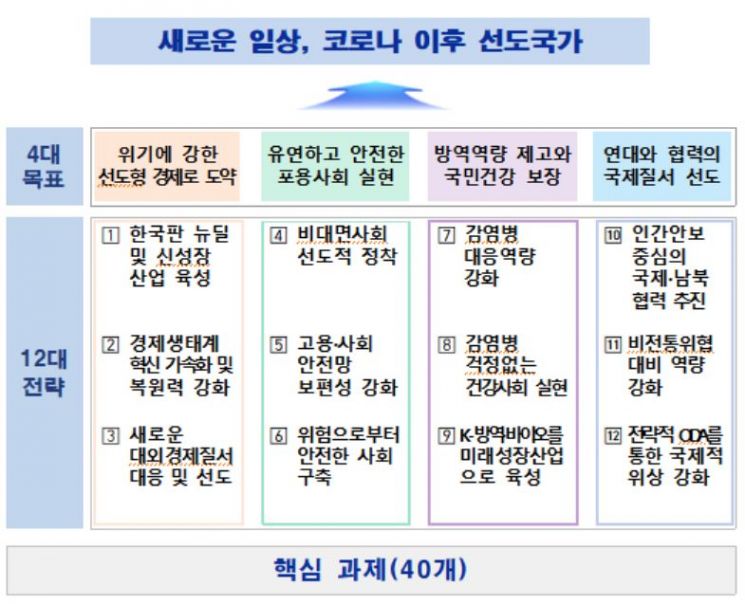
[Asia Economy Reporter Lim Cheol-young] On the 2nd, Prime Minister Chung Sye-kyun chaired the Government Seoul Office and reviewed and finalized the direction for promoting key tasks in the post-COVID-19 era.
The policy tasks reviewed and finalized that day were composed of 4 major goals, 12 strategies, and 40 core tasks through six Thursday dialogues and a pan-government task force (TF). The four major goals are: leap forward to a crisis-resilient leading economy, realization of a flexible and safe inclusive society, enhancement of quarantine capabilities and guarantee of public health, and leading an international order of solidarity and cooperation.
In response to the expansion of economic uncertainty and rapid changes in the economic ecosystem, the government will foster the Korean New Deal and new growth industries and promote innovation and resilience strengthening of the economic ecosystem to leap forward to a crisis-resilient leading economy.
Accordingly, the government selected core tasks such as ▲promotion of the Digital New Deal to lead the digital economy ▲promotion of the Green New Deal to prepare for economic and climate crises ▲fostering new growth industries such as logistics, distribution, and K-content. The government will establish the ‘Korean New Deal Comprehensive Plan (July)’ including digital and green new deals and strengthening the employment safety net, and prepare the ‘Non-face-to-face Industry Promotion Plan (September)’ and others.
To innovate the economic ecosystem and strengthen resilience, the government plans to accelerate innovation in key industries while strengthening an open innovation ecosystem and innovation infrastructure and promoting resilience strengthening of the economic ecosystem as core tasks. In this regard, the government will prepare the ‘Post-COVID Industrial Strategy (July)’ including support for key industry innovation and restructuring, the ‘AI and Data-based Manufacturing Innovation Advancement Strategy (July),’ and support companies in establishing business continuity plans.
Furthermore, to respond to the new external economic order, the government will prepare the ‘Comprehensive Strategy for Responding to Global Supply Chain Restructuring (July)’ to establish a global production base for advanced industries, and establish the ‘Post-COVID New Trade Strategy (July)’ and ‘Post-COVID External Economic Strategy (November)’ in response to changes in trade and external economic order, as well as ‘Sectoral Core National Strategies (December)’ for finance, medical care, tourism, public administration, shipping and logistics, etc.
◆Leading the establishment of a non-face-to-face society... Strengthening employment and social safety nets= As part of realizing a flexible and safe inclusive society and leading the establishment of a non-face-to-face society, the government will prepare ▲the ‘Korean Remote Education System Establishment Mid- to Long-term Plan (July)’ to enhance remote education and provide high-quality lifelong education ▲the ‘Open Lifelong Education and Training Measures (August).’ It will also establish the ‘Digital Media Communication Competency Enhancement Plan (August)’ to expand media literacy education.
To strengthen employment and social safety nets, the government will establish the ‘2nd Basic Livelihood Security Comprehensive Plan (2021?2023)’ (August) and promote the preparation of the ‘Mid- to Long-term Roadmap to Eliminate Blind Spots in Employment Insurance (December)’ to lay the foundation for universal employment insurance. It will prepare the ‘Social Responsibility Strengthening Measures for Childcare (December)’ to prevent childcare gaps and the ‘Child and Youth Protection and Safety Improvement Measures (July)’ to address concerns such as child abuse, and also revise laws and systems related to digital inclusion.
◆Enhancing quarantine capabilities and guaranteeing public health... Considering expansion of non-face-to-face medical services= To respond to the constant risk of infectious disease pandemics, the government will enhance quarantine capabilities and strengthen public health guarantees. To strengthen infectious disease response capabilities, it will upgrade the Korea Disease Control and Prevention Agency and establish regional disease response centers (August), and establish a ‘Comprehensive Plan for Healthcare Workforce’ to improve management of public hospitals and medical personnel (December). Additionally, it will build a public-private medical institution cooperation system by December and prepare a bed mobilization plan according to patient severity and a regional joint response system (October).
The government will also consider expanding non-face-to-face medical services through social discussions to improve medical convenience and prepare a ‘Preventive Health Management Plan for High-risk Groups of Infectious Diseases (December).’ To foster K-quarantine and bio industries, it will prepare the ‘K-Quarantine Global Expansion Strategy (December)’ and establish the National Infectious Disease Research Institute as a control tower for infectious disease research, including vaccine development and situation prediction, by June next year. It will also establish a ‘Comprehensive Plan for the Medical Device Industry’ and a ‘Plan to Strengthen Regenerative Medicine Competitiveness (December).’
◆International cooperation centered on human security... Strengthening capabilities against non-traditional threats= The government will promote international cooperation to respond to changes in the international order such as deglobalization, the spread of nationalism, and the expansion of traditional security concepts, and strengthen preparedness capabilities against non-traditional threats.
The government selected core tasks such as ▲securing international leadership in life and safety fields ▲pursuing diplomatic strategies according to the post-COVID international order ▲promoting inter-Korean cooperation in the human security field, activating discussions of the ‘Health Cooperation Friendship Group’ launched under Korea’s leadership, and promoting the hosting of the ‘Peacekeeping Ministerial Meeting (April 2021)’ and the ‘P4G Summit (2021).’
In addition, to prepare for non-traditional threats, the government will consider the role and development direction of the military and establish the ‘Integrated Civil-Military Response Information System’ and ‘Defense Disaster Support System’ for rapid information sharing. The government will also prepare the ‘Post-COVID ODA Strategy (July)’ to build strategic official development assistance (ODA), and ‘Re-designation of Priority ODA Partner Countries (December)’ and ‘Country-specific Cooperation Strategies’ considering strategic priorities such as foreign policy.
Based on the direction for promoting core tasks, the government will establish and announce specific promotion plans for each task and reflect the necessary budget in the 2021 budget.
© The Asia Business Daily(www.asiae.co.kr). All rights reserved.
![Clutching a Stolen Dior Bag, Saying "I Hate Being Poor but Real"... The Grotesque Con of a "Human Knockoff" [Slate]](https://cwcontent.asiae.co.kr/asiaresize/183/2026021902243444107_1771435474.jpg)















