First Suspected Case of COVID-19 On-Campus Transmission in Daejeon
Some Parents Say "School Attendance Should Be Suspended Due to On-Campus Spread Risk"
Experts Say "Root Cause Must Be Addressed... Strengthening Quarantine Measures Needed"
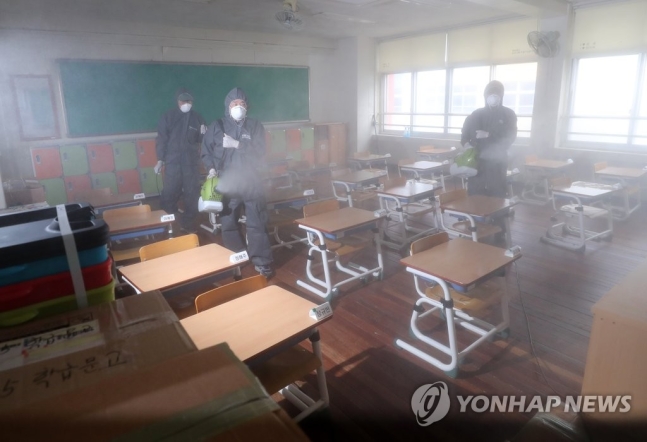 On the morning of the 30th of last month, a quarantine company official is disinfecting and sanitizing the school facilities at Daejeon Cheondong Elementary School in Cheondong, Dong-gu, Daejeon. Photo by Yonhap News
[Asia Economy Reporter Kim Ga-yeon] As the first suspected case of in-school transmission of the novel coronavirus disease (COVID-19) occurred since the start of in-person classes, parents are raising their voices demanding the suspension of in-person schooling. This is because, with the occurrence of a suspected in-school transmission case, the safety of children must be prioritized above all else.
On the other hand, some argue that while ensuring students' right to learn through ongoing classes, additional preventive measures that students can practice should be established. They point out that if in-person classes are suspended indefinitely until the COVID-19 outbreak ends, educational disparities may arise, and children may face difficulties developing social skills through communication and interaction.
Experts suggested that strengthening quarantine measures to reduce the number of confirmed cases is necessary to lower the risk of COVID-19 transmission within schools.
According to Daejeon City on the 30th of last month, two 5th-grade students at Cheondong Elementary School were confirmed positive for COVID-19 as the 120th and 121st cases, respectively. The 120th patient was a classmate of the 115th patient, who was confirmed positive the day before (on the 29th of last month), and it was identified that they had contact during the period from the 22nd to the 24th of last month when the 115th patient attended school. The 121st patient was confirmed to be in the same school and grade as the 115th patient. The two had contact while attending the same gymnasium.
Daejeon City announced on the 1st that COVID-19 diagnostic tests were conducted on 159 people, including 25 classmates of the 115th confirmed patient and 51 people attending the same gymnasium, all of whom tested negative. Fourteen surrounding schools, including the affected school, suspended in-person classes and switched to remote learning.
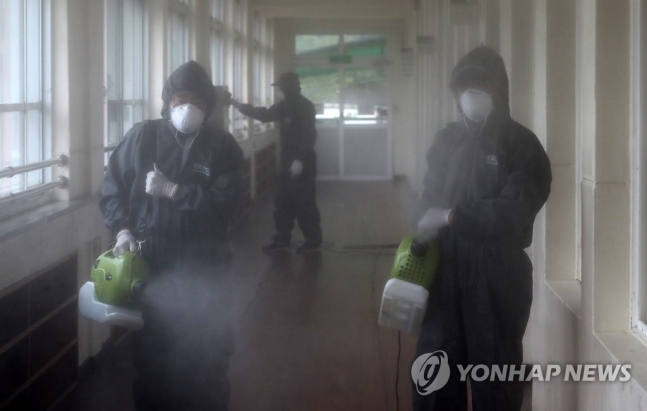 On the morning of the 30th of last month, a quarantine company official is disinfecting and sanitizing the school facilities at Daejeon Cheondong Elementary School in Cheondong, Dong-gu, Daejeon. Photo by Yonhap News
As a result, some parents expressed anxiety about in-school transmission and collectively voiced that in-person classes should be stopped.
Parent A, who has an elementary school child, said, "They confidently proceeded with in-person classes saying there were no transmission cases among students within the school, but look where we are now," adding, "There may have been no spread within the school until now, but no one knows when or where it might break out. The first case has appeared; is there any guarantee that other schools won’t have cases?"
Additionally, citizens have continued criticism through SNS and portal site comments, saying things like, "The government must take responsibility for the secondary infections," "Will they only wake up when hundreds of confirmed cases come out daily? Don’t fix the barn after losing the cow," and "I don’t understand why they take such risks when they could just stop in-person classes."
Meanwhile, some argue that additional preventive measures are needed to continue in-person classes. There is concern that full online classes could infringe on students' right to learn in the current situation where it is unknown when COVID-19 will end.
Office worker B (29) said, "I don’t think simply stopping in-person classes will solve the problem," adding, "If classes continue online, children who cannot guarantee their right to learn at home or families that cannot care for their children 24/7 may suffer greatly."
B added, "Shouldn’t schools devise more ways to block the possibility of COVID-19 transmission?" and "Since we don’t know when vaccines will be developed or when the pandemic will end, we can’t keep avoiding in-person classes indefinitely."
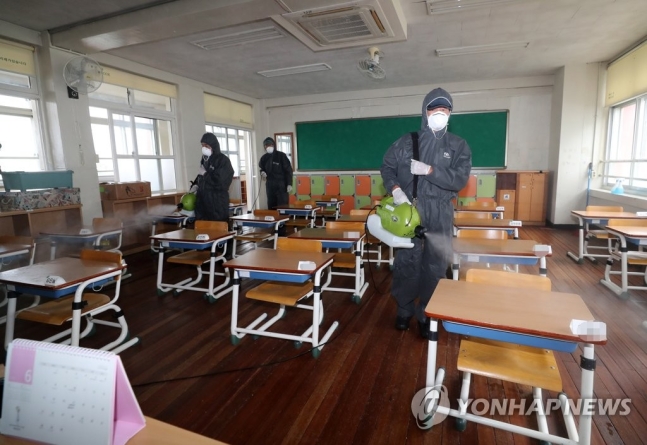 On the morning of the 30th of last month, a quarantine company official is disinfecting and sanitizing the school facilities at Daejeon Cheondong Elementary School in Cheondong, Dong-gu, Daejeon. Photo by Yonhap News
Experts pointed out that the fundamental cause must be addressed, warning that such infection cases can occur if the government does not strengthen quarantine measures.
Professor Kim Woo-joo, an infectious disease specialist at Korea University Guro Hospital, said in a phone interview with Asia Economy on the 1st, "Whether there is a risk of infection through contact among children in the same class when there is a confirmed case is not easy to say simply," adding, "There is a risk in metropolitan areas where many patients have recently been occurring. After being infected at home or at private academies, transmission can occur through prolonged close contact at school."
Professor Kim explained, "Since confirmed cases did not decrease and classes continued, this was somewhat predictable. Until April, while enhanced social distancing was implemented, the number of confirmed cases was stable, and cases of children being infected were few. As quarantine measures were relaxed, many community cases occurred, children got infected, and this eventually led to suspected in-school transmission cases."
He emphasized, "If the root cause is not addressed, these problems will continue to occur," and "We need to strengthen quarantine levels to reduce community patient occurrences."
Meanwhile, earlier, the education authorities responded to a national petition requesting to postpone in-person classes until COVID-19 is completely eradicated or a vaccine is developed, stating, "Given the uncertainty of vaccine development and the end of COVID-19, we concluded that we cannot indefinitely postpone in-person classes."
On the 24th of last month, Yoo Eun-hye, Deputy Prime Minister for Social Affairs and Minister of Education, said during a Blue House social live broadcast, "Educational disparities arising from remote learning at home could become another concern for our education system, which led to the difficult decision to proceed with in-person classes," while also acknowledging, "Although there have been no secondary infection cases within schools so far in this unprecedented COVID-19 situation, we fully understand the concerns and worries of parents watching over in-person classes."
© The Asia Business Daily(www.asiae.co.kr). All rights reserved.