Limited Measures Prioritized for Export of Defense-Related Equipment
Full Measures Could Threaten Hong Kong's Trade and Financial Intermediation Functions
[Asia Economy Reporter Naju-seok] The U.S. has decided to partially revoke Hong Kong's "special status" following the Chinese government's enactment of the Hong Kong National Security Law. This move by the U.S. is expected to inevitably impact Hong Kong, which has served as a financial and trade hub. If the U.S. fully abolishes Hong Kong's special status, the foundation of Hong Kong's existence could be shaken.
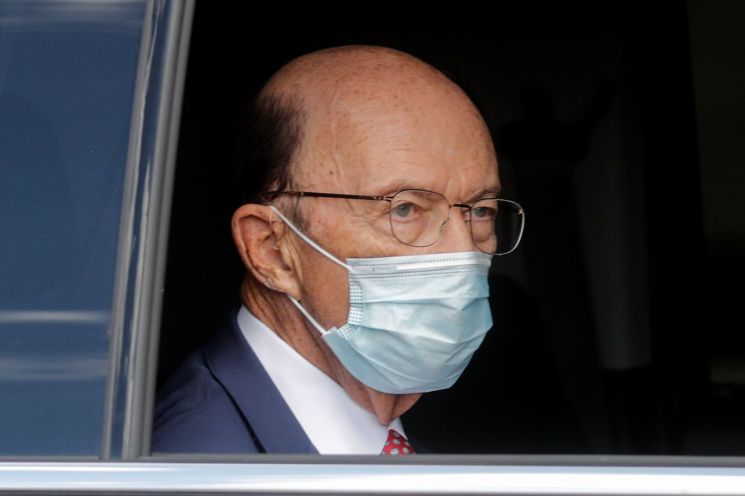
On the 29th (local time), U.S. Secretary of Commerce Wilbur Ross stated in a press release, "Regulations by the U.S. Department of Commerce that grant preferential treatment to Hong Kong, such as export license exceptions, will be suspended." U.S. Secretary of State Mike Pompeo remarked, "With China pushing forward the controversial law (Hong Kong National Security Law), it is no longer possible to distinguish whether exported goods are destined for Hong Kong or China." The U.S. announced that, anticipating China's enforcement of the Hong Kong National Security Law, it will proactively halt exports of U.S. defense equipment to Hong Kong and impose restrictions on defense and dual-use (commercial and military) technologies to Hong Kong.
Foreign media have assessed that this measure will initially remain symbolic. This is because the value of defense-related goods the U.S. exported to Hong Kong last year was only about $1.4 million (1.68 billion KRW). Most of the equipment consists of items used by police or correctional officers. However, some believe that depending on the scope of this measure, Hong Kong may face difficulties securing key components related to manufacturing. Nonetheless, since Hong Kong's economy is more service-oriented than manufacturing-based, the actual economic impact is expected to be limited.
However, the concern lies in how far this measure might be expanded.
The reason the U.S. granted Hong Kong different conditions from China after its return to China was based on the judgment that Hong Kong would be granted a high degree of autonomy by China. When Hong Kong was handed over from the United Kingdom to China in 1997, China agreed to implement the "one country, two systems" policy for Hong Kong until 2047. However, with the introduction of the Hong Kong National Security Law, it is judged that Hong Kong can no longer exercise a high degree of autonomy from China.
As the U.S. government reacts against the Hong Kong National Security Law by deciding to revoke Hong Kong's special status, not only Hong Kong's economy but also China's economy is expected to be affected. The U.S. has treated Hong Kong differently from mainland China in tariffs, investment, trade, and visa issuance through the Hong Kong Policy Act. Hong Kong was recognized as a separate customs territory and granted lower trade tariffs. Similarly, Hong Kong did not impose tariffs on U.S. products.
If Hong Kong's special status is ultimately revoked, Hong Kong could be subject to the same tariffs as China. If Hong Kong's exports are also subject to high tariffs, its role as a trade intermediary hub could be damaged.
The impact on the financial market could also be significant. Hong Kong has served as Asia's financial center, but this status may now be undermined.
© The Asia Business Daily(www.asiae.co.kr). All rights reserved.
![Clutching a Stolen Dior Bag, Saying "I Hate Being Poor but Real"... The Grotesque Con of a "Human Knockoff" [Slate]](https://cwcontent.asiae.co.kr/asiaresize/183/2026021902243444107_1771435474.jpg)















