Ministry of Gender Equality and Family Conducts 'Public Perception Survey on Family Diversity'
48.3% Accept Having Children Without Marriage
73.1% Support System Improvement Allowing Parents to Decide Child's Gender and Surname Through Agreement
[Asia Economy Reporter Lee Hyun-joo] Seven out of ten Koreans responded that even if they are not related by marriage or blood, they can be considered family if they share livelihood and residence.
The Ministry of Gender Equality and Family conducted a "Public Perception Survey on Family Diversity" containing these questions and announced the results on the 30th. The survey targeted general citizens aged 19 to 79 living in 17 cities and provinces nationwide. A total of 1,500 people participated.
The survey results showed that the social and personal acceptance of diverse family types has generally increased beyond the traditional concept of family centered on marriage and blood relations. 69.7% of respondents answered that even if they are not related by marriage or blood, they can be family if they share livelihood and residence. Additionally, 39.9% said that close relationships with emotional bonds can be considered family. The proportion of those who believe that family must be connected by legal marriage or blood relations was 64.3%, a decrease of 3.0 percentage points from last year.
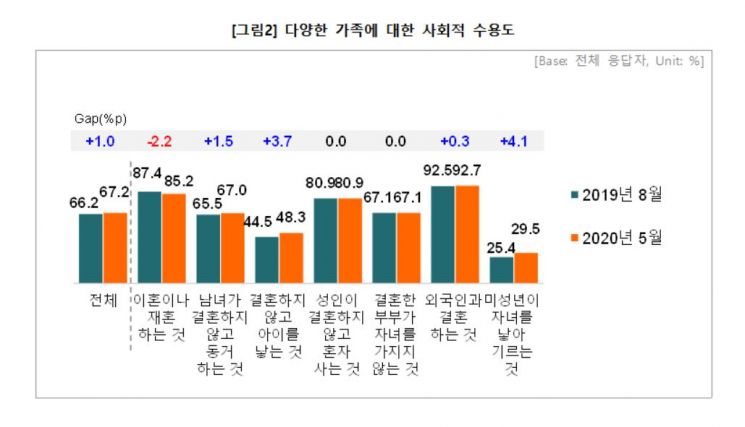
Acceptance of various family forms was high for marrying foreigners (92.7%), divorce or remarriage (85.2%), and adults living alone without marriage (80.9%). The acceptance of having children without marriage was 48.3%, an increase of 3.8 percentage points compared to last year. Only 29.5% of respondents accepted minors having and raising children, but this also increased by 4.1 percentage points from last year.
Acceptance of children from single-parent families (81.2%) and adopted children (80.4%) was also high, and acceptance of children from multicultural families showed a significant increase of 5.0 percentage points compared to the previous year.
The need for support policies for diverse families was particularly recognized for single-parent and unmarried parent families, and the need for support for single-person households increased across all age groups.
Currently, the surname and family registry of a newborn child generally follow the father, but 73.1% of respondents agreed with improving the system to allow parents to decide the surname and family registry through mutual agreement when registering the child's birth. Women (80.6%) showed a higher approval rate than men (65.8%), and younger age groups showed higher approval rates.
Regarding the question of abolishing the terms "children born out of wedlock (honoeja)" and "children born within marriage (honjungja)" that distinguish children based on their parents' marital status, 75.9% of respondents agreed. While 85.2% of people in their 40s agreed, only 57.8% of those in their 60s agreed.
© The Asia Business Daily(www.asiae.co.kr). All rights reserved.

















