Minister Kim Hyun-mi Mentions Differential Application Plan for Property Tax
Increasing Burden on Multi-Homeowners, Reducing Burden on Low-Income Citizens
Designation of Gimpo and Paju as Regulated Areas Confirmed
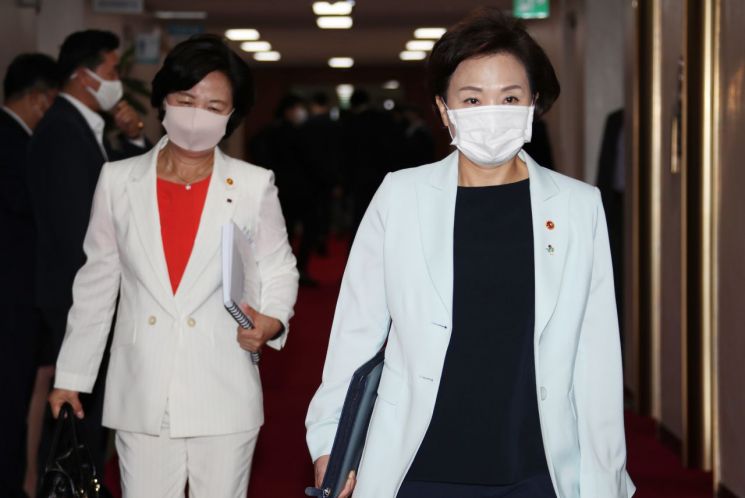 Minister of Land, Infrastructure and Transport Kim Hyun-mi (right) and Minister of Justice Chu Mi-ae are attending the Cabinet meeting held at the Government Seoul Office on the 30th. (Photo by Yonhap News)
[Asia Economy Reporter Moon Jiwon] Kim Hyun-mi, Minister of Land, Infrastructure and Transport, hinted at the possibility of a major tax reform as an additional real estate measure. This signals to the market that the government's next step will be to block the inflow of liquidity into real estate through a strong real estate tax bomb. Minister Kim also mentioned for the first time the possibility of applying differentiated property taxes based on the number of houses owned.
On the afternoon of the 29th, Minister Kim appeared on KBS Newsline to explain the contents of the June 17 real estate measures and the determination to stabilize housing prices, stating, "There is a phenomenon where liquidity is flowing into the real estate market because it cannot find profitable investment destinations," and added, "We need to prevent excessive liquidity from flowing into real estate through (investment profit) recovery mechanisms and tax strengthening."
Minister Kim particularly mentioned property tax, emphasizing, "There are countries that differentiate (property tax) rates depending on whether one is a multi-homeowner or an actual resident." Given recent criticisms that the tax burden has increased not only for multi-homeowners but also for single-home actual residents due to the rise in the realization rate of official property prices, this is interpreted as an intention to actively consider applying different property tax rates to reduce the burden on ordinary citizens.
In fact, the Korea Research Institute for Human Settlements, a government-affiliated research institute, recently released a report analyzing foreign real estate tax policies in countries such as France and Singapore, suggesting the possibility of promoting such policies. According to the report, Singapore applies a lower tax rate to owner-occupied houses and a relatively higher rate to rental houses when imposing property tax.
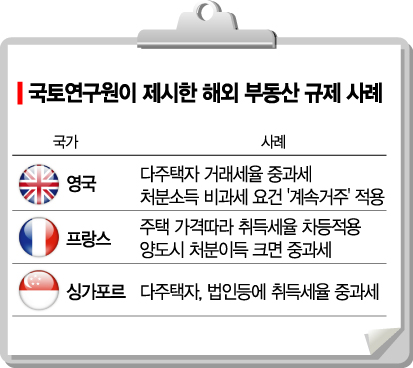
France also applies some differentiation, such as imposing a progressive real estate wealth tax on individuals with net assets exceeding 1.3 million euros. The Korea Research Institute for Human Settlements analyzed, "It is necessary to alleviate the burden on actual demanders while strengthening the tax burden on speculation, loopholes, and illegal transactions." The UK uses its tax system as a policy tool by imposing heavy taxes on high-priced houses and multi-homeowners to prevent rapid housing price increases.
In the industry, following the Korea Research Institute for Human Settlements and Minister Kim's mention of specific tax improvement directions on the same day, there is a prospect that the government may soon announce additional measures containing a comprehensive tax reform plan.
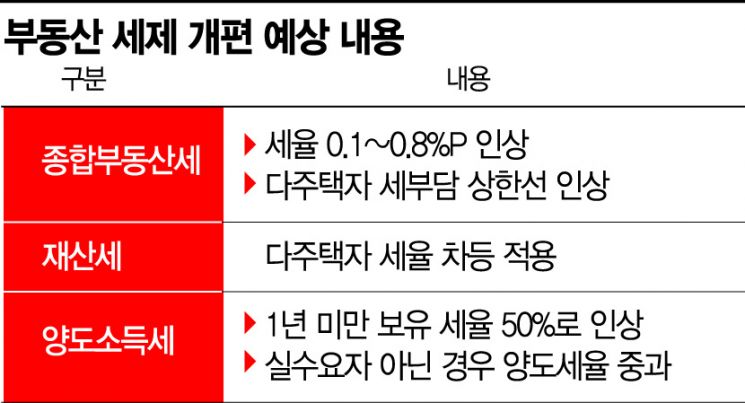
Minister Kim also reiterated her intention to reintroduce the comprehensive real estate tax amendment bill. Previously, the government attempted to push for an amendment to the comprehensive real estate tax law during the 20th National Assembly to raise the tax rate by 0.1 to 0.8 percentage points, but it failed due to opposition from the opposition party. Minister Kim said, "We proposed a tax reform plan to strengthen the tax burden on multi-homeowners in the December 16 measures, but the bill did not pass," adding, "If it passes in the 21st National Assembly, it will be effective."
The plan to designate Gimpo and Paju as regulated areas is virtually becoming a foregone conclusion. She said, "In some areas, balloon effects are appearing, and it is predicted that they will largely meet the conditions for regulated areas." Accordingly, unless there are special changes in the market, these areas are expected to be designated as regulated areas as early as next month.
Experts say it is difficult to predict the effects prematurely since specific reform plans have not yet been announced, but they foresee that the tax system can have some impact on the market. In fact, as the government has continuously raised official apartment prices and holding tax rates over the past few years, there have been disturbances in the real estate market, such as a flood of tax-saving listings before June 1, the property tax imposition date.
Woo Byung-tak, team leader of Shinhan Bank's Real Estate Investment Advisory Center, commented on Minister Kim's remarks the day before, saying, "It is a declarative meaning that the government may consider legislation to differentiate acquisition tax and property tax between multi-homeowners and single-homeowners," adding, "Strengthening the real estate tax system is expected to have effects such as suppressing multi-homeowners' housing holdings and stabilizing housing prices."
© The Asia Business Daily(www.asiae.co.kr). All rights reserved.
![Clutching a Stolen Dior Bag, Saying "I Hate Being Poor but Real"... The Grotesque Con of a "Human Knockoff" [Slate]](https://cwcontent.asiae.co.kr/asiaresize/183/2026021902243444107_1771435474.jpg)

















