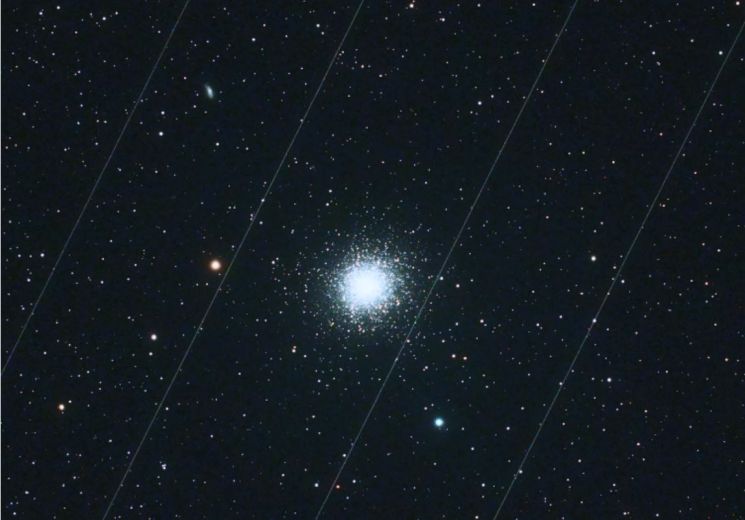
 The Korea Astronomy and Space Science Institute captured the trajectories of eight Starlink satellites while observing the globular cluster M13. The solid lines visible in the photo represent the paths of these satellites.
[Asia Economy Reporter Junho Hwang] The interference of clustered satellites with celestial observations has been detected by domestic researchers. The Korea Astronomy and Space Science Institute announced on the 29th that around 9 p.m. on the 22nd, while observing the globular cluster M13 in Goesan, Chungbuk, the trajectory of Starlink satellites, a cluster satellite from the U.S. company SpaceX, was captured.
The researchers attempted observation for about 5 minutes and detected the trajectories of 8 clustered satellites. In the actual photographed image, thin streaks can be seen around the brightly shining M13. These are traces left by Starlink-1418, 1447, 1351, 1451, 1403, 1457, 1441, and 1433 passing by.
Senior Researcher Youngsik Park of the Korea Astronomy and Space Science Institute said, "While observing the globular cluster M13 in the Hercules constellation on the evening of the 22nd, the Starlink satellites were captured interfering with celestial observations," adding, "In the future, it will be necessary to analyze in advance the times when Starlink satellites pass over the target before shooting."
Notably, this observation was made after 9 p.m., yet Starlink satellites were detected. Researcher Park explained, "Starlink satellites are low Earth orbit clustered satellites that reflect sunlight especially during about two hours before entering Earth's shadow around sunrise and sunset," and added, "The day after the summer solstice, when daylight is longest, Starlink satellites can be brightly observed even in the late evening or early dawn."
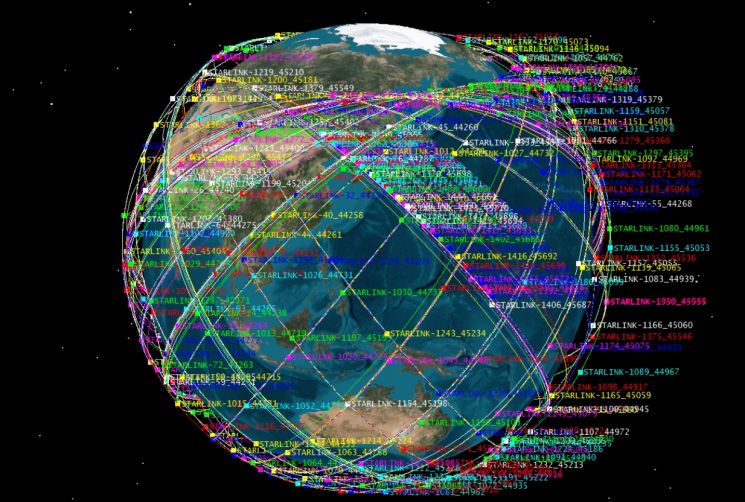 This is a depiction of the orbits of approximately 538 Starlink satellites orbiting the Earth, implemented using the STK (Satellite Tool Kit) program as of the 22nd.
Concerns in the astronomy community have deepened. SpaceX plans to expand Starlink to up to 12,000 satellites. Currently, about 538 Starlink satellites have been deployed. SpaceX, a private space exploration company led by Elon Musk, CEO of the electric car manufacturer Tesla, is launching satellites into low Earth orbit at altitudes between 500 km and 1,200 km to provide global internet service.
Researcher Park emphasized, "In the future, it will be necessary to analyze in advance the times when Starlink satellites pass over the target before deep sky imaging," and added, "Although SpaceX has test-launched DarkSat, coated with black paint to reduce reflectivity, and VisorSat, equipped with anti-reflective panels, already launched satellites will continue to pose difficulties for celestial observations using ground-based telescopes until their end of life."
The International Astronomical Union shares these concerns. The European Southern Observatory (ESO) stated in April in the Journal of Astronomy and Astrophysics that "based on a simple estimate of nighttime observations over one year, it is estimated that about 30% to up to 50% of observation images will be affected."
© The Asia Business Daily(www.asiae.co.kr). All rights reserved.


















