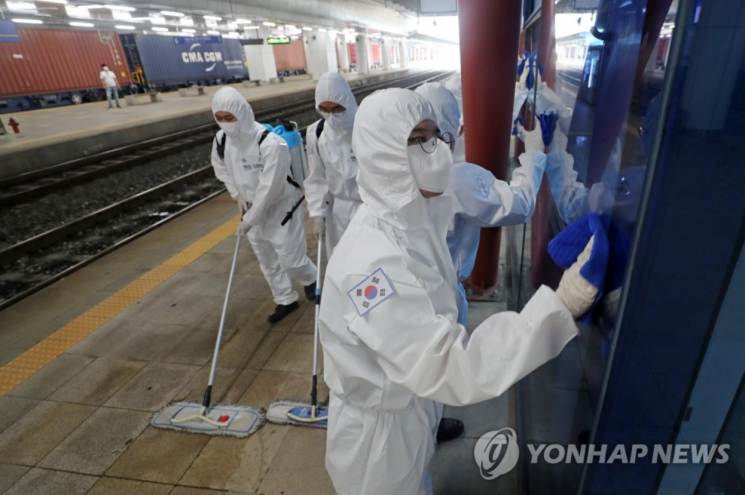
[Asia Economy Intern Reporter Min Jun-young] The government emphasized disinfecting frequently touched surfaces with a cloth soaked in disinfectant to prevent and curb the spread of the novel coronavirus infection (COVID-19), recommending the use of household bleach as the disinfectant.
When using disinfectants, it is recommended to wipe surfaces with a cloth soaked in the disinfectant. Spraying disinfectant may reduce its effectiveness and poses a risk of inhalation.
On the 26th, Jeong Eun-kyung, head of the Central Disease Control Headquarters (CDCH) at the Korea Disease Control and Prevention Agency, introduced disinfection methods during a regular COVID-19 briefing held at the Government Complex Sejong, stating, "Disinfecting surfaces of objects that may be contaminated with droplets is important to block the transmission of the COVID-19 virus."
The COVID-19 virus is mainly transmitted through respiratory droplets, but if a person touches an object contaminated with droplets from an infected person and then touches their eyes, nose, or mouth, infection can occur.
According to the CDCH, the COVID-19 virus can survive up to 4 hours on copper, up to 24 hours on cardboard, 1 day on cloth or wood, 2 days on glass, and 4 days on stainless steel and plastic via droplets.
Therefore, disinfecting surfaces of objects frequently touched by people is effective in preventing infectious diseases.
The CDCH explained that surfaces of objects frequently touched by people, such as door handles, railings, doorknobs, armrests of dining tables, and light switches within facilities, should be repeatedly wiped with a cloth (such as fabric or paper towels) soaked in disinfectant.
In bathrooms, faucets, doorknobs, toilet lids, and bathtubs should also be wiped. Especially after disinfection, the disinfected area must be ventilated.
While it is standard to use COVID-19 sterilizing disinfectants disclosed on the Ministry of Environment’s website, diluted sodium hypochlorite (household bleach) can also be used.
For household bleach, mix 20 ml of 5% sodium hypochlorite with 1 liter of water.
The health authorities do not recommend spraying or misting disinfectants. Using spraying or misting methods results in unclear coverage on surfaces, reducing disinfection effectiveness and posing a risk of inhaling disinfectants.
Spraying disinfectants in the air on roads or streets is also not proven effective and should be avoided as it may cause health and environmental problems.
Head Jeong Eun-kyung urged, "Spraying disinfectants in the air on roads or streets is not proven effective and may cause health and environmental issues, so it should be avoided."
She added, "Especially the elderly are vulnerable to harmful substances, so in daycare centers, schools, and senior centers, surfaces and floors that are frequently touched should be wiped and disinfected to prevent inhalation or contact with disinfectant components. After disinfection, residual substances should be wiped off and ventilation should be sufficient. We will continuously guide local governments and disinfection companies to use disinfectants safely," she emphasized again.
The CDCH added, "When disinfecting, disposable latex gloves or waterproof gloves such as rubber gloves and protective masks should be worn, and care should be taken not to touch the eyes, nose, or mouth during disinfection."
Also, after finishing disinfection, remove personal protective equipment, wash hands with soap and water, take a shower, and change clothes.
© The Asia Business Daily(www.asiae.co.kr). All rights reserved.
![Clutching a Stolen Dior Bag, Saying "I Hate Being Poor but Real"... The Grotesque Con of a "Human Knockoff" [Slate]](https://cwcontent.asiae.co.kr/asiaresize/183/2026021902243444107_1771435474.jpg)















