3-Day Isolation Facility, 10-Day Self-Quarantine
"Legal Sanctions for Self-Quarantine Violations
Short Isolation Life Feels Suffocating"
'Post-Isolation Syndrome' Leads to Extreme Choice by Woman in Her 20s
47.5% of Citizens Report "Anxiety and Depression"
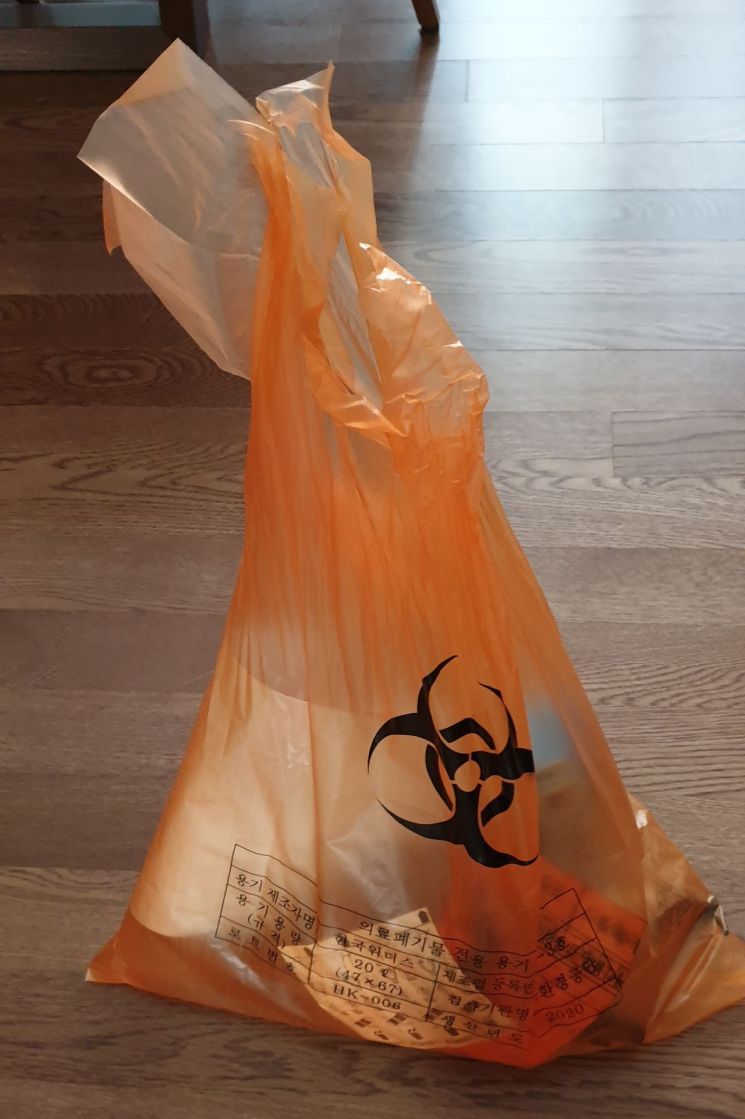 Song Mo (24), who returned from Switzerland last April and experienced quarantine life, said that he even felt fear from the infectious disease warning mark printed on the plastic bag.
[Asia Economy Reporter Donghoon Jeong] As the COVID-19 pandemic prolongs, the resulting 'social isolation' is also threatening citizens. Those who have experienced quarantine report mental distress caused by isolation and pressure.
Song Mo (24), who returned from Switzerland last April and experienced quarantine, said in a phone interview with the reporter on the 26th, "Even a short three-day stay in a quarantine facility caused significant mental stress," adding, "Hearing that violating self-quarantine rules would lead to legal penalties made life feel suffocating." Song had a fever during the entry process and stayed for three days at a quarantine facility in Gyeonggi Province for a COVID-19 test, then continued self-quarantine at home for about ten days. Although Song ultimately tested negative for COVID-19, he received psychological counseling due to stress.
Those who have experienced quarantine unanimously agree that 'COVID isolation' is as dangerous as the infectious disease itself. On the 22nd, a woman in her 20s, identified as A, took an extreme measure at the Jeju Human Resources Development Institute, which was used as a COVID-19 quarantine facility. A had been taking medication for mental health conditions such as depression. She came to Jeju for tourism and was quarantined after it was confirmed that a confirmed case had been on the same flight.
From January to June this year, the National Trauma Center and the Korean Psychological Association conducted a total of 374,310 telephone psychological counseling sessions nationwide. According to a survey conducted by the Gyeonggi Research Institute targeting 1,500 people aged 15 and older nationwide, 47.5% of South Koreans have experienced anxiety and depression due to the prolonged COVID-19 pandemic. Professor Kwak Geumju of Seoul National University’s Department of Psychology diagnosed, "The current reality of our society is that there is no appropriate space to resolve the simultaneous experience of all kinds of negative emotions such as depression and isolation."
There is also an analysis that maintaining an 'altruistic emotional' state during COVID-19 quarantine can reduce one’s own mental distress. Professor Baek Jongwoo of Kyung Hee University Hospital’s Department of Psychiatry said, "Research shows that those who overcame quarantine aftereffects best were people who thought during quarantine, 'I am helping with disease prevention and ways to overcome COVID-19,'" adding, "Government and local authorities responsible for quarantine measures need to pay attention to establishing mental health support plans for those in quarantine."
© The Asia Business Daily(www.asiae.co.kr). All rights reserved.
![Clutching a Stolen Dior Bag, Saying "I Hate Being Poor but Real"... The Grotesque Con of a "Human Knockoff" [Slate]](https://cwcontent.asiae.co.kr/asiaresize/183/2026021902243444107_1771435474.jpg)















