[Asia Economy Reporter Naju-seok] Natural gas futures prices have fallen to their lowest level in 25 years. The surge in inventory caused by deteriorating supply and demand conditions due to the novel coronavirus disease (COVID-19) acted as a negative factor.
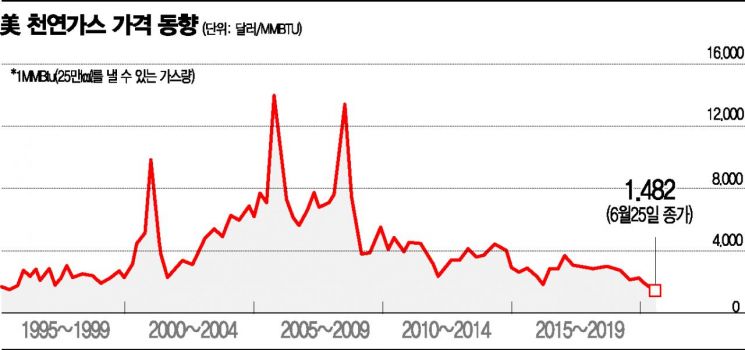
On the 25th (local time), the price of July delivery natural gas traded on the New York Mercantile Exchange was $1.482 per 1 MMBtu (the amount of gas that can produce 250,000 kcal). This is a 7.2% drop from the previous day and the lowest level since August 8, 1995.
The biggest reason for the sharp drop in natural gas prices is the surge in inventory in the United States. The U.S. Energy Information Administration (EIA) announced that U.S. natural gas inventory increased by 12 billion cubic feet (bcf) last week. Previously, Bloomberg News had forecasted 10.9 bcf, but the actual inventory was 1.1 bcf higher. As a result, U.S. natural gas inventory reached 3.012 trillion cubic feet (tcf). This is the largest scale since 2003 and an increase of 739 bcf compared to a year ago.
Bloomberg News explained that the accumulation of natural gas inventory in the U.S. indicates that supply and demand conditions for natural gas are deteriorating due to COVID-19.
Due to the 'shale boom,' the U.S. has seen a significant increase not only in crude oil production but also in natural gas production. Despite the decrease in demand, shale companies continued producing crude oil and natural gas, raising concerns about overproduction of natural gas. For this reason, natural gas prices have been on a downward trend recently.
The surge in natural gas inventory is due to multiple factors. Bloomberg News introduced that under concerns of oversupply, importers of U.S. natural gas canceled import volumes, which had a significant impact. Natural gas importers are reluctant to increase their inventories.
There is also an analysis that climate factors played a role. According to OilPrice.com, although the temperature in 48 U.S. states excluding Alaska was expected to rise to heatwave levels this summer, the actual temperature remained lower. Consequently, demand for natural gas used as fuel for power generation for cooling also decreased.
There is also a perspective pointing to supply factors. Since March, West Texas Intermediate (WTI) crude oil prices had been on a downward trend but recovered to around $40 per barrel due to large-scale production cuts agreed upon by oil-producing countries. As a result, shale companies began to increase production, and natural gas supply also increased accordingly. According to Bloomberg News' analysis, as of the 12th of this month, the average daily crude oil production in the U.S. for the previous week was 10.5 million barrels, but by the 19th, the average daily production for the previous week increased to 11 million barrels. Since reaching 13.1 million barrels in March this year, daily crude oil production in the U.S. had been declining due to falling oil prices and decreased demand. With the recent recovery in oil prices, production in the U.S. has started to increase again.
Nina Pahi, Head of North American Natural Gas at consulting firm Energy Aspect, explained, "(The EIA's announcement) significantly missed market expectations because it underestimated the possibility of production recovery and overestimated expectations that core industrial demand would improve."
© The Asia Business Daily(www.asiae.co.kr). All rights reserved.

















