National Assembly Budget Office Publishes 'Public Institution Fiscal Soundness Analysis' Report
"Debt Decrease Since 2013 Normalization Measures... Recent Increase"
Total Debt Increased by 21.4 Trillion Last Year... Net Income 600 Billion
"Financial Soundness Management Needed to Prevent Fiscal Burden in Public Institutions"
[Asia Economy Reporter Kim Bo-kyung] A 'warning sound' has been raised over the increasing debt of public institutions. In particular, it was found that the ratio of public enterprise debt to GDP in South Korea is the highest among the Organization for Economic Cooperation and Development (OECD) countries, prompting calls for "the need to manage financial soundness."
On the 26th, the National Assembly Budget Office published a report titled "2019 Fiscal Year Public Institution Financial Settlement Status and Fiscal Soundness Analysis."
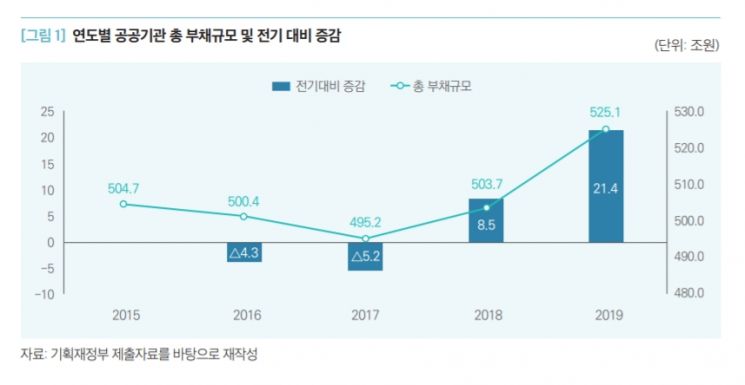
According to the report, as of last year, the total debt of public institutions was 525.1 trillion won, an increase of 21.4 trillion won (4.2%) compared to 2018. The total net income has continuously decreased since 2016, recording 600 billion won last year.
In the case of Korea Electric Power Corporation (KEPCO), it recorded a net loss of 1.2 trillion won in 2018 and 2.3 trillion won last year, while the National Health Insurance Service (NHIS) experienced net losses of 3.9 trillion won and 3.6 trillion won in 2018 and 2019, respectively.
Last year, the total debt ratio of public institutions was 156.3%, up 1.1 percentage points from the previous year, and the ratio of total public institution debt to GDP also rose by 0.9 percentage points to 27.4% compared to 2018.
The Budget Office explained, "Since the implementation of the Ministry of Strategy and Finance's 'Public Institution Normalization Measures' at the end of 2013, the total debt scale, debt ratio, and the ratio of total public institution debt to GDP, which had been continuously decreasing, have recently turned to an increasing trend."
Furthermore, the Budget Office stated that the government needs to manage the financial soundness of bank-type public institutions.
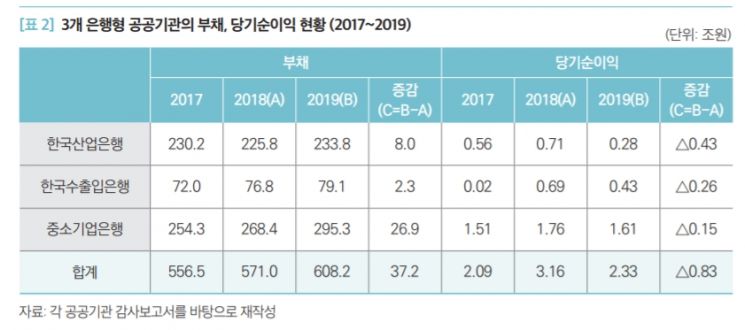
The total debt of three bank-type public institutions?Korea Development Bank, Export-Import Bank of Korea, and Industrial Bank of Korea?last year was 608.2 trillion won, an increase of 37.2 trillion won compared to the previous year. Net income decreased for all three institutions compared to the previous period. The total net income sum was 2.33 trillion won, down 830 billion won from the previous period.
The average BIS ratio (capital adequacy ratio) of the three bank-type public institutions last year was 14.31%, which had increased from 2015 to 2018 but began to decline last year.
The Budget Office advised, "Bank-type public institutions have a 'loss compensation clause' under their establishing laws, whereby if losses cannot be covered by retained earnings, the government compensates for the shortfall. To prevent potential fiscal burdens in the future, it is necessary to manage the financial soundness of bank-type public institutions."
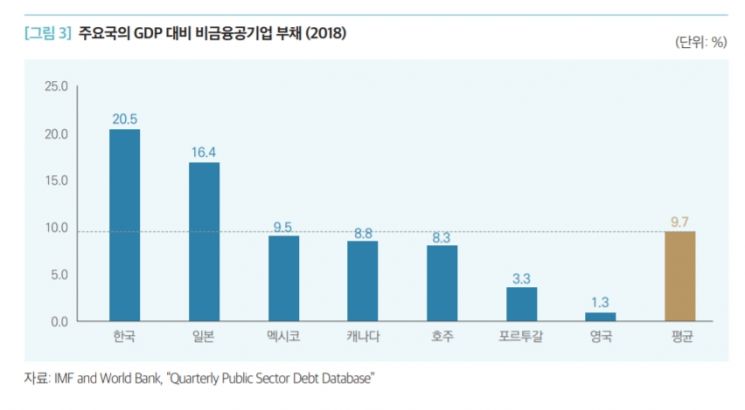
The debt ratio to GDP of non-financial public enterprises such as Korea Electric Power Corporation (KEPCO) and Korea Land and Housing Corporation (LH) was also found to be more than twice the OECD average.
As of 2018, the ratio of non-financial public enterprise debt to GDP in South Korea was 20.5%, the highest among the seven OECD countries reporting statistics. Compared to the average of the seven countries (9.7%), it was 10.8 percentage points higher.
The Budget Office stated, "The debt ratio of non-financial public enterprises is at a high level compared to major countries," and added, "When analyzing national fiscal soundness, attention should be paid to the increasing trend of public institution debt, which is not included in national debt (D1)."
© The Asia Business Daily(www.asiae.co.kr). All rights reserved.
![Clutching a Stolen Dior Bag, Saying "I Hate Being Poor but Real"... The Grotesque Con of a "Human Knockoff" [Slate]](https://cwcontent.asiae.co.kr/asiaresize/183/2026021902243444107_1771435474.jpg)

















