Bank of Korea 'June 2020 Consumer Sentiment Survey'
[Asia Economy Reporter Kim Eun-byeol] Housing price sentiment in June surged by the largest margin in 21 months. As Seoul apartment prices turned upward ahead of the June 17 real estate measures, consumers who had expected housing prices to decline over the past two months also changed their outlook.
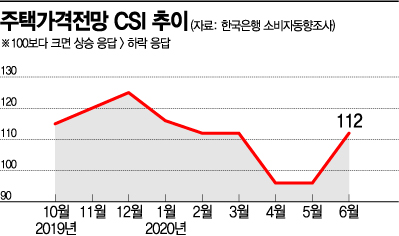
According to the 'June 2020 Consumer Sentiment Survey' released by the Bank of Korea on the 26th, the Housing Price Outlook Consumer Sentiment Index (CSI) for this month rose 16 points from the previous month to 112. This is the largest increase in 21 months since September 2018 (+19 points). The housing price outlook CSI also rose 5 points in December last year ahead of the December 16 measures. However, the absolute figure remains lower compared to the past peak (128 in September 2018).
The CSI is a statistic that quantifies consumer perceptions and expectations about the economic situation through surveys. A value above 100 means that the number of households expecting housing prices to rise in one year exceeds those expecting a decline.
Many young office workers anticipated a rise in housing prices. Women (113) showed a slightly higher expectation than men (112), and by age group, those under 40 predicted housing price increases. The housing price outlook CSI for those under 40 was 117, higher than the 110-111 range for those aged 40 to 70.
By occupation, self-employed individuals recorded a CSI of 111, while salaried workers scored 113. People earning between 3 million to 4 million KRW or 4 million to 5 million KRW per month had a CSI of 114, indicating a higher expectation of price increases compared to other groups. Regionally, the housing price outlook CSI for the six major metropolitan cities was 116, 5 points higher than Seoul and other cities (111).
Kwon Cheo-yoon, head of the Statistical Survey Team at the Bank of Korea’s Economic Statistics Bureau, stated, "According to the Korea Real Estate Agency’s apartment sales price index, while Seoul prices declined after the COVID-19 outbreak intensified, prices nationwide maintained an upward trend. The overall price increase trend and the turnaround in Seoul influenced this result." Regarding detailed classifications, he added, "Since the COVID-19 outbreak, salaried workers have been less negatively affected in their consumption sentiment compared to the self-employed."
Meanwhile, as the spread of COVID-19 slowed, overall consumer sentiment rose for the second consecutive month. The Consumer Confidence Index (CCSI) for this month was 81.8, up 4.2 points from May. The CCSI is calculated using six of the 15 indices that make up the Consumer Sentiment Index (CSI): current living conditions, outlook on living conditions, household income outlook, consumption expenditure outlook, current business conditions, and future business conditions. A value below 100 indicates pessimism compared to the long-term average (2003?2019). Although the absolute CCSI remains below 100 and thus pessimistic, consumer sentiment has improved for two consecutive months.
This survey was conducted from the 10th to the 17th of this month, targeting 2,500 households in urban areas nationwide. A total of 2,368 households responded.
© The Asia Business Daily(www.asiae.co.kr). All rights reserved.
![Clutching a Stolen Dior Bag, Saying "I Hate Being Poor but Real"... The Grotesque Con of a "Human Knockoff" [Slate]](https://cwcontent.asiae.co.kr/asiaresize/183/2026021902243444107_1771435474.jpg)















