Financial Services Commission Finalizes Original Plan for 2 Billion Won Fine
NongHyup Bank "Regretful Due to Many Legal Controversies"
Other Banks on Alert for Possible Impact
[Asia Economy Reporter Jo Gang-wook] NH Nonghyup Bank has been fined 2 billion KRW by financial authorities for selling funds through an Original Equipment Manufacturer (OEM) method. This is the first time a bank, as a seller, has been sanctioned for failing to submit a securities registration statement related to OEM and series funds. The financial sector is unsettled as other banks, which serve as fund sales channels, are expected to be widely affected.
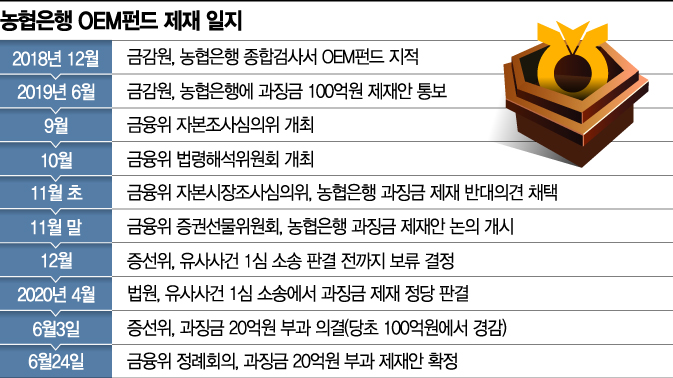
According to financial authorities and the financial sector on the 25th, the Financial Services Commission held a regular meeting the day before and finalized the 2 billion KRW fine imposed on Nonghyup Bank by the Securities and Futures Commission on the 3rd as originally proposed. The initial penalty proposed by the Financial Supervisory Service was 10 billion KRW, but the Securities and Futures Commission lowered it to 2 billion KRW, judging the original fine to be excessive.
Nonghyup Bank is accused of ordering funds from Fine Asia Asset Management and Aram Asset Management via the OEM method from 2016 to 2018, splitting them into private funds with fewer than 49 investors to evade public fund regulations. OEM funds are those created by asset management companies under orders, instructions, or requests from fund sellers such as banks or securities firms, which is prohibited under the Capital Markets Act. Nonghyup Bank has argued that it sold financial products from March 2016 to March 2018, and the obligation to submit securities registration statements to sellers was imposed only after the law was enacted in May 2018, making retroactive application unreasonable. They also emphasized that there were no losses to the investors of the disputed funds.
The bank stated, "We respect the Financial Services Commission's decision and accept it with a heavy heart." However, they also expressed regret, saying, "This is the first time a fund seller has been sanctioned for not submitting a securities registration statement while selling collective investment securities, and there were many legal controversies regarding the application of the law."
Within the financial sector, the prevailing opinion is that this decision is excessive. Although the financial authorities confirmed the penalty by viewing the bank as an 'arranger' in fund sales, the Bioinfra case referenced by the authorities is fundamentally different from this case. It is pointed out that sellers who only handle the sales of collective investment securities (such as funds) without conducting due diligence on the securities issuer cannot be considered arrangers under the Capital Markets Act.
Earlier in April, the Seoul Administrative Court ruled against the plaintiff in a lawsuit filed by the arranger of Bioinfra Life Sciences' paid-in capital increase, who challenged the Securities and Futures Commission's fine imposition. This lawsuit was filed by arranger A, who contested the fine imposed by the Securities and Futures Commission in November last year for failing to submit securities registration statements during four paid-in capital increases from 2014 to 2015. A claimed that the 151 million KRW fine was unjust.
Academia and the legal community still see many legal issues. They point out that although there are similarities, the parties involved differ as individuals and corporations, and the forms differ as equity securities and beneficiary certificates.
Kwon Jae-yeol, Dean of Kyung Hee University Law School, said, "The Nonghyup Bank case differs from similar lawsuit precedents and factual circumstances, and there are many legal issues. Also, since related lawsuits are pending in the appellate court due to legal interpretation controversies, it is unreasonable to simply apply this to the financial market."
A financial sector official lamented, "Typically, when creating and selling a product, business consultations between the manufacturer and distributor are basic. However, this sanction will block communication between fund sellers and asset managers."
Some speculate that Nonghyup Bank is likely to proceed with administrative litigation due to the burden of being the first case. However, amid recent signs of banks opposing financial authorities, concerns are growing about Nonghyup Bank joining this trend.
Another financial sector official said, "In cases of legal controversy, it is common practice to use all available means, including administrative litigation, even if litigation costs exceed fines, to prevent potential breach of fiduciary duty by top executives in the future." However, they added, "Due to concerns about possible retaliatory inspections, they will ultimately have to watch the authorities closely."
© The Asia Business Daily(www.asiae.co.kr). All rights reserved.
![Clutching a Stolen Dior Bag, Saying "I Hate Being Poor but Real"... The Grotesque Con of a "Human Knockoff" [Slate]](https://cwcontent.asiae.co.kr/asiaresize/183/2026021902243444107_1771435474.jpg)
















