Bank of Korea '2019 Public Sector Accounts (Provisional)'
[Asia Economy Reporter Eunbyeol Kim] Last year, the surplus in the public sector decreased by nearly 40 trillion won compared to 2018. Although revenues slightly increased, expenditures rose at a much higher rate. Due to the impact of the spread of the novel coronavirus disease (COVID-19), which has inevitably led to reduced tax revenues and expanded fiscal spending, it is highly likely that the surplus will shrink this year.
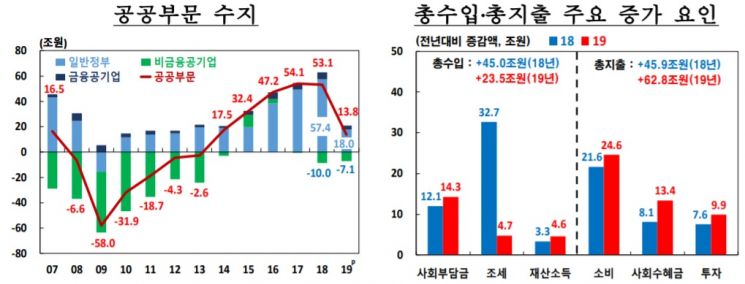
According to the "2019 Public Sector Accounts (Provisional)" data released by the Bank of Korea on the 25th, the public sector balance (total revenue - total expenditure) recorded a surplus of 13.8 trillion won last year, a decrease of 39.3 trillion won from the previous year (53.1 trillion won). This is the largest decline since 2009, right after the global financial crisis. At that time, the deficit expanded by 51.5 trillion won compared to 2008.
Total public sector revenue increased by 23.5 trillion won (2.8%) to 876.3 trillion won, but total expenditure rose by 62.8 trillion won (7.9%) to 862.4 trillion won. Final consumption expenditures such as personnel expenses, operating costs, and health insurance benefit payments increased, and social benefit payments like basic pensions and national pension receipts also rose sharply.
Breaking it down by sector, the central government saw a decrease in national tax revenue due to tax rate cuts, and with a significant increase in investment and transfer expenditures, it shifted to a deficit. Local governments experienced an increase in local tax revenue, but the surplus size shrank. The social security fund recorded a surplus as revenues exceeded expenditures, slightly increasing the surplus compared to the previous year.
The social security fund's surplus (38.6 trillion won) slightly increased compared to the previous year (37.7 trillion won) as social contribution revenues exceeded social security expenditures.
Non-financial public enterprises such as Korea Electric Power Corporation and Korea Land and Housing Corporation reduced their deficit (7.1 trillion won). This was due to a 1.1% increase in total revenue (175.2 trillion won) and a 0.6% decrease in total expenditure (182.3 trillion won) for non-financial public enterprises last year.
Financial public enterprises such as Korea Development Bank and Korea Housing Finance Corporation recorded a surplus of 2.9 trillion won, about half of the previous year's 5.7 trillion won, as total expenditures (37.1 trillion won) increased significantly.
Last year, the Korean public sector balance was 0.7% of nominal Gross Domestic Product (GDP). This was higher than the UK (-2.1%) and Australia (-1.3%), but lower than Switzerland (1.5%). Excluding the social security fund, the public sector balance was -1.3% of nominal GDP.
The growth rate of employee compensation, which refers to wages received as remuneration for labor such as salaries, expanded from 6% in 2018 to 6.6% in 2019. Although the growth rate of employee compensation in the general government sector slowed from 6.7% to 6.2%, the rate in public enterprises rose sharply from 2.6% to 9.3%, influenced by government policies such as converting non-regular workers to regular positions.
© The Asia Business Daily(www.asiae.co.kr). All rights reserved.
![Clutching a Stolen Dior Bag, Saying "I Hate Being Poor but Real"... The Grotesque Con of a "Human Knockoff" [Slate]](https://cwcontent.asiae.co.kr/asiaresize/183/2026021902243444107_1771435474.jpg)















