KCCI and Ministry of Industry to Hold Sandbox Review Committee on 25th... Approve 8 Cases Including Non-Face-to-Face Medical Services for Overseas Koreans
Plan to Provide Medical Services for Over 5,000 Overseas Korean Workers
Approval of Innovative New Industry Products from AI Vending Machines, Drones, OTA to Sharing Economy and Pet Tech
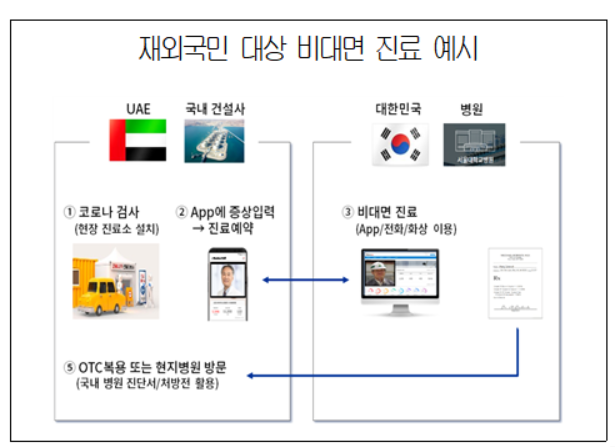
A new path has opened for overseas workers caught in the panic of the novel coronavirus infection (COVID-19) to easily receive medical treatment remotely.
The Korea Chamber of Commerce and Industry (KCCI) Sandbox Support Center and the Ministry of Trade, Industry and Energy announced on the 25th that they held a sandbox review committee meeting and approved eight private sandbox cases, including the first remote medical treatment for overseas Koreans.
As COVID-19 cases in the Middle East, including the United Arab Emirates (UAE) and Qatar, are reaching record highs, concerns have been raised questioning whether the approximately 5,000 Korean workers there will be left unattended.
KCCI applied for the first private sandbox project for ‘remote medical treatment for overseas Koreans.’ KCCI stated, “Many nationals face difficulties accessing medical services due to local policies prioritizing citizens of the host country, as well as language and medical accessibility issues,” adding, “Especially, SOS calls have been pouring in from overseas workers in the Middle East, where COVID-19 cases are surging.”
When Koreans living abroad enter their symptoms into an application, doctors from major hospitals in Korea provide remote consultations via phone, video call, or the application over a LAN connection. Korean doctors issue prescriptions or guide the use of over-the-counter medicines, allowing patients to receive necessary treatment at local hospitals. Although medical acts such as diagnosis and prescription between doctors and patients are generally prohibited under current medical law, a two-year temporary permit has been granted to provide remote medical services for overseas Koreans. The Ministry of Health and Welfare plans to institutionalize remote medical services for overseas Koreans in the future.
Song Seung-jae, CEO of digital health platform company Life Semantics, which received the temporary permit, said, “When I first presented the business plan to Seoul National University Hospital and others, they agreed 120%,” adding, “It was heartbreaking that domestic medical staff had to do something for overseas Koreans struggling due to COVID-19.” Accordingly, the Ministry of Trade, Industry and Energy and the Ministry of Health and Welfare granted the temporary permit through the sandbox with the principle of ‘protecting Korean nationals to the end.’
Park Yong-man, chairman of KCCI, reportedly instructed, “Time is urgent. Proceed with the project as soon as possible.” Woo Tae-hee, executive vice president of KCCI, said, “Koreans living abroad have had difficulty using local hospitals due to local citizen-first policies and unreliable local medical services and language barriers,” and expressed hope that “this will provide practical help to overseas Koreans trembling from COVID-19.”
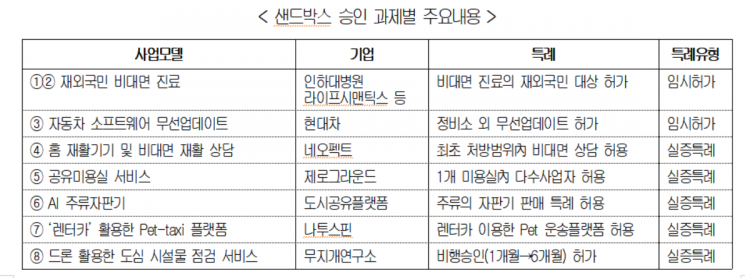
In addition to the two cases related to remote medical treatment for overseas Koreans, the approved private sandbox projects include ▲wireless software updates for automobiles ▲home rehabilitation device ‘Smart Glove’ ▲shared beauty salons ▲artificial intelligence (AI) liquor vending machines ▲pet taxi service using rental cars ▲urban facility inspection service using drones, totaling eight cases.
Automobile software will also be able to receive automatic wireless updates (OTA, Over The Air Update) like smartphones. While global car companies such as BMW already offer OTA services, in Korea, this is currently limited to repair shops as it falls under automobile maintenance. The review committee granted a temporary permit to allow OTA updates on vehicles with the owner’s consent.
Also, a home rehabilitation device and service called ‘Smart Glove’ for patients with polio and stroke who have difficulty moving will be launched in the domestic market. Although exported to over 40 countries including the United States, it could not be introduced domestically due to the ban on remote medical treatment. The review committee granted a special exemption for demonstration and allowed remote consultation and advice within the initial prescription scope for about 2,000 polio and stroke patients.
The AI liquor vending machine will also undergo market testing. When consumers complete pre-adult verification on the AI liquor vending machine, the refrigerator door opens, and when items are taken from the vending machine, AI recognizes the items and automatically processes payment. This can prevent minors from purchasing alcohol and protect small business owners from damages caused by intentional alcohol purchases using stolen IDs. The review committee granted a special exemption for demonstration to test the machine in small business establishments in the first year and expand to manned and unmanned convenience stores in the second year based on the results.
The shared beauty salon, which was blocked due to the Public Health Control Act established in the 1990s, will also open. A shared beauty salon is a platform where multiple hairdressers operate within one salon business location, sharing facilities such as shampoo rooms and perm machines. Hairdressers can start a business by paying only a fixed membership fee without additional costs such as key money or interior expenses.
Patrol drones that inspect urban facilities through autonomous flight will also be permitted. These drones are equipped with thermal cameras to check for heat pipe damage and high-resolution cameras to detect road surface damage. Under current law, drone flights in military-controlled airspace require monthly approval, and camera use via drones is restricted under the Personal Information Protection Act. The review committee granted a special exemption for demonstration, allowing six-month flight approvals on the condition that performance and safety standards are met and that footage recorded during drone takeoff and landing is deleted.
A pet taxi service without ride refusals has also started operations. When passengers traveling with pets reserve pet transportation through an application, a pet taxi using rental cars transports them. Current law prohibits paid transportation using rental cars. Considering the practical difficulty of using public transportation due to ride refusals, the review committee allowed paid transportation using 120 rental cars exclusively for pet transportation in the Seoul area.
Woo Tae-hee, executive vice president of KCCI, said, “With active support from the Office for Government Policy Coordination and the Ministry of Trade, Industry and Energy, the private sandbox support center has taken its first step, introducing projects with significant industrial ripple effects such as remote medical treatment, sharing economy, pet tech, AI vending machines, drones, and OTA,” adding, “We will continue to support the launch of innovative products and technologies that will become pioneers of new businesses.”
© The Asia Business Daily(www.asiae.co.kr). All rights reserved.
![Clutching a Stolen Dior Bag, Saying "I Hate Being Poor but Real"... The Grotesque Con of a "Human Knockoff" [Slate]](https://cwcontent.asiae.co.kr/asiaresize/183/2026021902243444107_1771435474.jpg)

















