[Asia Economy Reporter Junho Hwang] A new organic semiconductor material resembling graphene has been developed. An international joint research team led by Kim Gi-moon, head of the Complex Systems Self-Assembly Research Group at the Institute for Basic Science (IBS), synthesized a two-dimensional conductive polymer with electrical properties superior to silicon by utilizing the self-assembly characteristics of molecules, and the research results were introduced in the international academic journal Chem on the 23rd.
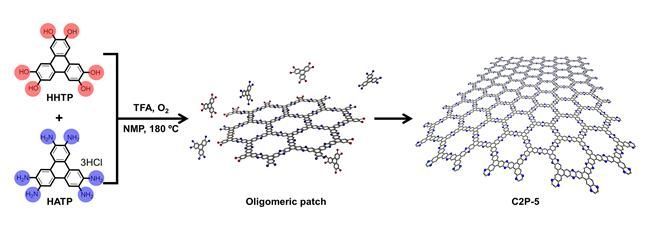
The research team drew inspiration from the hexagonal honeycomb shape of graphene and developed a new material using triphenylene, a polymer favorable for forming a honeycomb structure. Six hydroxyl groups (-OH) were introduced into some triphenylene molecules, and amine groups (-NH2) were introduced into others. After dissolving these molecules in a solvent and heating them, they synthesized a two-dimensional conductive polymer with a honeycomb structure similar to graphene.
They also elucidated the synthesis mechanism. Due to the acidic catalyst used in the synthesis process, the triphenylene polymer partially carries a positive charge (+). Because of the electrostatic repulsion between these positive charges, the polymers do not stack on top of each other but are evenly dispersed in the solution. This overcame previous limitations and enabled the synthesis of conductive polymer thin films with sizes of several hundred micrometers (㎛).
Co-corresponding author Research Fellow Baek Kang-kyun explained, "Even dispersion, meaning high solubility, is advantageous for fabricating devices in the desired form," adding, "Using the synthesized polymer, organic devices can be easily fabricated through solution processes such as drop casting, significantly reducing the processing costs required for semiconductor device development."
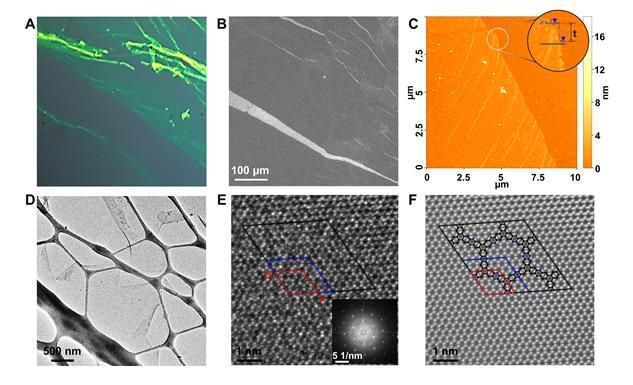
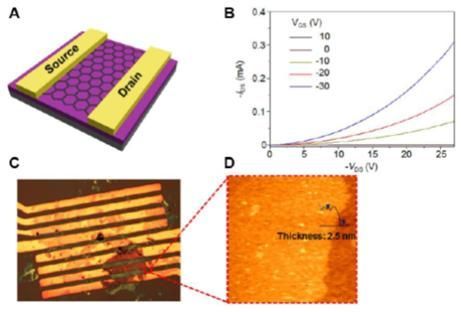
Subsequently, the research team fabricated organic thin-film transistors to evaluate the electrical properties of the 'pseudo-graphene.' The carrier mobility of the material reached up to 4 cm²/Vs, about four times higher than silicon. This is the best performance among two-dimensional conductive polymers developed so far. Furthermore, by stacking graphene on top of the pseudo-graphene, they implemented a photodetector device and demonstrated that the fabricated device can detect a wide range of light from ultraviolet to infrared.
Conductive polymers can chemically adjust electrical properties including the band gap. This means they can exhibit characteristics of conductors, semiconductors, and insulators.
It is possible to realize organic electronic devices made solely of conductive polymers or to develop 'customized devices' by tuning their properties according to the intended use. The research team expects applications in various fields requiring lightweight, flexible, and high-performance materials such as ultrafast semiconductors, high-efficiency solar cells, and rollable displays.
Organic semiconductors are next-generation technologies that can replace conventional inorganic semiconductors such as silicon semiconductors. This is because they can overcome all the limitations of inorganic semiconductors, including high cost, complex processes, thickness, and flexibility. In particular, conductive polymers are attracting attention as materials that can further advance the field of organic semiconductors.
Kim Gi-moon, head of the IBS research group, said, "Thanks to the cooperation and collective research among IBS research groups, we were able to achieve the fruits of long-term research," adding, "If high-level collective research continues in the future, it will become a driving force to solve humanity's challenges."
© The Asia Business Daily(www.asiae.co.kr). All rights reserved.
![Clutching a Stolen Dior Bag, Saying "I Hate Being Poor but Real"... The Grotesque Con of a "Human Knockoff" [Slate]](https://cwcontent.asiae.co.kr/asiaresize/183/2026021902243444107_1771435474.jpg)

















