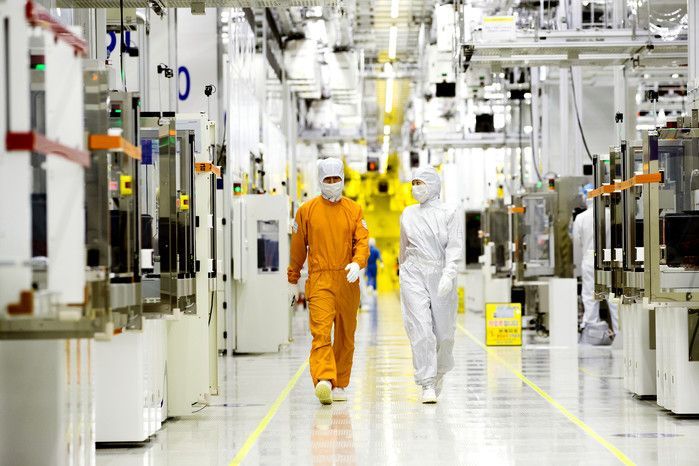
[Asia Economy Reporter Junho Hwang] Domestic researchers have developed a new material to be used as an insulator that prevents electron leakage inside semiconductors. Using this material is expected to further increase the operating speed of semiconductor chips such as memory or reduce the size of semiconductors even more.
A joint international research team including Professor Hyunseok Shin from the Department of Natural Sciences at Ulsan National Institute of Science and Technology (UNIST), Senior Researcher Hyunjin Shin from Samsung Electronics’ Advanced Institute of Technology, and the Institute for Basic Science announced the successful development of an insulator with an extremely low dielectric constant. The research results were published on the 25th (local time) in the international academic journal Nature.
Development of a New Insulator
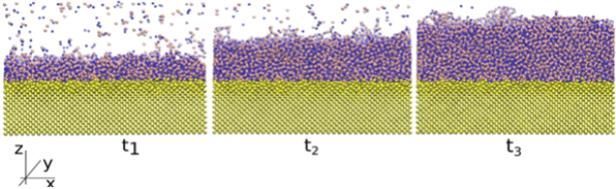
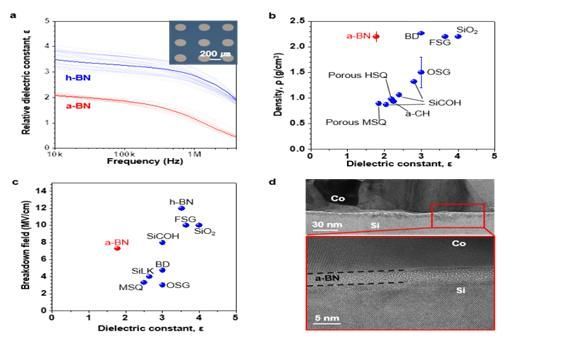
The research team succeeded in synthesizing an amorphous boron nitride material. This material has a dielectric constant more than 30% lower than existing insulators. Insulators that prevent electrons from leaking from metal wiring to other parts inside semiconductor materials must have a low dielectric constant, which indicates sensitivity to external electric fields. The lower the dielectric constant, the less electrical interference occurs, allowing the spacing between rapid wiring inside semiconductor devices to be reduced. This enables the production of smaller semiconductors.
In current nanometer-scale semiconductor processes, as devices become smaller, internal electrical interference worsens, which actually slows down information processing speeds. For this reason, developing new materials with low dielectric constants that minimize electrical interference is key to overcoming the limits of semiconductors.
The research team expects that the newly developed material, with a dielectric constant of 1.78, which is lower than the dielectric constant (2.5) of porous organosilicate currently used as an insulator in semiconductor processes, will reduce power consumption and increase operating speed of semiconductor chips.
Additionally, the team noted that existing insulators have the drawback of weak strength due to tiny air holes, but using amorphous boron nitride eliminates the need for air holes, thus maintaining high strength.
Through this research, the team also revealed, using theoretical calculations and the 4D beamline at the Pohang Accelerator Laboratory, that the reason for the low dielectric constant of amorphous boron nitride is the 'irregularity of atomic arrangement.'
Semiconductors Become Faster and Smaller
Seokmo Hong, a first author and PhD candidate at UNIST, explained the research process: "While studying whether hexagonal boron nitride (white graphene) could be deposited on substrates at low temperatures, I accidentally discovered the dielectric properties of 'amorphous boron nitride' and confirmed its applicability as a semiconductor insulator."
Corresponding author Professor Hyunseok Shin of UNIST emphasized, "If this material is commercialized, it will greatly help overcome crises facing the semiconductor industry such as China’s semiconductor rise and Japan’s export restrictions. It is a core material technology that can continue the semiconductor super-gap strategy."
Co-corresponding author Hyunjin Shin, Senior Researcher at Samsung Electronics’ Advanced Institute of Technology, said, "This research result is an exemplary case where academia and industry cooperated to find solutions to technical challenges considered difficult in the semiconductor industry."
© The Asia Business Daily(www.asiae.co.kr). All rights reserved.
![Clutching a Stolen Dior Bag, Saying "I Hate Being Poor but Real"... The Grotesque Con of a "Human Knockoff" [Slate]](https://cwcontent.asiae.co.kr/asiaresize/183/2026021902243444107_1771435474.jpg)

















