Pork Neck Meat Price Rises 19.8% from Previous Month
Seoul Area Dining Costs for Gimbap, Naengmyeon, etc. Also '↑'
[Asia Economy Reporters Choi Saeng-hye, Lee Seung-jin] Due to the government emergency disaster relief funds distributed since mid-last month, food and dining prices in May saw a temporary increase.
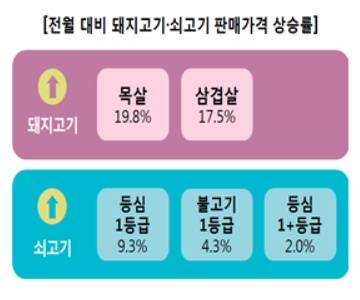
According to the comprehensive price information portal 'Chamgagyeok' of the Korea Consumer Agency on the 23rd, the prices of six domestic pork and beef items rose sharply in May due to the distribution of emergency disaster relief funds. The price of domestic pork neck meat averaged 2,608 KRW per 100g, up 19.8% from 2,177 KRW in April. The price of pork belly (100g) also rose 17.5%, from an average of 2,364 KRW in April to 2,778 KRW in May. Beef prices for sirloin (grade 1), bulgogi (grade 1), and sirloin (grade 1+) increased by 9.3%, 4.3%, and 2.0%, respectively.
Prices of 16 widely consumed processed foods, including sesame oil (4.9%), cola (3.9%), and tofu (3.8%), also increased. Among 30 popular processed food items, prices of 16 items such as sesame oil (4.9%), cola (3.9%), tofu (3.8%), and curry (1.8%) rose. Notably, fish cake prices have increased for three consecutive months recently, and tofu prices, which had been falling since February, rose in May. Prices of 11 items, including orange juice (-2.7%), soybean paste (-2.2%), and red pepper paste (-1.6%), fell compared to April, and instant rice prices declined for two consecutive months.
Dining-out prices are also on the rise. According to an online survey conducted by the Rural Development Administration on the 28th of last month with 880 consumer panelists, about 60% of respondents reported using the emergency disaster relief funds for purchasing agricultural and food products and dining out, consistent with these findings. Particularly, the percentage of respondents who said they dined out increased more than sevenfold from 4.7% in April to 36.3% in May.
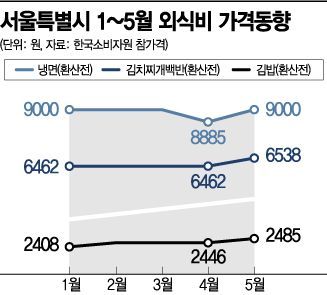
According to Chamgagyeok's dining-out price trends, prices of gimbap, naengmyeon, and kimchi stew set meals in Seoul rose in May compared to the previous month. Gimbap prices increased from 2,446 KRW in April to 2,485 KRW, naengmyeon from 8,885 KRW to 9,000 KRW, and kimchi stew set meals from 6,462 KRW to 6,538 KRW. In major provincial cities, prices were either stable or even decreased compared to the previous month. A dining industry official explained, "The effects of emergency disaster relief funds appear particularly prominent in Seoul, where commercial districts are well developed."
Until April, due to consumption stagnation caused by social distancing, prices of four out of eight representative dining items in Seoul had fallen compared to January, before the full onset of the COVID-19 pandemic. Notably, naengmyeon prices in Seoul fell for the first time since March 2017, and prices of jajangmyeon, a popular affordable dish, also declined.
Although the dining-out market somewhat recovered with the distribution of disaster relief funds in May, more than half of the already distributed funds have been used, and with COVID-19 infection numbers still not decreasing, there are forecasts that consumption sluggishness will continue in the second half of the year. Woo Hye-young, a researcher at Ebest Investment & Securities, said, "Consumer sentiment index (CCSI) and others showed slight improvement in May compared to the previous month," but added, "It will take some time for consumption, which has been depressed by COVID-19, to fully recover to previous levels."
© The Asia Business Daily(www.asiae.co.kr). All rights reserved.
![Clutching a Stolen Dior Bag, Saying "I Hate Being Poor but Real"... The Grotesque Con of a "Human Knockoff" [Slate]](https://cwcontent.asiae.co.kr/asiaresize/183/2026021902243444107_1771435474.jpg)
















