Suspicious Installation of Loudspeakers Across North Korea DMZ
Two Years After Removal Following 2018 Panmunjom Declaration
Military Authorities Likely to Restore Loudspeakers for Countermeasures Against North Korea
 On the 22nd, a North Korean military post can be seen in Kaepung County, Hwanghaebuk-do, North Korea, as viewed from the Peace Observatory in Ganghwa County, Incheon.
 On the 22nd, it was reported that North Korea is reinstalling loudspeakers aimed at South Korea at various locations in the Demilitarized Zone (DMZ), which had been dismantled following the April 27, 2018 Panmunjom Declaration agreement. Previously, North Korea declared the breakdown of inter-Korean relations and announced that its projects targeting the South would be converted into 'anti-South projects,' and it is interpreted that related measures are being implemented swiftly.
Military authorities are known to have detected North Korea reinstalling loudspeaker broadcasting facilities aimed at South Korea in the border area and are closely monitoring the situation.
North Korea dismantled about 40 loudspeakers installed in the frontline area on May 1, 2018. South Korea also dismantled fixed and mobile loudspeaker broadcasting facilities installed at about 40 frontline locations on May 4 of the same year.
The dismantling of loudspeaker broadcasting facilities is regarded as the first implementation case of the historic Panmunjom Declaration signed by President Moon Jae-in and North Korean State Affairs Commission Chairman Kim Jong-un.
In Article 2, Clause 1 of the 2018 Panmunjom Declaration, the two leaders agreed to "stop all hostile acts including loudspeaker broadcasts and leaflet distribution in the Military Demarcation Line area and dismantle the means for such acts."
However, after about two years since the dismantling, the reinstallation work is underway, and it is expected that slander and propaganda activities against South Korea through loudspeaker broadcasts will resume in the DMZ area.
Military authorities are also known to plan restoring previously dismantled facilities as a countermeasure in response to North Korea's installation of loudspeaker facilities.
Loudspeaker broadcasts are considered "the psychological warfare tool that hurts North Korea the most." When the output is maximized, the broadcast content can be heard about 24 km away at night and about 10 km away during the day. A military official stated that when the output is maximized, North Korean military units near the Military Demarcation Line (MDL) can hear the broadcasts day and night.
South Korea also possesses new mobile loudspeaker vehicles capable of transmitting sound over distances more than 10 km farther than the existing fixed loudspeakers.
Loudspeaker broadcasts targeting North Korea began in 1963 and have been repeatedly suspended and resumed depending on the ups and downs of inter-Korean relations.
During the Roh Moo-hyun administration in 2004, loudspeaker broadcasts targeting North Korea were suspended and facilities dismantled following an agreement at the inter-Korean general-level military talks, but they were reinstalled during the Lee Myung-bak administration in 2010 as a response to the Cheonan ship sinking incident.
During the Park Geun-hye administration in January 2016, loudspeaker broadcasts targeting North Korea were resumed again as a response to North Korea's fourth nuclear test.
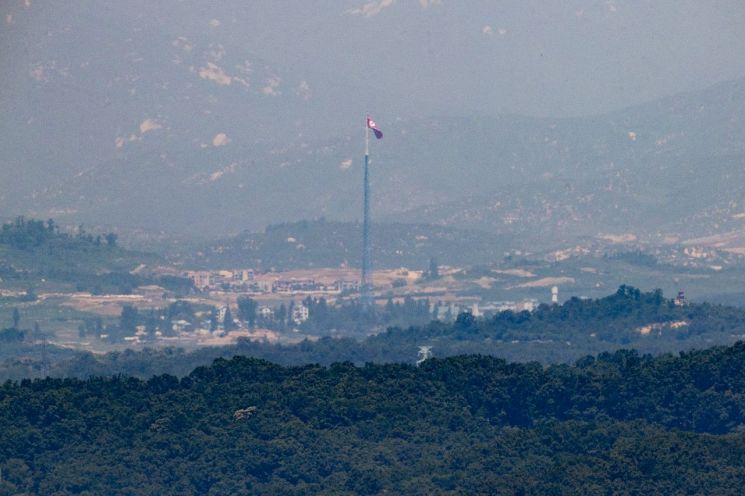 On the 22nd, the North Korean flag was fluttering in the village of Kijeong-dong in the western frontline Demilitarized Zone (DMZ), as seen from the border area of Paju-si, Gyeonggi-do.
Meanwhile, Kim Yo-jong, First Deputy Director of the North Korean Workers' Party, who has recently been overseeing the offensive against South Korea, hinted in a statement on the 4th at the closure of the inter-Korean joint liaison office, complete dismantling of the Kaesong Industrial Complex, and the termination of the inter-Korean military agreement, and it is expected that North Korea will accelerate related projects.
On the 5th, the United Front Department of North Korea mentioned in a statement that it would "begin review projects" to implement Kim Yo-jong's statement, and just three days later, it completely cut off inter-Korean communication channels. Following a statement on the 13th hinting at the closure of the liaison office, North Korea blew up the liaison office just three days later.
On the 16th, the General Staff of the Korean People's Army disclosed four action plans: deployment of troops to Mount Kumgang and the Kaesong Industrial Complex, return of guard forces to DMZ guard posts (GPs), elevation of combat readiness, and leaflet distribution targeting South Korea.
As the entire North Korean regime executes Kim Yo-jong's orders in a unified manner, it is expected that her status will be elevated and internal cohesion strengthened.
© The Asia Business Daily(www.asiae.co.kr). All rights reserved.
![Clutching a Stolen Dior Bag, Saying "I Hate Being Poor but Real"... The Grotesque Con of a "Human Knockoff" [Slate]](https://cwcontent.asiae.co.kr/asiaresize/183/2026021902243444107_1771435474.jpg)

















