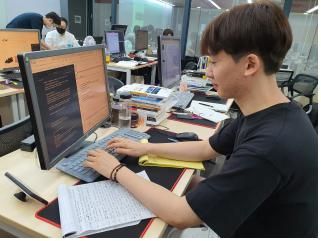
 Mr. Park Sang-hyun, who enrolled at Korea Polytechnics University Bundang Convergence Technology Education Center.
[Asia Economy Reporter Kim Bo-kyung] Park Sang-hyun, 29 years old this year, graduated from the Department of Chinese Language and Literature at Tsinghua University in China and worked as an administrative officer at the Guangzhou Consulate for two years. He was mainly responsible for collecting data on China's economic and trade sectors, analyzing the situation, and writing reports. While in charge of research related to the Fourth Industrial Revolution, he became interested in the information technology (IT) field but felt it was "a world far from my humanities background."
After returning to Korea, he leveraged his language skills to prepare for employment in overseas sales and marketing. However, he could not escape the status of a 'job seeker' for over a year. By chance, he learned about the recruitment for the Data Convergence Software Department (10-month course) at Korea Polytechnics Bundang Convergence Technology Education Center. The phrase 'no university major required' in the eligibility criteria was a great relief to him.
Park said, "Although there are difficulties in learning a new field, I am greatly motivated by the learning atmosphere where peers exchange opinions," and expressed his ambition, "I want to create a Chinese language education application that reflects regional dialects and local expressions."
As universities, which had been subdued due to the novel coronavirus infection (COVID-19), shifted partially to face-to-face classes, the bustle of freshmen brought vitality. Especially this year, Korea Polytechnics attracted attention with freshmen who have diverse backgrounds.
Besides Park's case, notable examples include Song Myung-jin (28), who became a student after being a specialized high school teacher to become an aviation expert teacher, and Kang Hyo-jin (30), who challenged herself as a bioanalysis technician after working as a seed researcher. Although their stories differ, they all chose Polytechnics dreaming of better careers and better lives.
Song earned a bachelor's degree in aerospace engineering and a master's degree in mechanical and metal education. After working as a mechanical and metal teacher at Jinju Mechanical High School, he took a leave of absence and decided to enroll in the two-year aviation maintenance program at the Polytechnics Aviation Campus. Song said, "I want to become the best aviation expert teacher in Korea," and showed his determination by adding, "I also want to challenge myself to obtain global maintenance certification."
Kang, who worked as a seed researcher at a company, became a freshman this year in the two-year Bio Food Analysis program at the Polytechnics Bio Campus. She chose to enter Polytechnics with the idea of professionally learning bioanalysis technology. She said, "After graduation, I want to work by utilizing my major skills in controlling harmful substances in food and analyzing food components."
Lee Seok-haeng, chairman of Korea Polytechnics, stated, "We will expand the range of vocational education and training fields such as big data, aviation MRO, and bio, and cultivate technical talents needed in the field through sufficient education and training," and added, "We will faithfully fulfill our fundamental role of providing better jobs to the public."
© The Asia Business Daily(www.asiae.co.kr). All rights reserved.
![Clutching a Stolen Dior Bag, Saying "I Hate Being Poor but Real"... The Grotesque Con of a "Human Knockoff" [Slate]](https://cwcontent.asiae.co.kr/asiaresize/183/2026021902243444107_1771435474.jpg)















