SMBA Research Institute Releases Report on 'Changes in Consumer Trends Due to COVID-19 and Corporate Responses'
[Asia Economy Reporter Kim Cheol-hyun] As the novel coronavirus infection (COVID-19) crisis prolongs, the era of 'Ontact,' where people meet online beyond non-face-to-face (untact) interactions, is arriving, prompting claims that proactive responses from small business owners and SMEs are necessary.
Jo Hye-jung, a research fellow at the Korea Institute for Industrial Economics & Trade (President Lee Byung-heon), announced this on the 21st in a report titled "Changes in Consumer Trends Due to COVID-19 and Corporate Responses" (SME Focus No. 20-14).
According to the report, the spread of COVID-19 has rapidly brought about changes in lifestyles and economic structures worldwide. The implementation of movement restrictions such as border closures and entry bans, as well as social distancing measures, is altering consumer behavior, and these changes are expected to continuously impact small business owners and SMEs.
The report emphasized the need to pay attention to the global promotion of preference for digital-based non-face-to-face channels as a change in consumption patterns caused by COVID-19. The number of visits to e-commerce platforms worldwide reached 14.34 billion in March this year, an increase of about 1.5 billion compared to January, indicating that consumers are choosing online channels where they can consume while physically avoiding contact with others.
COVID-19 has also brought changes to consumers' food consumption habits, influencing the activation of online consumption in the food market. The proportion of meals eaten inside the home and the willingness to order delivery or takeout have increased, and growth in related online-based markets is also expected.
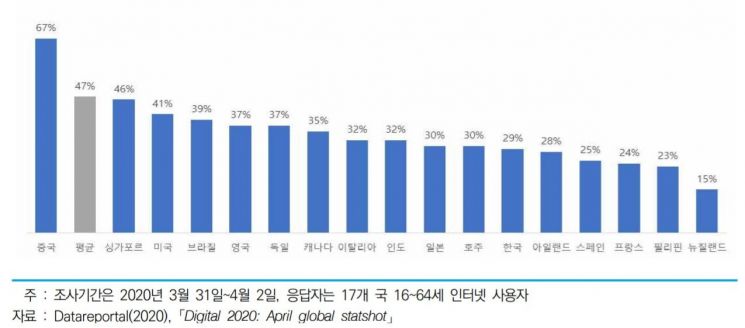
Furthermore, interactions through digital tools and related platforms are expected to strengthen even after COVID-19. Among workers who experienced telecommuting after the outbreak, 46% responded that they plan to continue telecommuting post-COVID-19, suggesting changes in work environments due to the normalization of telecommuting experienced during the pandemic. This is also expected to contribute to the activation of remote education methods through digital platforms.
The report also highlighted cases of companies innovating with untact services in retail distribution, office, education, and legal fields in response to changing consumer trends due to COVID-19. For example, the domestic startup Badadream operates a service that delivers seafood through group purchases based on customer data. Toss Lab provides a messenger-based online collaboration tool characterized by automation and unification of tasks. Edutech startup Classting operates an interactive learning platform that facilitates communication in classes, with school attendance delays and online classes due to COVID-19 serving as business opportunities. Legaltech startup Amicus Rex operates AI-based non-face-to-face legal services, offering solutions for automatic drafting and management of various legal documents.
The report emphasized that these online-centered changes could pose a sales decline crisis for offline-oriented companies but also present opportunities to explore new business prospects, thus requiring proactive responses from small business owners and SMEs. Small business owners and SMEs need to seek new business structures based on digital platforms and improve their corporate constitution. Traditional offline businesses need to discover competitive untact business opportunities by utilizing digital platforms, and for this, understanding changes in consumer behavior and technological shifts in the relevant industries in the post-COVID era, as well as a shift in business operation awareness, are necessary, the report added. Government support for discovering digital-based business models and technology development and linkage is also needed to respond to the non-face-to-face society. Additionally, structural changes in support projects reflecting the characteristics of newly emerging business models are required.
Research fellow Jo Hye-jung stated, "From the government's perspective, it is necessary to support the education and training system for workers affected by the rapid digitalization of industries after COVID-19," adding, "It is necessary to prepare education and training programs so that workers in occupations where jobs decrease due to the onlineization of consumption can easily transition to other online and digital jobs."
© The Asia Business Daily(www.asiae.co.kr). All rights reserved.
![Clutching a Stolen Dior Bag, Saying "I Hate Being Poor but Real"... The Grotesque Con of a "Human Knockoff" [Slate]](https://cwcontent.asiae.co.kr/asiaresize/183/2026021902243444107_1771435474.jpg)















