World Refugee Day, Ongoing Conflicts Over Refugee Acceptance
Refugee Rights Network: "Not Refugee Protection Policy but Refugee Rejection Policy"
National Action for Refugee Measures: "Serious Problem of Fake Refugees... Citizens Losing Jobs"
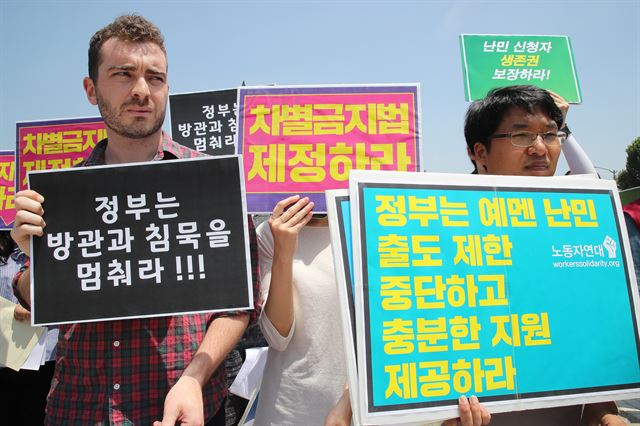 On the afternoon of June 20, 2018, World Refugee Day, members of civic groups including the Refugee Rights Center urged the government to stop discriminatory refugee policies at a press conference condemning refugee policies held at the fountain plaza in front of the Blue House in Jongno-gu, Seoul. Photo by Yonhap News
[Asia Economy Reporter Han Seung-gon] On the 20th, marking "World Refugee Day," conflicts surrounding refugees trying to settle in South Korea are intensifying. There is a sharp divide between calls to protect refugee human rights and demands to immediately abolish the Refugee Act, which is said to produce fake refugees.
On the 18th, the Refugee Human Rights Network held a press conference urging the government and the National Assembly to "abolish the refugee rejection policy and respond to the amendment of the Refugee Act to guarantee refugee human rights." The organization pointed out that since South Korea enacted the Refugee Act, the refugee recognition rate and support policies have deteriorated.
Lee Il, chairman of the Refugee Human Rights Network and a lawyer at the public interest law center 'Appeal,' criticized the government for not establishing a long-term refugee policy.
Lawyer Lee stated, "The content of South Korea's refugee policy over 26 years has ultimately been a refugee rejection policy, not a refugee protection policy."
He criticized various policies that make refugee acceptance difficult, such as insensitivity to criticism of the low refugee recognition rate of only 0.4%, a significant decrease in the number of recognized refugees since the Refugee Act was implemented, immigration control policies aimed at blocking refugee inflow from abroad, and the absence of policies regarding living expenses and work permits.
Last year, only 42 people were recognized as refugees through screening, accounting for 0.4%. This figure contrasts sharply with the average recognition rate of 3.7% from 2013, when the Refugee Act was enacted, to 2019, and the pre-Refugee Act average recognition rate of 18.9%.
During the same period, the European Union (EU) recorded a refugee recognition rate of 23.1%. The number of recognized refugees by the government has been decreasing annually. The number of recognized refugees (including resettlement refugees) was 121 in 2017, 144 in 2018, and 79 in 2019. As a result, South Korea ranks only 139th among all refugee-hosting countries worldwide.
This is why there are calls from a humanitarian perspective to protect refugee human rights and help them maintain their livelihoods. Consequently, some point out that there may be refugee hatred.
A 30-year-old office worker, Mr. A, said, "The issue of accepting refugees is not a matter of pros and cons," adding, "Ignoring their human rights and opposing acceptance is essentially based on refugee hatred." He emphasized, "The refugee issue is a global issue, not just for South Korea. In such a situation, it is right for Korea to show a model example."
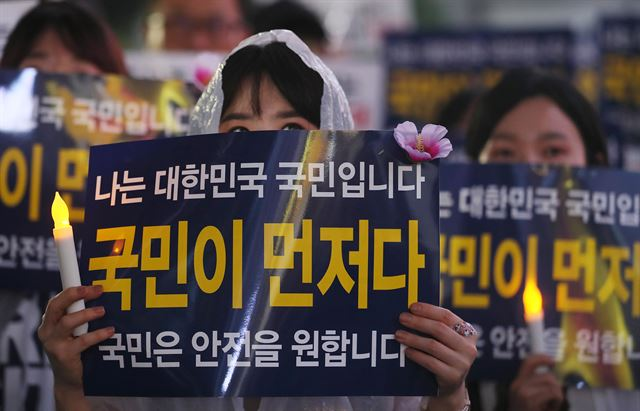 On the afternoon of July 30, 2018, participants hold placards at a rally calling for the abolition of the Refugee Act and the visa-free entry system in front of Donghwa Duty Free Shop in Jongno-gu, Seoul. Photo by Yonhap News.
On the other hand, there are voices calling for the complete abolition of the Refugee Act. Fifty-eight civic groups, including the Refugee Countermeasure National Action, Citizens First National Action, Truth History Education Research Association, Freedom and Human Rights Practice National Action, and Multicultural Feminism Response Union, urged the abolition of the Refugee Act on the 19th.
They held a press conference at 2 p.m. in front of the Seoul Government Complex, issuing a statement saying, "Immediately abolish the Refugee Act that produces fake refugees, which are the lifeline of refugee brokers."
They pointed out, "June 20 this year is World Refugee Day. According to the United Nations Refugee Agency, as of the end of last year, refugees account for 1% of the world's population, totaling 79.5 million." They added, "Due to fake refugees produced by some refugee brokers abusing the current Refugee Act, our citizens are losing jobs, and the increase in crime and infiltration of terrorists into the country threaten the national economy and security."
They further claimed, "Most of the refugee applicants coming to our country are presumed to be fake refugees planned by refugee brokers, so it is natural that the refugee recognition rate is below 1%. Among the refugee applicants, 30-40% are foreign workers residing in the country or illegal immigrants who misuse refugee applications as a means to obtain legal residency status temporarily."
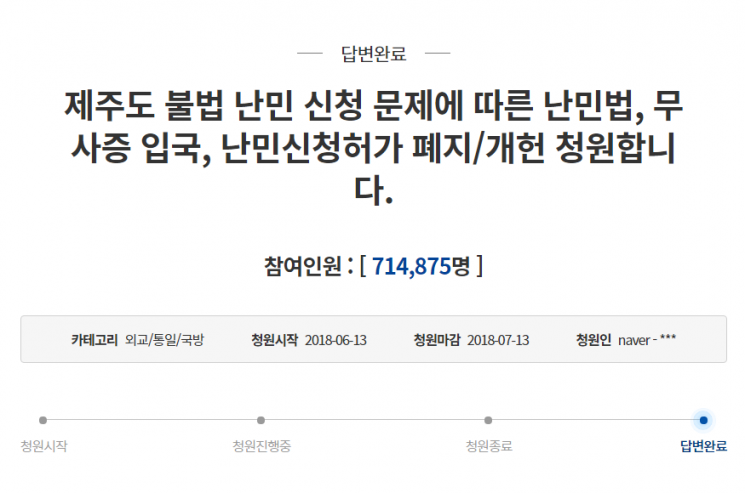 A petition posted on June 13, 2018, on the Blue House National Petition Board calling for the abolition of the Refugee Act. Photo by Blue House National Petition Board
They added, "The collective refugee application incident by Yemenis who entered Jeju Island without a visa in 2018 is a good example of fake refugees," noting, "As a result of that incident, the Blue House petition to abolish the Refugee Act exceeded 710,000 signatures in just one month, marking the highest number of recommendations since the Blue House petition system began."
On August 1, 2018, the Blue House stated that it was practically difficult to withdraw from the Refugee Convention or abolish the Refugee Act in response to the public petition opposing refugee acceptance. This petition, triggered by the Yemeni refugee incident in Jeju Island, called for stricter refugee entry regulations and was supported by a total of 714,875 people.
At that time, Park Sang-ki, Minister of Justice and the responsible ministry, responded to the "Abolish the Refugee Act" petition by saying, "We take the concerns of the people expressed in this petition seriously," but added, "Considering our country's international status and national interests, it is practically difficult to withdraw from the Refugee Convention or abolish the Refugee Act."
He also announced plans to strengthen screening to prevent false refugees and dispel concerns about serious crimes. Minister Park emphasized, "We will strengthen identity verification by mandating the submission of social network service (SNS) accounts when applying for refugee status," and "We will conduct strict screening regarding persecution reasons, drug tests, infectious diseases, and serious crimes."
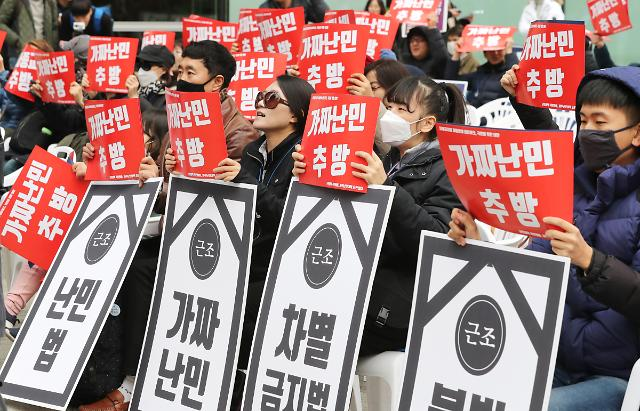 Refugee Countermeasure National Action officials are holding a rally against conscientious objection to military service and for the expulsion of fake refugees in front of Jongno Tower, Jongno-gu, Seoul, on November 17, 2018.
 [Photo by Yonhap News]
Amid the conflicts surrounding refugee acceptance, the number of foreign residents in South Korea has surpassed 2.5 million for the first time.
According to the December 2019 statistical monthly report released by the Immigration and Foreigners Policy Headquarters of the Ministry of Justice on the 17th, as of the end of December 2019, the number of foreign residents was 2,524,656, an increase of 3.7% from the previous month and 6.6% compared to the same period last year.
Following surpassing 1 million in August 2007 and 2 million in June 2016, the era of 2.5 million foreigners has opened. This figure corresponds to 4.9% of the total population of the Republic of Korea.
By nationality, China accounts for 1,101,782 people, or 43.6%. Among them, 701,098 (63.3%) are ethnic Koreans in China, commonly called Joseonjok.
Vietnam follows with 224,518 people, then Thailand (209,909), the United States (156,982), and Japan (86,196).
By region of residence for registered foreigners, Gyeonggi Province has the highest number with 414,318, followed by Seoul (281,876), Chungnam (including Sejong City, 76,375), Gyeongnam (76,123), and Incheon (72,259).
The number of illegal foreign residents (unregistered foreigners) reached 390,281, a 9.9% increase from the previous year. The illegal residency rate among all foreign residents also rose by 0.5 percentage points from 2018 to 15.5%.
Last year, the number of refugee applicants was 15,452, a 4.5% decrease from 2018.
© The Asia Business Daily(www.asiae.co.kr). All rights reserved.
![Clutching a Stolen Dior Bag, Saying "I Hate Being Poor but Real"... The Grotesque Con of a "Human Knockoff" [Slate]](https://cwcontent.asiae.co.kr/asiaresize/183/2026021902243444107_1771435474.jpg)


















