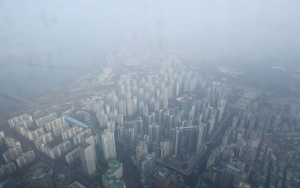
Miryang Arirang Observatory Hosts Observation Event at Outdoor Plaza
National Gwacheon Science Museum Provides Real-Time Online Live Broadcast
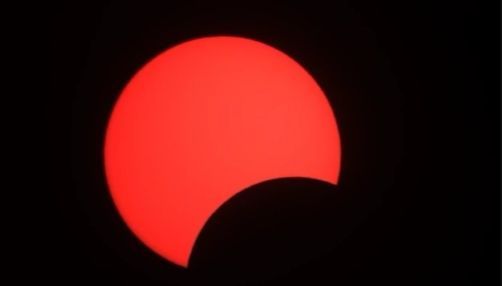
[Asia Economy Intern Reporter Kim Bong-ju] On the 21st, a partial solar eclipse that will not occur again for the next 10 years will be visible nationwide.
This partial solar eclipse is the largest in area in over 8 years since May 21, 2012, when about 80% of the sun's surface was covered, among eclipses observable in South Korea.
A solar eclipse is a phenomenon where the sun is partially or fully obscured by the moon as seen from Earth. If the sun is completely covered, it is called a total solar eclipse; if only part of it is covered, it is a partial solar eclipse; and if only the edge of the sun remains visible, it is called an annular solar eclipse.
This eclipse will be observable across West Africa and Asia, with an annular solar eclipse occurring in central West Africa, northern India, China, and Taiwan.
In Seoul, the partial eclipse will begin at 3:53 PM, with the moon gradually covering the lower part of the sun, reaching its maximum coverage of 45% of the sun's surface area around 5:02 PM.
Afterwards, the partial eclipse will end around 6:04 PM as the moon completely moves away from the sun.
The previous partial eclipse occurred on December 26 of last year. This eclipse covers the sun more than any partial eclipse since May 21, 2012, when about 80% of the sun was obscured.
Since this partial eclipse occurs late in the afternoon, to observe the entire process, one must be in a location without tall buildings or mountains to the west.
However, looking directly at the sun with the naked eye, magnifying glasses, or binoculars to view the eclipse can cause severe eye damage, including blindness.
Therefore, to safely observe the eclipse, protective equipment such as telescopes equipped with solar filters or special eclipse glasses must be worn.
The Miryang Arirang Space Observatory will hold a partial eclipse observation event at the outdoor plaza at 3:30 PM on the day. Participation is free of charge.
The Gwacheon National Science Museum will broadcast the partial eclipse live online. The online broadcast will be available from 3:50 PM to 6:10 PM via YouTube and Facebook.
Meanwhile, the next solar eclipse is scheduled for June 1, 2030, meaning that one must wait 10 years to see another eclipse.
© The Asia Business Daily(www.asiae.co.kr). All rights reserved.