[Monthly Aviation Editor-in-Chief Kim Jae-han] The U.S. Army is pushing to introduce a new helicopter to replace the UH-60 Black Hawk. The Black Hawk is a representative utility helicopter operated by about 4,000 units worldwide, including the U.S. military. South Korea’s Army, Navy, and Air Force also operate it for various purposes such as mobility, search and rescue, and VIP transport. However, since it was developed over 40 years ago, the U.S. Army plans to introduce a new helicopter to replace the aging Black Hawk.
▲ U.S. Army replacing helicopter fleet = Currently, the U.S. Army is developing two types of new helicopters to replace its aging models. One is the "Future Attack Reconnaissance Aircraft (FARA)" for armed reconnaissance, and the other is the "Future Long-Range Assault Aircraft (FLRAA)" for transport and troop mobility. Among these, the Future Long-Range Assault Aircraft will replace the aging Black Hawk in the future.
The Future Long-Range Assault Aircraft, set to replace the Black Hawk starting in 2030, is characterized by its ability to fly faster and farther than the Black Hawk. In fact, the maximum cruising speed envisioned by the U.S. Army for the Future Long-Range Assault Aircraft is 520 km/h, nearly twice as fast as the Black Hawk’s 280 km/h. The U.S. Army plans to use this high speed to rapidly deploy troops in urgent combat situations and enhance survivability against ground attacks. Additionally, while the Black Hawk can fly about 2,200 km, the Future Long-Range Assault Aircraft is expected to fly more than twice that distance, approximately 4,520 km.
▲ Sikorsky, Boeing, and Bell enter the development competition = Currently, the companies competing in the Future Long-Range Assault Aircraft development project are the U.S. Sikorsky/Boeing team and Bell. These are globally renowned helicopter manufacturers. Especially since the U.S. Army operates about 2,200 Black Hawks, competition among these manufacturers to secure the development contract is intensifying.
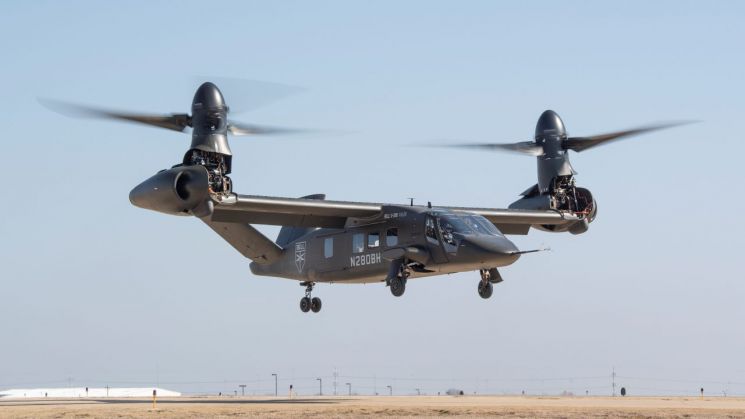
In this context, Bell opened the first salvo in the competition. In December 2017, Bell successfully conducted the first flight of its proposed model, the V-280 Valor. Bell applied the tiltrotor technology from its previously developed V-22 Osprey to the Valor and conducted the first flight early on. Notably, the Valor features fixed-wing long wings and propellers that act as main rotors, enabling vertical takeoff and landing, hovering, and fast flight like a fixed-wing aircraft. Through repeated flight tests, the Valor gradually increased its speed, reaching 556 km/h in March last year.
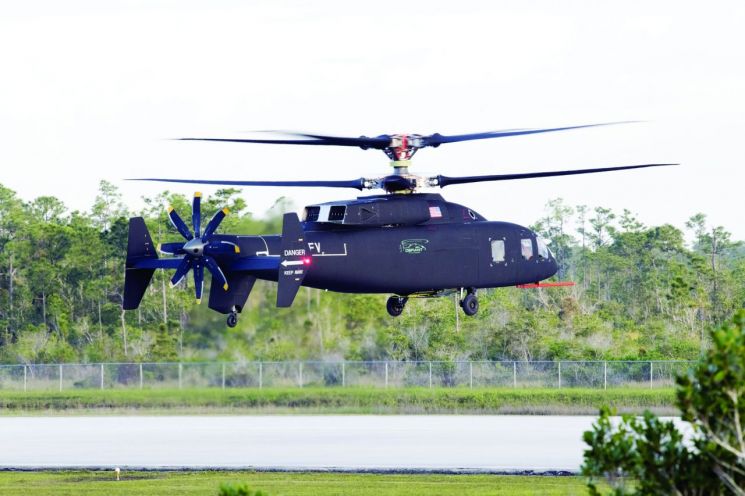
The competitor to the Valor is the Sikorsky/Boeing team’s Defiant. It conducted its first flight in March last year, about a year later than the Valor. Unlike the Valor, the Defiant is a so-called compound helicopter with two main rotors rotating in opposite directions and a large rear-mounted propeller for thrust. This unique design gives it an external appearance similar to a traditional helicopter but allows it to fly at speeds impossible for conventional helicopters. In a flight test conducted last January, the Defiant recorded a speed of 555 km/h.
▲ The U.S. Army’s choice = The Future Long-Range Assault Aircraft competition is essentially a contest between tiltrotor and compound helicopters. However, comparing them is not straightforward due to their differing strengths and weaknesses. For example, tiltrotors resemble fixed-wing aircraft and can fly faster than compound helicopters, but they are unfamiliar aircraft for an army accustomed to traditional helicopters. On the other hand, compound helicopters are familiar to army pilots, maintain agility at low speeds like conventional helicopters, and are advantageous for operations in confined areas. However, from an aerodynamic perspective, they cannot fly faster than tiltrotors. The U.S. Army’s final choice between these two aircraft with distinct pros and cons is attracting much attention.
© The Asia Business Daily(www.asiae.co.kr). All rights reserved.
![Clutching a Stolen Dior Bag, Saying "I Hate Being Poor but Real"... The Grotesque Con of a "Human Knockoff" [Slate]](https://cwcontent.asiae.co.kr/asiaresize/183/2026021902243444107_1771435474.jpg)

















