Simultaneous Deployment of 3 Aircraft Carriers, First Time in 2 Years and 7 Months Since Peak of North Korea Nuclear Crisis
North Korea Warned for Provocations Against South, China Strongly Reacts to South China Sea Provocations
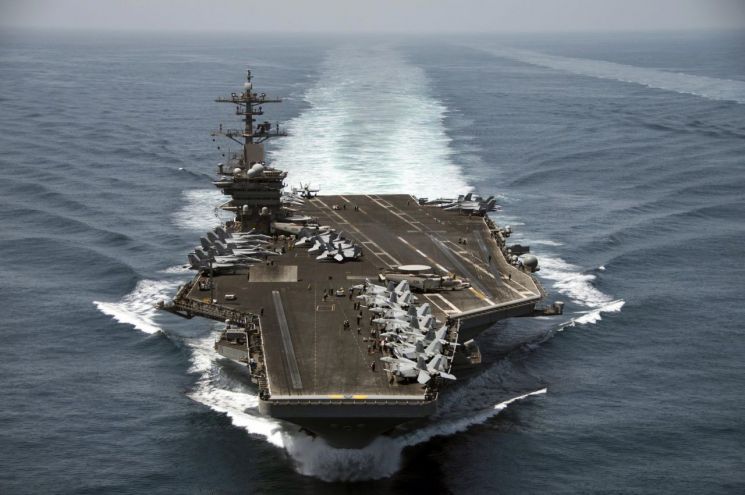
[Asia Economy Reporter Lee Hyun-woo] The U.S. Navy's deployment of three main aircraft carriers in the Pacific has heightened military tensions across Northeast Asia. This is the first time in two years and seven months since November 2017, when the North Korean nuclear crisis peaked, that the U.S. has simultaneously deployed three carrier strike groups in the Pacific. This move is interpreted as a warning aimed simultaneously at North Korea, which has recently escalated provocations against South Korea, and China, which has increased provocations in the South China Sea.
According to CNN on the 15th (local time), the U.S. Navy's three 100,000-ton class main aircraft carriers?the USS Ronald Reagan, USS Theodore Roosevelt, and USS Nimitz?have recently been deployed simultaneously in the Pacific, conducting patrol activities. These carriers carry more than 60 fighter jets, and each carrier strike group is reportedly accompanied by various strategic weapons, including escort destroyers and submarines.
CNN reported that the simultaneous deployment of three aircraft carriers in the Pacific is the first since November 2017, when the North Korean nuclear crisis was intensifying. At that time, immediately after North Korea conducted its sixth nuclear test, the U.S. deployed three carriers in the East Sea of the Korean Peninsula and conducted joint exercises with the South Korean military, carrying out a high-intensity show of force against North Korea. Colin Koh, a researcher at the Singapore Institute of Defence and Strategic Studies, explained, "The simultaneous deployment of three U.S. aircraft carriers in the Pacific was a strong response to China's disparagement of the U.S. Navy as being incapacitated due to the COVID-19 pandemic."
While the primary purpose of this carrier deployment is to pressure China in areas such as the East China Sea, it is also analyzed as a measure to simultaneously check North Korea. On the same day, U.S. Secretary of Defense Mark Esper, in an article contributed to Singapore's local media The Straits Times, stated, "The United States will strive to build closer security relationships with regional allies and partners amid challenges posed by the COVID-19 pandemic and the Chinese Communist Party," while emphasizing, "Efforts with South Korea to achieve North Korea's 'final, fully verified denuclearization (FFVD)' and lasting peace on the Korean Peninsula are also included in this."
Previously, China had showcased its naval power by sending its aircraft carrier Liaoning strike group to the Taiwan Strait to conduct a show of force while the U.S. carrier strike groups were absent from the Pacific due to quarantine measures amid the COVID-19 pandemic. North Korea, recently led by Kim Yo-jong, the first deputy director of the Workers' Party, has hinted at military provocations against South Korea and has steadily increased its nuclear arsenal, provoking the U.S. and the international community. The Stockholm International Peace Research Institute (SIPRI) estimated yesterday that North Korea's nuclear warhead count increased by about 10 compared to last year, reaching approximately 30 to 40 warheads.
Chinese state media uniformly opposed the U.S. carrier deployment. The Chinese Communist Party's official newspaper Global Times strongly criticized the U.S. carriers for threatening China in the South China Sea and accused the U.S. of pursuing hegemonic politics in the region. Another state media outlet, the People's Liberation Army Daily, emphasized that China possesses anti-ship ballistic missiles, known as "carrier killers," and can conduct firepower drills against the U.S. military.
© The Asia Business Daily(www.asiae.co.kr). All rights reserved.
![Clutching a Stolen Dior Bag, Saying "I Hate Being Poor but Real"... The Grotesque Con of a "Human Knockoff" [Slate]](https://cwcontent.asiae.co.kr/asiaresize/183/2026021902243444107_1771435474.jpg)















