[Asia Economy Reporters Inho Yoo and Hyunjung Kim] The Moon Jae-in administration's 22nd real estate policy announcement is entering its final countdown.
This policy is expected to include high-intensity measures aimed at curbing 'gap investment,' which has been actively occurring in mid- to low-priced housing transactions, in addition to expanding regulated areas in the metropolitan area where the balloon effect is spreading.
However, the market is expressing concerns that this policy will be an extension of the existing 'whack-a-mole' measures that have only repeated side effects so far, potentially causing another balloon effect.
According to the Ministry of Economy and Finance and the Ministry of Land, Infrastructure and Transport on the 16th, the government will hold a ministerial meeting (Green Room Meeting) chaired by Deputy Prime Minister and Minister of Economy and Finance Hong Nam-ki on the 17th to finalize and announce the comprehensive real estate measures.
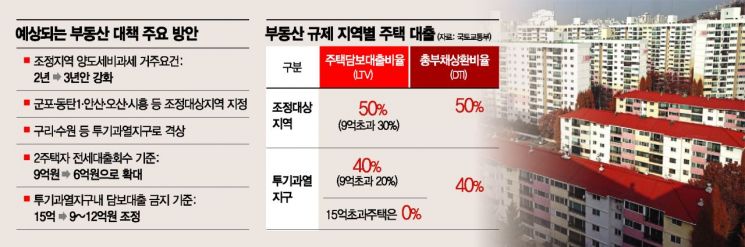
This policy is expected to directly target gap investment, which involves investing with jeonse (long-term lease deposits). Since the '12.16 measures' last year tightened loan regulations, gap investment, where buyers purchase homes with jeonse deposits amounting to as much as 70% of the house price, has surged.
According to data submitted by the Ministry of Land, Infrastructure and Transport to the National Assembly, from the beginning of this year to April, out of 53,491 housing transactions over 300 million KRW in speculative overheated districts such as Seoul, Gwacheon and Hanam in Gyeonggi Province, and Suseong District in Daegu, 21,096 were for rental purposes.
This represents a 124.8% increase compared to the same period last year. As housing purchase loan regulations tightened, the balloon effect spread through gap investment, where only 20-30% of the house price is paid with jeonse deposits.
One likely measure is strengthening the capital gains tax exemption requirements within regulated areas. Currently, one-homeowners in adjusted target areas are exempt from capital gains tax if they meet the two-year ownership and two-year residence requirements, but the government is considering extending these requirements to three years each. Some also mention imposing fines if buyers who purchase homes with jeonse deposits do not move in within a certain period.
Strengthening the requirements for jeonse loan eligibility is also reportedly on the table. Under the 12.16 measures, if a borrower of a jeonse loan purchases a home priced over 900 million KRW or owns two or more homes, the jeonse loan must be recalled. This time, the government is likely to tighten the recall threshold from 900 million KRW to 600 million KRW or possibly ban jeonse loans altogether for owners of high-priced homes.
Expansion of regulated areas such as speculative overheated districts and adjusted target areas is becoming a foregone conclusion. It is likely that the metropolitan area's speculative overheated districts will be expanded and the entire Gyeonggi Province, excluding border areas, will be designated as adjusted target areas.
New candidates for inclusion in adjusted target areas include Incheon, Gunpo and Ansan in Gyeonggi Province, and Daejeon. Suwon and Guri, already designated as adjusted target areas, are likely to be upgraded to speculative overheated districts.
According to the Korea Real Estate Board, among existing adjusted target areas, places showing notable price increases over the past three months include Guri City (7.43%), Yeongtong District (5.95%), and Gwonseon District (5.82%) in Suwon.
In speculative overheated districts, mortgage loans for homes priced over 1.5 billion KRW are prohibited, and the loan-to-value ratio (LTV) for amounts exceeding 900 million KRW is lowered to 20%. In adjusted target areas, the LTV is 50% for homes priced up to 900 million KRW and 30% for amounts exceeding that. The debt-to-income ratio (DTI) is capped at 50%, and the requirements for first-priority subscription for housing are also strengthened.
Additionally, there are reports that the government is considering lowering the high-priced home threshold for a complete ban on mortgage loans in speculative overheated districts from 1.5 billion KRW to between 900 million and 1.2 billion KRW.
Furthermore, tax measures to curb regulatory circumvention, such as individuals establishing corporations to purchase apartments, are also expected to be introduced.
However, the market warns that this policy will also cause a balloon effect. Given the abundant market liquidity and the market's resistance to most measures, expanding regulated areas and tightening loans may only stimulate housing prices in other non-regulated areas.
Some voices argue that blocking gap investment could hinder upward residential mobility from monthly rent to jeonse and from jeonse to homeownership.
Professor Kwon Dae-jung of Myongji University said, "The government has introduced pinpoint regulations whenever there is overheating in real estate investment, but regulations create resistance, which will cause another market instability. Blocking gap investment may also harm genuine demanders."
© The Asia Business Daily(www.asiae.co.kr). All rights reserved.
![Clutching a Stolen Dior Bag, Saying "I Hate Being Poor but Real"... The Grotesque Con of a "Human Knockoff" [Slate]](https://cwcontent.asiae.co.kr/asiaresize/183/2026021902243444107_1771435474.jpg)















