12·16 Measures Lose Effectiveness After 9 Weeks
Housing Price Instability Increases as Regulations Accumulate
Balloon Effect Causes Sharp Rise in Mid-Low Price Complexes
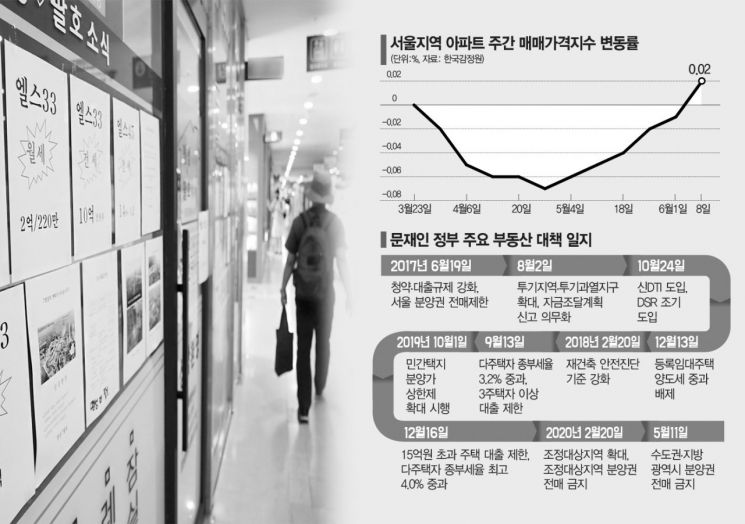
[Asia Economy Reporters Moon Jae-won and Lee Chun-hee] All efforts have failed. Despite the Moon Jae-in administration releasing 21 real estate measures over three years to curb soaring housing prices, the market's assessment is that all have failed. Chasing after regions where prices rise like a "whack-a-mole" game and belatedly imposing "pinpoint regulations" has failed to control prices in those areas, only increasing the "balloon effect." The victims of this are ordinary citizens who now find it difficult to buy even mid-to-low priced homes.
The government insists it will continuously introduce measures until housing prices are controlled, but the accumulation of regulations has only increased price instability. The market has even developed resistance, and trust in policies has plummeted.
◆ Additional regulations? ... The market heats up even more = According to industry sources on the 15th, as housing prices, which had stalled, show signs of recovery, the government is considering additional regulatory measures. However, as expectations grow that regulations may be announced as early as this week, buyers’ anxiety that "if not now, it may be difficult to secure a home" is increasing, further heating up the market.
In areas already under regulation or expected to be regulated, transactions close to record prices are taking place. The representative of real estate agency A in Jamsil-dong, Songpa-gu, Seoul, said, "Last month, all urgent sales were sold out, and the remaining properties are mostly priced at pre-COVID-19 levels, but there are many inquiries from buyers." The representative of real estate agency B near Shingil New Town in Shingil-dong, Yeongdeungpo-gu, where prices have recently risen sharply, said, "There were many inquiries over the past weekend," adding, "Many cases involved signing preliminary contracts without properly viewing the properties."
Given this market situation, the government's repeated warnings have been met with a cold response. Despite the December 16th measures last year, which included a ban on loans for homes over 1.5 billion KRW, combined with the economic downturn caused by COVID-19, Seoul's housing prices have only declined for 9 weeks this year. During this period, the decline rate in Seoul apartment sale prices was a total of 0.39%, only half of the 0.68% increase recorded in December last year.
◆ Short-term measures invite policy failure = Experts analyze that the government's focus on inconsistent short-term regulations is the cause of failure. Without long-term policies and vision, the government has repeatedly imposed pinpoint regulations whenever housing prices become unstable in specific areas, causing even previously stable real estate markets to fluctuate.
In fact, as the government tightened loan regulations on homes priced over 900 million KRW, the number of "gap investment expeditions" seeking low-priced apartments in provincial areas has increased. Representative examples include Cheongju in Chungbuk, where a synchrotron accelerator facility has been confirmed, and non-regulated areas such as Pyeongtaek in Gyeonggi-do and Cheonan in Chungnam. As speculative funds flow in and apartment prices rise, only genuine buyers suffer. Among frontline real estate agencies, there are voices saying, "Speculators act faster than regulations."
The increasingly complex regulations are also cited as a problem. Nationwide, areas are classified according to government standards into speculative zones, speculative overheating zones, adjusted target areas, land transaction permission zones, and non-regulated areas, with differentiated applications of loans, taxes, resale restrictions on pre-sale rights, and subscription conditions. Due to the subdivision of regulations over more than 20 measures, even residents in the affected areas find it difficult to understand what restrictions apply.
◆ Ignoring liquidity power... only building resistance = As complex regulations pile up, market resistance grows. While the 9.13 measures in 2018 led to a 32-week continuous decline in Seoul housing prices, the effect of the 12.16 measures lasted only 9 weeks. Prices of high-end apartments in Gangnam rebounded, and mid-to-low priced complexes surged, lowering trust in regulations.
Since most regulations are short-term, there is widespread speculation that the government may reverse regulations 180 degrees if the economic downturn continues. An industry insider said, "Although the tax burden, including comprehensive real estate tax, is increasing and the situation in Gyeonggi-do is unstable, owners of high-end homes in Gangnam still have high expectations for price increases," adding, "Isn't the reason they continue to hold prime real estate through burden-bearing gifts ahead of the tax imposition date because of this?"
Professor Shim Kyo-eon of Konkuk University's Department of Real Estate said, "The government initially pushed too hard on the war against speculation, causing many adverse effects, and tended to ignore the power of liquidity," adding, "Current government measures may have short-term effects, but most will inevitably have opposite effects in the mid-to-long term. Instead of anti-market policies like suppressing reconstruction, long-term measures such as increasing supply in high-demand areas are needed."
© The Asia Business Daily(www.asiae.co.kr). All rights reserved.
![Clutching a Stolen Dior Bag, Saying "I Hate Being Poor but Real"... The Grotesque Con of a "Human Knockoff" [Slate]](https://cwcontent.asiae.co.kr/asiaresize/183/2026021902243444107_1771435474.jpg)
















