[Asia Economy Reporter Kim Jong-hwa] The process of ordering furniture has become a form of play. On online malls, customers can customize furniture to match their tastes and the characteristics of each family member, as well as to express the structure and personality of their home, allowing them to enjoy it like a conversation or game with their family.
Customizing is a type of made-to-order service where manufacturers or artisans create products according to customer demands. The customizing process has become a form of play because, influenced by COVID-19, homes have become a means of expressing individuality, and the range of custom furniture orders has become so diverse that it far exceeds consumer expectations.
Adjusting the size within 10 cm to the customer's desired dimensions and selecting colors almost infinitely are basic options. Depending on the consumer's lifestyle and preferences, raw materials and finishes can also be chosen, and even advice on home styling direction is provided. Following this trend, the furniture industry has significantly expanded its range of customizing products this year.
A company that has captured customers' attention with bold customizing is Aloso, a sofa brand of the Fursys Group. Aloso offers consumers more than 900 options, including about 60 types of sofa finishes ranging from premium Italian leather to functional materials resistant to stains and water. They also operate a home styling consulting service called 'Decology,' which suggests overall home styling directions, including sofas, to help customers create spaces that suit their personal tastes.
The representative product is the 'Querencia Sofa.' Reflecting Korea's floor-sitting culture, it is a low-profile modular sofa with a lowered seat height. Customers can order it in various configurations such as a single lounge for one-person households, a corner lounge optimized for conversations with family and acquaintances, or a three-module lounge that can be used like a bed.
In kitchen furniture, Enex is leading customizing. After launching the industry's first customizing kitchen 'Kitchen Palette Series' in the second half of 2018, they introduced the built-in wardrobe 'Wardrobe Palette Series' earlier this year, gradually increasing the product lineup.
The Kitchen Palette Series offers consumers choices among 8 door types, 18 colors, and 27 handles, while the Wardrobe Palette Series offers 2 door types, 13 colors, and 27 handles. The customizing dining table 'O!BEUT Series' allows customers to select from 3 types of raw materials, with a total of about 80 options to tailor to customer preferences.
The customizing competition between Hanssem and Hyundai Livart, the top companies in the furniture industry, focuses on mattresses and beds. Hanssem's 'Four Seasons' mattress consists of a pad, topper, and spring mattress that can be separated by zipper, allowing customers to choose firmness and functions according to their sleeping habits and preferences.
In cold winters, a heating pad made from nano-heating fibers can be used; in hot summers, a rayon material that quickly dries sweat; and in spring and autumn, clean pads made with allergy-care and waterproof fabrics are available. Despite being sold only in offline stores, the Four Seasons mattress has become a super popular product, selling over 2,000 units monthly on average this year and accounting for 40% of offline mattress sales.
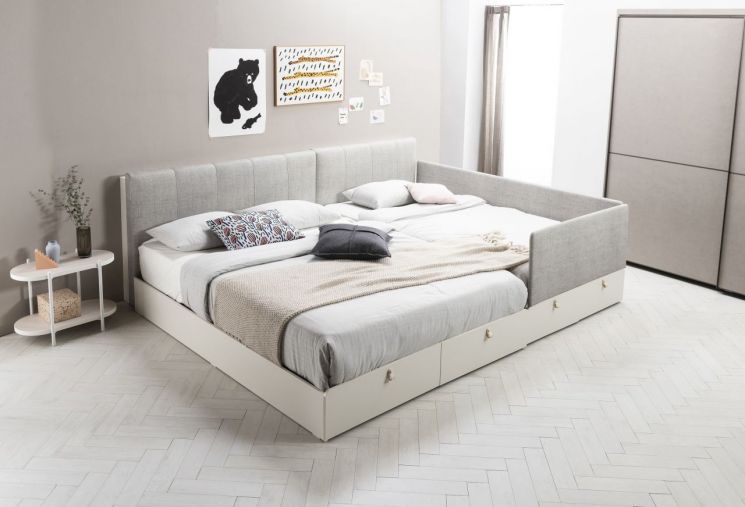
Hyundai Livart's 'Archive Storage Family Bed' enhances storage functions and can be configured in 20 different forms depending on options. Based on customer reviews, the location of the drawers under the bed can be changed in various ways. The headboard can be selected as either a standard or cushion type, and options include lighting, phone charging functions, and shelves for placing books and phones.
Jang Hye-young (44), who works full-time, said, "While ordering the bed, I was able to understand my children's personalities through conversations," adding, "During remote work, we enjoy changing options like a game and selecting furniture that suits each other's tastes."
A furniture industry insider said, "Since COVID-19, the number of 'Jipstagram' users who post photos of their homes instead of food has increased significantly," and predicted, "As consumer tendencies to pursue differentiated, unique items become clearer, customizing products will continue to grow."
© The Asia Business Daily(www.asiae.co.kr). All rights reserved.

















