Foreign Policy "Inclusion of India in New Cold War Makes Conflict Resolution Difficult"
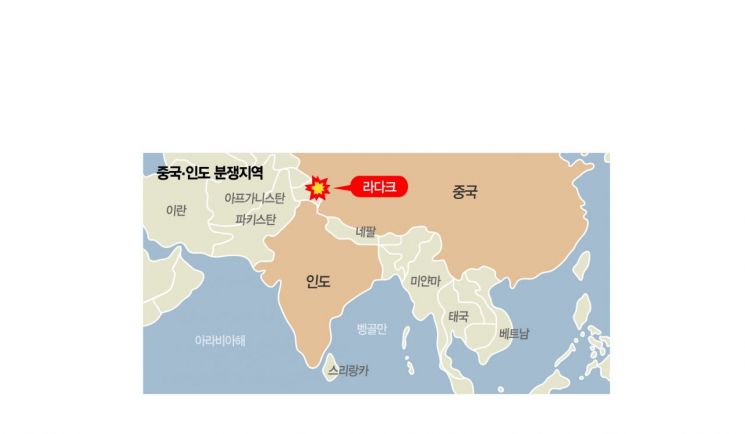
[Asia Economy Beijing=Special Correspondent Sunmi Park] The border dispute between China and India is emerging as a powder keg in the new Cold War between the U.S. and China. Although efforts to ease tensions have been made since soldiers from both countries clashed last month in the disputed Himalayan Ladakh region, the issue is becoming more complicated as it escalates as an extension of the U.S.-China confrontation.
On the 11th (local time), foreign affairs media Foreign Policy analyzed the recent standoff between China and India, stating, "The border issue between China and India, the China-Pakistan Economic Corridor being built as part of China's Belt and Road Initiative, and China's aggressive strategy to expand its influence are driving India closer to the U.S." It added, "As India joins the new Cold War framework between the U.S. and China, resolving the conflict between China and India has become more complex."
China and India have only reached a basic agreement in principle to maintain military and diplomatic accords aimed at peacefully resolving the conflict in the Ladakh region. However, no concrete measures to ease tensions between the two countries have been proposed. Although troops from both sides have withdrawn slightly from three locations within Ladakh, there has been no change in the military deployment near Pangong Lake in Ladakh, where the standoff was most severe.
China and India were once so close that the phrase "Hindi-Chini Bhai-Bhai" (India and China are brothers) was popular. This phrase was widely used in 1954 when Jawaharlal Nehru, India's first Prime Minister, met Mao Zedong in Beijing and signed the Panchsheel Treaty, which contained the five principles of peaceful coexistence between the two countries.
However, the border conflict began when Britain, which colonized India, set the McMahon Line as the border along the Himalayas in 1914. China considers this border line an unequal treaty made during the colonial era and insists that the border should be set according to traditional boundaries before British invasion. India, on the other hand, claims the McMahon Line as the border, which favors India, leading to disputes. Since the first clash in the Ladakh region in August 1959, the two countries have continued border disputes for over half a century.
Moreover, the gap between China and India has widened as China has pushed forward the Belt and Road Initiative targeting Pakistan, which is hostile to India, in recent years. China and Pakistan agreed in 2015 to develop the China-Pakistan Economic Corridor, a multi-billion-dollar project to build roads, railways, and oil pipelines over a 3,000 km stretch from Xinjiang, China, to the Gwadar port in Pakistan. In response, India is expanding infrastructure and erecting barriers in the Ladakh region, where it faces disputes with China.
Furthermore, India is strengthening its relationship with the U.S. due to concerns over China's aggressive expansion of economic and political influence in the South China Sea and the Indian Ocean. Although India has gradually moved closer to the West since the 1990s, its alignment with the U.S. has accelerated in response to China's assertive influence. The U.S. has also made India a key player in its Indo-Pacific strategy to counter China's Belt and Road Initiative.
Foreign Policy analyzed that due to India's geopolitical position in the new Cold War between the U.S. and China, the relationship between China and India is inevitably drifting further away from the "Hindi-Chini Bhai-Bhai" era. Although the two countries have shown willingness to ease border tensions through military talks, it remains uncertain whether the conflict can be easily resolved as it is intertwined with the U.S.-China new Cold War framework.
China replaced the commander in charge of the Ladakh region with Major General Xu Qiling, who is regarded as a "rising young star," and mobilized state media to emphasize military readiness against India. Anti-China sentiment is also rising in India. The Confederation of All India Traders (CAIT) launched a boycott campaign called "Indian Goods ? Our Pride" on the 10th, aiming to reduce imports of Chinese products by about $13 billion by 2021. On social media, posts and videos urging people not to buy Chinese products are spreading, intensifying the boycott movement against Chinese goods.
© The Asia Business Daily(www.asiae.co.kr). All rights reserved.
![Clutching a Stolen Dior Bag, Saying "I Hate Being Poor but Real"... The Grotesque Con of a "Human Knockoff" [Slate]](https://cwcontent.asiae.co.kr/asiaresize/183/2026021902243444107_1771435474.jpg)















