Most Retailers Welcome Holidays
Convenience Stores See Strong Sales of Expensive Products and Alcohol
[Asia Economy Reporters Hye-seon Lim, Min-young Cha] One month after the government’s emergency disaster relief funds were distributed, the retail industry experienced mixed fortunes. While most retailers smiled broadly at the consumption boost brought by the special demand from the relief funds, large discount stores alone faced a decline in sales, wearing a gloomy expression.
Large Discount Stores Missed Out on the Special Demand
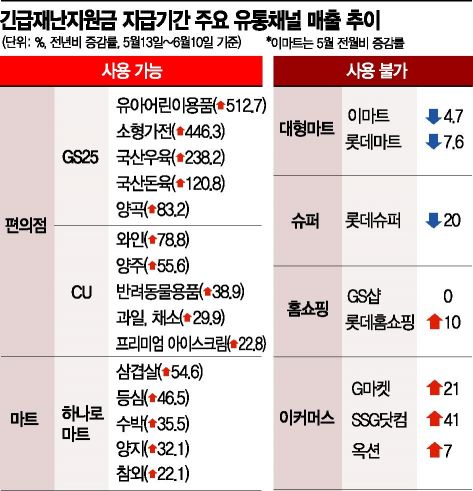
According to the retail industry on the 12th, from the 13th of last month when the relief funds were distributed until the 10th of this month, sales at large discount stores decreased by more than 4% compared to the same period last year. Lotte Mart’s total sales dropped by 7.6%. Sales of staple foods, livestock products, and alcoholic beverages fell by 10.2%, 5.4%, and 3.5% respectively compared to the same period last year. Emart also saw a 4.7% decline in sales last month. Sales of top-selling items such as livestock products, fruits, and vegetables were sluggish. Sales of beef, pork, fruits, and vegetables decreased by 13%, 11%, 12%, and 8% respectively. The government’s policy to prohibit the use of disaster relief funds at large discount stores, department stores, entertainment businesses, and online e-commerce platforms appears to have redirected consumers to stores where the funds could be used, such as Hanaro Mart, supermarkets, and convenience stores.
Beneficiaries See Sharp Sales Increase
During the same period, Hanaro Mart Yangjae branch’s sales increased by 31.9% compared to the same period last year. Sales of beef sirloin (46.5%), brisket (32.1%), pork belly (54.6%), watermelon (35.5%), and oriental melon (22.1%) performed well. These items overlap with those that underperformed at large discount stores. A Hanaro Mart representative said, "We believe the disaster relief funds contributed to the increase in sales," adding, "Once the relief funds are exhausted, the sales growth rate is expected to slow down."
In convenience stores, sales growth was significant for higher-priced products. At CU convenience stores, sales of alcoholic beverages such as wine (78.8%), whiskey (55.6%), and beer (10.6%) increased. Demand was also high for items with typically low purchase frequency, such as pet supplies (38.9%). With more people dining at home, sales of ready-to-eat meals (21.2%) and food ingredients (40.0%) also rose. At GS25, sales of children’s products (512.7%), small electronics like Bluetooth earphones (446.3%), meat (238.2%), and grains (83.2%) surged. A GS25 representative explained, "As convenience stores have evolved into neighborhood shopping platforms, customers are increasingly buying not only simple snacks but also meat and fruits," adding, "Customers using disaster relief funds tended to purchase relatively expensive products."
Among supermarkets, only GS The Fresh, where disaster relief funds can be used, saw sales increase. From the 13th to the 27th of last month, sales of grains, vegetables, and wine at GS The Fresh rose by 44.1%, 16.2%, and 20.6% respectively. In contrast, Lotte Super, where the relief funds could not be used, experienced a 20% drop in sales.
Despite disaster relief funds not being usable, e-commerce and home shopping companies either saw sales increase or maintain last year’s levels. SSG.com and Gmarket recorded sales increases of 41.0% and 21.0% respectively. Lotte Home Shopping’s sales rose by 10%, while GS Shop maintained similar levels to previous years.
This is interpreted as a continuation of the non-face-to-face (untact) trend that accelerated due to the COVID-19 pandemic.
Equity Controversy Continues
Within the retail industry, there have been ongoing criticisms regarding the fairness of where disaster relief funds can be used. The purpose of distributing the relief funds is to provide financial assistance to citizens struggling due to COVID-19 and to stimulate consumption to revitalize the local economy. However, convenience stores, which performed relatively well even after COVID-19, were included as beneficiaries of the relief funds, while large discount stores, which suffered the most, were excluded, deepening the "rich get richer, poor get poorer" phenomenon. Especially for large discount stores, about 70% of their partners are small and medium-sized businesses such as farms and fisheries, so excluding them from eligible usage locations is seen as failing to properly reflect the original intent of the relief funds. Ultimately, only large discount stores experienced a sales decline, turning concerns into reality.
Seo Yong-gu, Dean of the Graduate School of Business at Sookmyung Women’s University, pointed out, "Regardless of whether industries are eligible or not for the use of relief funds, the focus should be on common industry concerns such as economic stimulus and improving consumer convenience," adding, "It is time to give sufficient consideration to the usage locations for the fundamental purpose of the system, which is ‘revitalizing domestic consumption.’"
© The Asia Business Daily(www.asiae.co.kr). All rights reserved.
![Clutching a Stolen Dior Bag, Saying "I Hate Being Poor but Real"... The Grotesque Con of a "Human Knockoff" [Slate]](https://cwcontent.asiae.co.kr/asiaresize/183/2026021902243444107_1771435474.jpg)















