UNIST Professor Park Cheolmin's Research Team Succeeds in Synthesizing Cyclobutene Compounds
New Synthesis Technology Aids Drug Development and Side Effect Improvement Studies
 UNIST research team. Professor Park Cheol-min at the bottom left, researcher Ha Su-jin, and team members.
[Asia Economy Yeongnam Reporting Headquarters Reporter Kim Yong-woo] A technology has been developed to synthesize the skeleton that composes drugs using visible light. The new synthesis technology is expected to aid in new drug development and research to improve side effects of existing drugs.
Ulsan National Institute of Science and Technology (UNIST) announced on the 11th that Professor Park Cheol-min's research team in the Department of Natural Sciences succeeded in synthesizing ‘cyclobutene compounds’ using visible light and a photocatalyst.
Drugs have a structure consisting of a ‘skeleton’ like a tree trunk and various ‘branches’ called ‘functional groups,’ and cyclobutene is one of these ‘skeletons.’ Using the cyclobutene synthesis method developed by the research team, cyclobutene compounds can be synthesized with high efficiency without damaging the functional groups.
Drugs produce therapeutic effects by binding to molecules such as proteins present in the body and activating or inhibiting biological functions related to those molecules. The binding between drugs and biomolecules is as precise as a key and lock relationship, so synthesizing drug molecules with specific structures is very important.
Cyclobutene, a core structure of drugs and natural products, is one of the difficult skeletons to synthesize. It has a four-carbon atom square ring structure, but the bent part of the ring is unstable.
Although it can be synthesized using ultraviolet light, the high energy of ultraviolet light affects the functional groups attached to the ‘cyclobutene’ skeleton, limiting the synthesis of cyclobutene compounds with various functional groups.
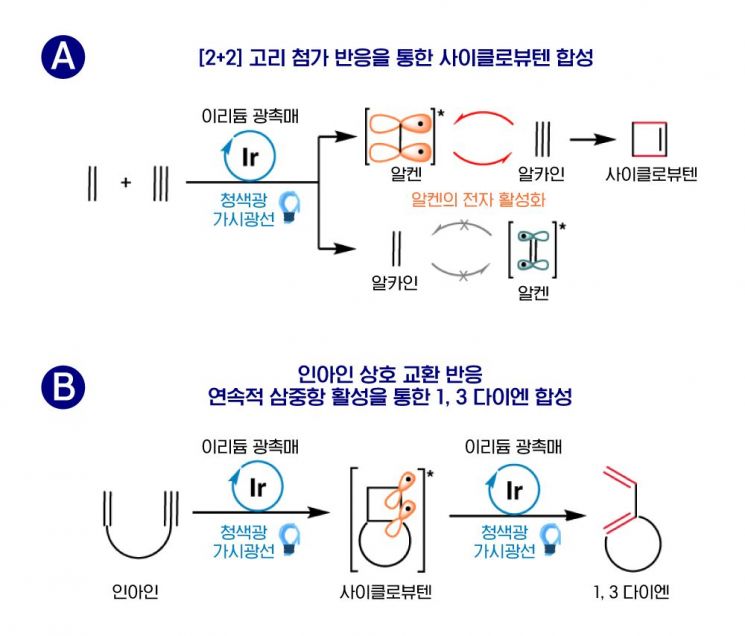
Professor Park Cheol-min’s team synthesized cyclobutene compounds using blue visible light with low energy and an iridium photocatalyst. Using this method, they obtained cyclobutene compounds with functional groups attached at up to 99% efficiency. The problem of limited types of functional groups due to damage caused by ultraviolet light was also overcome.
Researcher Ha Su-jin, a combined master's and doctoral course student in the Department of Natural Sciences, explained, “We succeeded in synthesizing cyclobutene by using ring addition reactions of ‘alkenes’ with double-bonded carbon atoms and ‘alkynes’ with triple-bonded carbon atoms.”
The research team elucidated the principle of cyclobutene synthesis by visible light and iridium photocatalyst using density functional theory. It was revealed that the iridium photocatalyst, excited by the energy of visible light, activated the electrons of ‘alkenes’ first rather than ‘alkynes,’ causing the ring addition reaction.
Professor Park Cheol-min said, “Through this research, we developed a new synthesis method for cyclobutene, a core structure of various drugs and natural products. Using the developed synthesis method, cyclobutene skeletons with various functional groups can be created, which can be used not only for drugs but also for the development of various chemical products.”
This research was supported by the National Research Foundation of Korea and UNIST. The research results were published on May 19 (local time) in the world-renowned academic journal ‘Nature Communications.’
© The Asia Business Daily(www.asiae.co.kr). All rights reserved.
![Clutching a Stolen Dior Bag, Saying "I Hate Being Poor but Real"... The Grotesque Con of a "Human Knockoff" [Slate]](https://cwcontent.asiae.co.kr/asiaresize/183/2026021902243444107_1771435474.jpg)

















