Official Plan Confirmed for More Than 3 Icebreakers and 4 New Polar Military Bases
Trump Signs Polar National Interest Memorandum
Russia Has 9 Times More Icebreakers Than the US...Threat to Alaska Defense
China Accelerates Arctic Expansion Following 'Ice Silk Road' Declaration
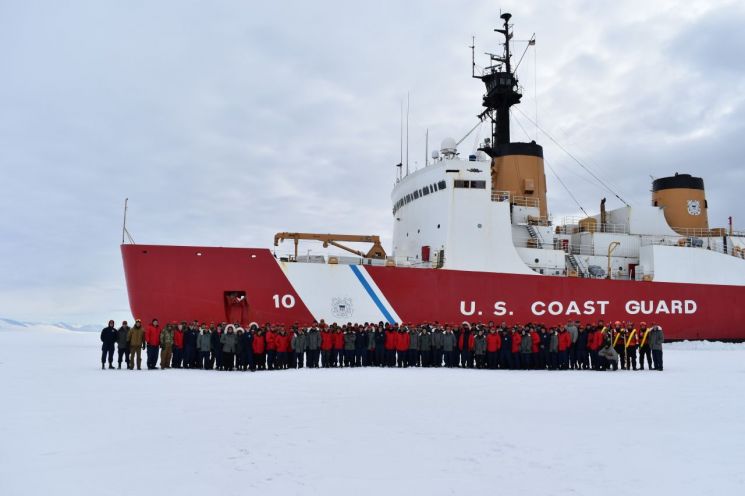 An image of the US Coast Guard (USCG) icebreaker Polestar. [Image source: USCG official website/www.uscg.mil]
[Asia Economy Reporter Lee Hyun-woo] The U.S. government has officially announced plans to build large icebreakers and construct military bases in polar regions. Following Russia, which possesses the world's largest icebreaker fleet and has established military bases across the Arctic, and China, which has revealed plans to advance by building a 'Ice Silk Road' in the Arctic Ocean, the U.S. has also entered the competition. This signals the possibility of a new Cold War among major powers expanding into a struggle for control over the polar regions.
On the 9th (local time), the White House announced on its website that President Donald Trump signed a "Memorandum on Protecting National Interests in the Arctic and Antarctic Regions." The memorandum outlines plans to build at least three large icebreakers, including nuclear-powered icebreakers, to strengthen the U.S. polar fleet capabilities, and to establish four new military bases in polar areas such as Alaska. This is the first time the U.S. government has revealed concrete plans to enhance its military capabilities in the polar regions. The plan involves the participation of the U.S. State Department, Department of Defense, Department of Energy, Department of Commerce, and Department of Homeland Security, with each agency expected to develop detailed plans within the next two months to achieve the goals by 2029.
The decision to significantly strengthen U.S. military power in the polar regions is widely interpreted as a response to Russia's military buildup in the Arctic. According to the U.S. political media outlet The Hill, the U.S. Coast Guard (USCG) reports that Russia possesses 46 icebreakers, more than nine times the U.S. fleet of five. Since 2015, Russia has established the Arctic Command and built 15 large military bases in the Arctic region, along with constructing dozens of icebreakers, including ultra-large nuclear-powered icebreakers with a displacement of 30,000 tons. In contrast, the U.S. has no large military bases in the polar regions, including Alaska, and currently has no new icebreakers under construction.
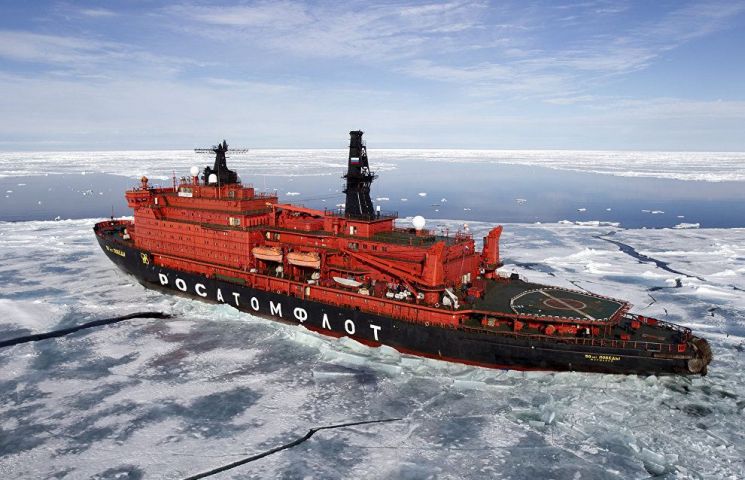 The Russian nuclear-powered icebreaker Arktika [Image source=Rosatom official website/www.rosatom.ru]
During former President Barack Obama's administration, the U.S. retired several aging icebreakers out of its fleet of seven, citing environmental protection in the polar regions, and canceled all new construction plans. The Navy's 2nd Fleet, which was responsible for polar security, was also disbanded. However, this stance changed 180 degrees after the Trump administration took office. As Russia's military buildup in the polar regions emerged as a tangible threat, the 2nd Fleet was reestablished in 2018, and discussions on replenishing icebreakers began in earnest.
The U.S. Department of Defense anticipates that due to global warming, the ice in the Bering Strait between Alaska and Siberia will remain in a thawed state for up to six weeks or more, raising significant security concerns for Alaska. Thinning ice has made it easier for Russian nuclear-powered submarines to operate near the Alaskan coast. The U.S. Coast Guard is reportedly considering installing anti-air missile bases in Alaska to defend its territory.
Besides security, the vast underground resources are another major reason both countries are vying for control over the Arctic. The U.S. Geological Survey (USGS) estimates that the Arctic region holds about 90 billion barrels of oil, accounting for 15% of the world's oil reserves, and 1,670 trillion cubic meters of natural gas, representing 30% of global natural gas reserves. Notably, the main resource deposits are located in areas where the Exclusive Economic Zones (EEZ) of the U.S. and Russia in the Arctic Ocean overlap. This increases the likelihood of military conflict between the two nations.
China has also shown great interest in advancing into the Arctic. Last year, the U.S. and China engaged in fierce competition over Greenland. In February of last year, the Chinese government attempted to provide $500 million in funding through state-owned banks for a new airport construction project by the Greenlandic autonomous government, in exchange for establishing exploration bases along Greenland's coast. However, this plan was thwarted by U.S. opposition. In August of the same year, President Trump personally inquired with the Danish government about purchasing Greenland.
In 2018, the Chinese government released a white paper on Arctic policy, declaring its intention to build an Ice Silk Road connecting China, the Arctic, and Europe as part of the Belt and Road Initiative. China received small nuclear reactor technology for ships from Russia and constructed nuclear-powered icebreakers. This is interpreted as a move to preemptively control not only Arctic resources but also Arctic shipping routes.
© The Asia Business Daily(www.asiae.co.kr). All rights reserved.
![Clutching a Stolen Dior Bag, Saying "I Hate Being Poor but Real"... The Grotesque Con of a "Human Knockoff" [Slate]](https://cwcontent.asiae.co.kr/asiaresize/183/2026021902243444107_1771435474.jpg)
















