
[Asia Economy Reporter Lee Chun-hee] As the population living in multi-family housing (apartments) continues to increase, the government has announced plans to change the timing of inter-floor noise measurement to just before completion in order to address the worsening issue of noise between floors. This decision comes in response to criticisms that the current pre-approval system, which relies on laboratory experiments, lacks effectiveness.
The Ministry of Land, Infrastructure and Transport (MOLIT) announced on the 9th the 'Post-Verification System for Floor Impact Sound Insulation Performance in Multi-Family Housing' to more effectively improve the inter-floor noise problem.
Currently, since 2005, MOLIT has been implementing the 'Floor Structure Approval System,' which conducts pre-experiments on floor impact sounds, the main causes of inter-floor noise, such as 'light impact sound' generated by dragging furniture or dropping objects, and 'heavy impact sound' caused by children running around. This involves creating floor structures similar to actual housing inside laboratories at institutions like Korea Land and Housing Corporation (LH) or the Korea Institute of Civil Engineering and Building Technology, measuring noise, and assigning ratings.
However, the Board of Audit and Inspection revealed in May last year that measurements of inter-floor noise in 191 households across 28 complexes nationwide showed that 184 households (96%) had performance levels lower than the pre-approved noise insulation grades. Notably, 114 households (60%) failed to meet the current minimum performance standards of 58 dB for light impact sound and 50 dB for heavy impact sound. This exposed the limitations of pre-certification based on laboratory-constructed structures rather than actual constructed housing.
In response, MOLIT stated at the time, "We plan to establish a method to measure insulation performance post-construction to encourage the development of improved insulation technologies and ensure solid construction." After undergoing research and development (R&D), the 'post-verification system' that measures floor impact sound insulation performance after floor finishing installation and before the application for use inspection has now taken shape.
The newly implemented post-verification system will apply to all multi-family housing complexes with 30 or more households that require project plan approval. Before the use inspection application, which is part of the apartment completion process, a sample of households will be selected per complex, and the average floor impact sound insulation performance measured in these households will be calculated. The use inspection authority, such as the mayor or district head, will be mandated to verify this. However, exemptions will be considered for studio apartments where the likelihood of floor impact sound is significantly low and for buildings with frame structures that guarantee excellent insulation performance. If the insulation performance falls below the standard, the use inspection authority will order supplementary measures such as additional installation of soundproofing materials.
However, since these supplementary measures will be conducted at the final stages of construction, the possibility of post-construction remediation is limited, so they will be recommended rather than mandatory. Lee Yuri, Director of the Housing Construction Supply Division at MOLIT, explained, "Especially for heavy impact sound, performance improvement after construction is limited, which may prolong disputes," adding that even if the measures remain recommendations, "additional sanctions such as public disclosure are possible if not implemented." She also noted, "In a market dominated by pre-sale, construction companies will inevitably be influenced by being identified as excellent or poor performers in inter-floor noise insulation, which will naturally encourage solid construction."
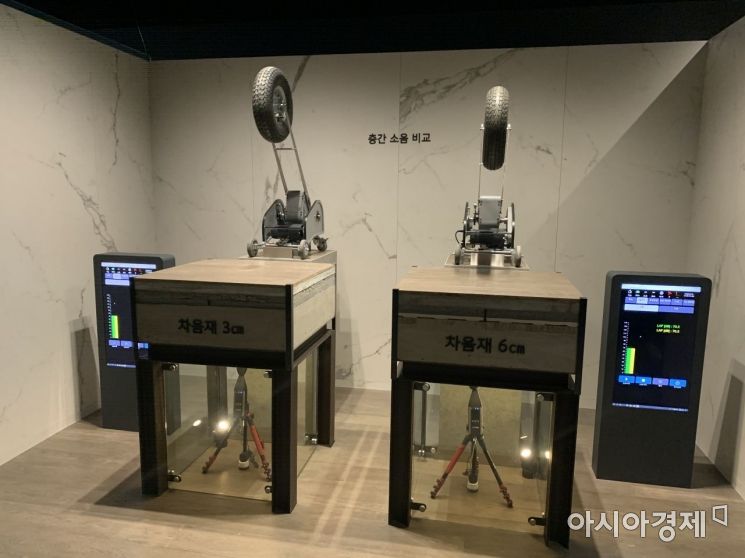
Detailed measurement methods will also be improved. Currently, heavy impact sound caused by children running or heavy objects falling is measured using the 'Bang Machine' method, which drops a tire from a height of 85 cm. However, this will be changed to the 'Impact Ball' method, which involves freely dropping a rubber ball about the size of a volleyball weighing approximately 2.5 kg from a height of 1 meter. This method was introduced by ISO (International Organization for Standardization) in April and is known to have higher similarity to real-life impact sources such as children running.
The target sample size for measurement is set at 5% of the total households. MOLIT explained that although ISO recommends a 10% sample size, the standard was relaxed to 5% due to the high proportion of identical floor plans within domestic apartment complexes.
However, considering that currently only two specialized institutions?the Korea Institute of Construction & Living Environment Test and Research and the Korea Research Institute of Ships and Ocean Engineering?can conduct measurements, the initial implementation will start with a 2% sample size. The plan is to expand measurement capabilities to private institutions and gradually increase the sample size to 5%.
MOLIT plans to establish an 'Inter-floor Noise Performance Center' (tentative name) to oversee the post-verification process, ensuring fair and transparent selection of sample households and measurement procedures, with public management and supervision. After accumulating performance measurement data over a certain period, the ministry will annually announce construction companies with excellent performance and apply benefits such as relaxed sample application ratios.
To implement the system, MOLIT intends to amend the Housing Act within this year, conduct surveys, and finalize performance standards by 2022. From July 2022, the post-verification system will apply to multi-family housing projects receiving project plan approval. The existing pre-approval system will be abolished in conjunction with the new system.
Lee Yuri, Director of the Housing Construction Supply Division at MOLIT, said, "This system improvement focuses on more accurately measuring actual living noise that citizens experience and reducing daily inconveniences." She added, "We expect it to serve as a catalyst to promote technological development and solid construction in the construction industry, thereby enhancing performance." She concluded, "We will promptly proceed with system refinement and technology development to ensure the smooth implementation of the post-verification system."
© The Asia Business Daily(www.asiae.co.kr). All rights reserved.
![Clutching a Stolen Dior Bag, Saying "I Hate Being Poor but Real"... The Grotesque Con of a "Human Knockoff" [Slate]](https://cwcontent.asiae.co.kr/asiaresize/183/2026021902243444107_1771435474.jpg)















