Government Controversy Over the 'Anti-North Korea Leaflet Law'
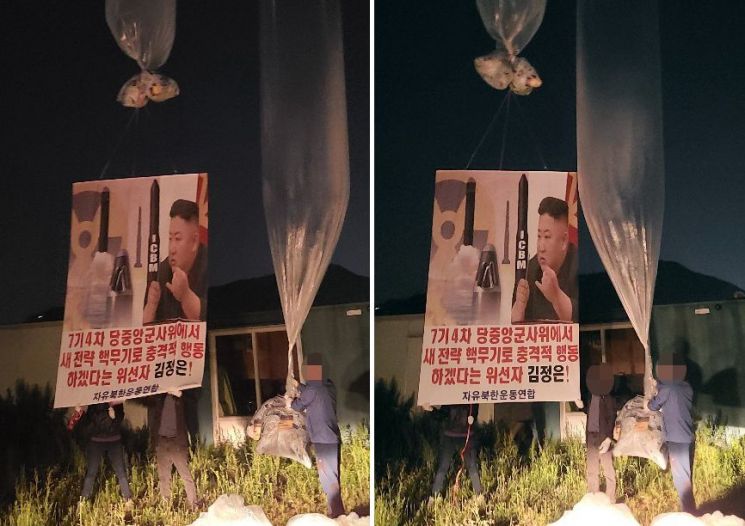 The North Korean defector organization, the Free North Korea Movement Alliance, announced on the 1st that on the 31st of last month, they sent 500,000 leaflets titled "Kim Jong-un Threatens to Launch New Strategic Nuclear Weapons," 50 booklets, 2,000 one-dollar bills, and 1,000 memory cards (SD cards) attached to 20 large balloons from Wolgot-ri and Seongdong-ri in Gimpo City toward North Korea.
The photo shows the North Korean defector organization distributing leaflets to North Korea.
The government has begun preparing legislation to ban the distribution of leaflets to North Korea, intensifying the 'intra-South conflict' surrounding the issue. On one side is the argument that leaflet distribution cannot be stopped under the constitutional value of freedom of expression, and on the other is the opinion that no value takes precedence over the safety and lives of the people. The government intends to harmoniously reflect both values in the bill, but due to sharp disagreements, it is expected to take considerable time before the legislation is enacted.
On the 4th, Professor Kim Geun-sik of Gyeongnam National University argued that "in a liberal democratic country, there is no way to block leaflet distribution," calling the government's ban on leaflet distribution to North Korea an excessive legislative measure. He emphasized, "I believe the effectiveness of leaflets to North Korea is not high, but regardless of effectiveness or the rightness of the means, under the constitutional value of freedom of expression, the act of distributing leaflets cannot be restricted by anything."
International human rights organizations also expressed critical views on the government's recent move.
Phil Robertson, Deputy Director for Asia at Human Rights Watch (HRW), said in an interview with RFA, "North Korea does not respect the South Korean government, so it is absurd that after the statement, the Ministry of Unification hastily announced it would see what legal measures it could take to stop (leaflet distribution to North Korea)." He added, "The South Korean government should seriously consider changing its strategy."
He described leaflet distribution as a harmless activity and said, "If the Ministry of Unification strictly cracks down on defectors' (leaflet distribution) activities, it would be very regrettable."
On the other hand, there are many voices that the existential threat posed by leaflet distribution to North Korea cannot be overlooked.
Hong Min, Director of the North Korea Research Division at the Korea Institute for National Unification, said, "Whenever leaflet distribution to North Korea is announced, residents in border areas such as Paju and Yeoncheon feel a very real threat to their lives," adding, "Freedom of expression should not be ignored, but the right to life and safety is also important."
He also suggested that the government should block a defector group’s announcement to distribute one million leaflets to North Korea on the 70th anniversary of the Korean War. Hong said, "In the past, when leaflet distribution was announced, North Korea made highly threatening statements, escalating tensions," and added, "We must not prioritize freedom of expression alone and put the safety of all South Korean citizens at risk."
In this situation, finding common ground seems difficult. In fact, the need for legislation related to leaflet distribution to North Korea has been raised before, but it has never passed the National Assembly.
In 2008, Park Joo-sun, then a member of the Democratic Party, proposed an amendment to the 'Inter-Korean Exchange and Cooperation Act' requiring notification to the Minister of Unification before distributing leaflets to North Korea, but it did not even reach the plenary session.
After an incident in October 2014, when North Korea fired flare guns at leaflets launched by a defector group from Yeoncheon, Gyeonggi Province, and the military responded, significantly escalating military tensions, similar bills were proposed but again failed to pass the National Assembly.
Hong said, "The Ministry of Unification’s push for legislation is fully justified," but added, "However, consensus between the ruling and opposition parties is necessary, and it is doubtful whether this process will pass easily."
Meanwhile, amid rising tensions on the Korean Peninsula with North Korea issuing warnings that the situation could reach a 'worst phase' if leaflet distribution does not stop, the United Nations (UN) expressed hope for the resumption of inter-Korean dialogue.
UN Secretary-General Ant?nio Guterres stated on the 4th (local time), "I have repeatedly supported the reopening of dialogue channels between the two Koreas," and "I welcome and support constructive measures by the parties involved," according to the U.S. Radio Free Asia (RFA).
This statement reflects the position that rather than entering a tense phase following North Korean Workers' Party First Deputy Director Kim Yo-jong’s criticism of leaflet distribution and warning of the possible termination of the military agreement, the two Koreas should engage in dialogue.
© The Asia Business Daily(www.asiae.co.kr). All rights reserved.
![Clutching a Stolen Dior Bag, Saying "I Hate Being Poor but Real"... The Grotesque Con of a "Human Knockoff" [Slate]](https://cwcontent.asiae.co.kr/asiaresize/183/2026021902243444107_1771435474.jpg)















