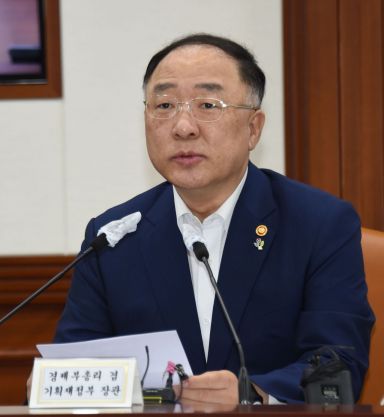
 Hong Nam-ki, Deputy Prime Minister and Minister of Economy and Finance, is delivering opening remarks while presiding over the '2nd Innovation Growth Strategy Meeting' held on the 4th at the Government Seoul Office in Gwanghwamun, Seoul.
[Asia Economy Reporter Joo Sang-don] Hong Nam-ki, Deputy Prime Minister and Minister of Economy and Finance, announced on the 4th, "We have selected three tasks?urban domestic shared lodging, development and utilization of vacant houses in rural fishing villages, and forest tourism?as candidates for the Han-geureum model, and we will promote discussions aiming to establish successful cases within this year."
Deputy Prime Minister Hong made these remarks while presiding over the 2nd Innovation Growth Strategy Meeting and the 21st Economic Ministers’ Meeting held at the Government Seoul Office on the same day.
Hong Nam-ki explained, "The Han-geureum model is a social compromise mechanism for coexistence that takes a bigger step forward through mutual concessions between parties and, if necessary, government mediation support when the introduction of new businesses is delayed due to conflicts of interest in new industry and new business areas," adding, "I hope the launch of the Han-geureum model will serve as a foundation to take a further step forward in 'innovation through coexistence.'"
The government plans to expand the application of the Han-geureum model in the future when conflict resolution is needed regarding the introduction of new businesses such as the sharing economy or non-face-to-face services.
The meeting also discussed innovative measures for foreign exchange services. Although innovative attempts are focused on convergence, non-face-to-face currency exchange, and remittance services, it was judged that qualitative innovation expansion is restricted due to entry and business regulations and prohibition of consignment.
Accordingly, the government decided to fully allow consignment of currency exchange and remittance operations and sharing of remittance networks among small remittance operators. Banks will be able to deliver foreign currency exchanged to customers through courier services, parking lots, airlines, etc., and small remittance operators will be able to deliver remittance funds to customers via ATMs. Additionally, the government will confirm within 30 days whether new foreign exchange services are subject to regulations and, if necessary, establish a new rapid confirmation and exemption system for new business regulations that exempts regulations across the industry. To promote competition among foreign exchange service providers, the government will expand currency exchange and remittance operations of securities and card companies and relax entry requirements for fintech companies in foreign exchange services. The government plans to immediately implement related authoritative interpretations and complete revisions to the Foreign Exchange Transactions Act Enforcement Decree and related regulations by September.
© The Asia Business Daily(www.asiae.co.kr). All rights reserved.

















