At the National Museum of Modern and Contemporary Art Cheongju until October 4
[Asia Economy Reporter Byunghee Park] The National Museum of Modern and Contemporary Art (MMCA) is holding the first half of the year special exhibition introducing art conservation science, "Conservator C's Day," at the MMCA Cheongju until October 4.
The life cycle of an artwork consists of collection, exhibition, and conservation/restoration. "Conservator C's Day" is an exhibition introducing the "conservation/restoration" phase of an artwork's life cycle, revealing the often unseen stories of conservation science at museums through the exhibition. The "C" in the exhibition title refers both to "Conservator" and "Cheongju," and simultaneously serves as the third-person honorific suffix "-ssi."
From the moment of creation, artworks undergo changes and damage due to environmental and physical influences, but through the touch of a conservator, they regain life. "Conservator C's Day" approaches conservation science by focusing on the conservator at the center of this process, looking into the daily life of the fictional character "Conservator C." From the planner’s perspective, the exhibition takes a humanistic approach to the daily life of a conservator, visualizing the daily routines and concerns of one individual who performs conservation and restoration within various relationships among artists, artworks, and audiences. This exhibition aims to view the "science" of contemporary art conservation from cultural and artistic perspectives.
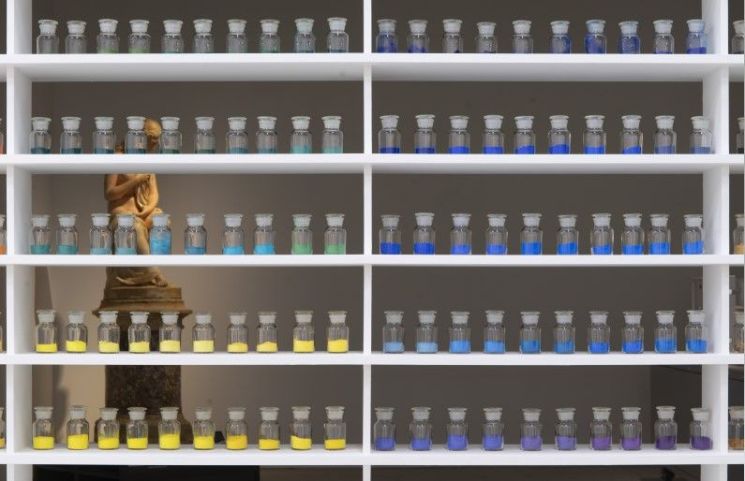 Installation view of over 500 types of various pigments
 Photo by National Museum of Modern and Contemporary Art
The exhibition is organized into five themes based on key words that represent a conservator’s day: wounds, tools, time, concerns, and thoughts. These are presented as "C Facing Wounds," "C's Tools," "C Stacking Time," "C's Concerns," and "C's Study."
"C Facing Wounds" is a space where visitors can empathize with the emotions of a conservator who routinely confronts the physical damage of artworks. In an empty, dark space, only the sounds created by sound artist Han-gil Ryu resonate. In this visually excluded space, various sounds reminiscent of material damage?such as mechanical noises and ruptures?evoke tension and anxiety.
"C's Tools" recreates the scene of a conservation science laboratory by exhibiting actual conservation tools, pigments, analytical data, and reinterpreted images together. Artist Jisoo Kim collected the scents of the Cheongju conservation science lab and the body odor of conservators during her visits and installed them in glass bottles. Artist Jeong Jeong-ho introduces photographic works focusing on various scientific equipment in the conservation lab from new perspectives. Artist Jae-beom Joo presents animation videos using pixels, the smallest units of images.
In the "C's Tools" space, hundreds of pigments, optical instruments such as microscopes, and analytical data are displayed together to show the reality of a conservator. Notably, analysis graphs tracking changes in the composition of white pigments from the 1920s to the 1980s were created by analyzing oil paintings by Gu Bon-ung (1906?1953) and Oh Ji-ho (1905?1982), representatives of modern and contemporary Korean Western painting. Three-dimensional graphs visualizing the chemical properties of paints differing by manufacturer demonstrate the "science" aspect of conservation science. Additionally, analysis methods using ultraviolet, infrared, and X-rays reveal hidden images in paintings invisible to the naked eye. Particularly, X-ray imaging uncovered images presumed to be a house and fence in Gu Bon-ung’s 1940 work "Woman," and a hidden female figure in Oh Ji-ho’s 1927 work "Landscape."
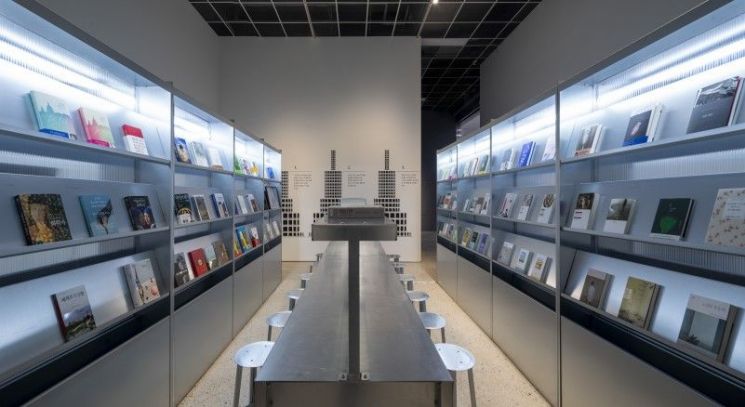 Installation view of Zero Lab's 'C's Library (2020)' [Photo by National Museum of Modern and Contemporary Art]
"C Stacking Time" exhibits actual artworks from the MMCA collection that have undergone conservation treatment, along with videos documenting the restoration process. The restoration of Niki de Saint Phalle’s (1930?2002) "Black Nana (Lara, 1967)," which suffered severe surface discoloration and flaking due to outdoor exhibition, introduces methodologies for conserving contemporary art. Additionally, soap sculpture works such as Mikyung Shin’s "Venus (1998)" demonstrate the material characteristics of contemporary art and the multi-faceted experimental conservation and restoration processes.
"C's Concerns" visualizes the various dilemmas conservators face during the conservation and restoration process. It particularly addresses the challenges of restoring new media artworks that use TV as a medium, focusing on the acceptance of new technologies and equipment. Artist Jongdeok Woo presents three differing opinions on the restoration issues of Nam June Paik’s work "Electronic Superhighway (1988)" through a video installation. The video, split into three channels featuring one person expressing different views, illustrates the process of a conservator contemplating and finding direction while performing restoration.
"C's Study" is the research space of a conservator who preserves and restores fluid contemporary art. It displays novels, art and science books, and other materials that reflect the sensibility of Conservator C, who is both a scientist and possesses a background in the humanities.
The "Conservator C's Day" exhibition can also be experienced through a "Curator Exhibition Tour" video on the YouTube channel. The tour, featuring explanations by curator Yujin Kim and vivid footage of the exhibition space, will be broadcast live for 30 minutes starting at 4 p.m. on July 2. The video will remain available on YouTube after the live broadcast.
© The Asia Business Daily(www.asiae.co.kr). All rights reserved.
![Clutching a Stolen Dior Bag, Saying "I Hate Being Poor but Real"... The Grotesque Con of a "Human Knockoff" [Slate]](https://cwcontent.asiae.co.kr/asiaresize/183/2026021902243444107_1771435474.jpg)

















