Constructed as a Free Trade Port Realizing Market Opening and Trade and Investment Liberalization
 [Image source=Yonhap News]
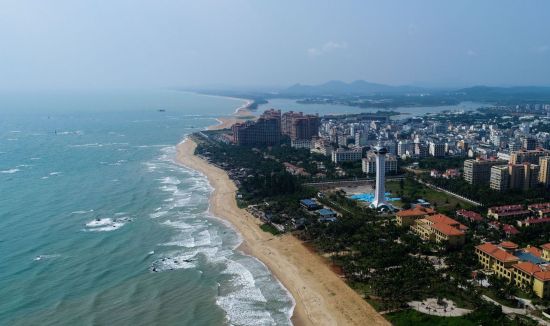
[Asia Economy Beijing=Special Correspondent Park Sun-mi] The Chinese government has concretized plans to develop the southern island of Hainan into a free trade port where market opening and trade and investment liberalization are realized. This plan to establish a free trade port comes amid international concerns that Hong Kong's status, once a symbol of openness and liberalization during the legislative process of the Hong Kong National Security Law (Hong Kong Security Law), may be shaken.
On the 1st (local time), the Communist Party of China and the State Council jointly released the document titled "Overall Plan for the Construction of Hainan Free Trade Port." This is 1 year and 8 months after officially designating Hainan as a free trade pilot zone in October 2018 and announcing plans to develop it into a free trade port in the long term.
The construction of the Hainan Free Trade Port aims to build Hainan into a globally influential, high-quality free trade port by 2050. The scope of application covers the entire Hainan Island. First, by 2025, a basic system for the free trade port focusing on trade and investment liberalization will be established, and by 2035, the plan is to achieve freedom and convenience in domestic and foreign capital movement, entry and exit, and logistics, thereby further maturing the operational level of the free trade port.
The Hainan Free Trade Port development plan is one of the reform and opening-up projects personally led by Chinese President Xi Jinping, alongside the construction plan of the Xiong'an New Area near Beijing. President Xi first revealed the concept of building the Hainan Free Trade Port at the Boao Forum for Asia in April 2018.
On the day the document containing the Hainan Free Trade Port construction plan was released, President Xi said, "The construction of the Hainan Free Trade Port is a significant policy," and instructed, "A high-quality, high-level free trade port must be built." The document also states, "Amid the rise of protectionism and unilateralism and significant headwinds against economic globalization, China will support globalization and take practical actions to build a community with a shared future for mankind through the construction of the Hainan Free Trade Port."
On the 2nd, Xinhua News Agency explained that the Chinese government is pushing forward the plan with the expectation that Hainan, which will become the largest economic special zone, can be at the forefront of integration into the global economic system. On the same day, state-run media such as Xinhua News Agency and People's Daily prominently featured the Hainan Free Trade Port construction plan, reflecting the importance of the matter.
According to the document, Hainan will be granted greater autonomy in reforms, and laws and regulations will be applied more flexibly and efficiently than in other regions of China. Institutional obstacles that hinder production will be removed, and policies supporting national strategic goals in terms of institutional innovation, growth promotion, and expansion of openness will be prioritized. To achieve the promotional effects of the Belt and Road Initiative, exchanges and cooperation with Southeast Asian countries will be strengthened, and joint development with the Taiwan region, encompassing Guangdong-Hong Kong-Macao, will also be promoted.
Specifically, to secure human resources, individual income tax for talents will be capped at 15%, and corporate income tax for enterprises in key nurturing industries will be lowered to 15%. The goal is to develop Hainan into a "zero-tariff" zone with no customs duties imposed, starting with tariff exemptions on certain imported goods. Import tariff exemptions will be applied to production equipment and transportation means imported by enterprises for their operations. Import tariffs and various exhibition goods import tariffs and sales taxes on raw materials for production will also be exempted.
The annual duty-free shopping limit per person will be raised to 100,000 yuan (approximately 17 million KRW), more than triple the previous limit. To actively attract foreign investment, the negative list for market entry will be minimized, and foreign companies will be treated the same as Chinese companies in government procurement projects. The plan also includes goals for a higher level of financial sector opening compared to other regions in China, aiming to develop Hainan as a trading venue for energy, shipping, stocks, and more.
Meanwhile, the announcement of the Hainan Free Trade Port construction plan amid growing anxiety over Hong Kong's status due to the forced enactment of the Hong Kong Security Law is analyzed as China preparing an alternative to Hong Kong, emphasizing market opening and liberalization to strengthen its image as a defender of free trade against the United States.
Since President Xi revealed the plan for the Hainan Free Trade Port, development in Hainan has accelerated. According to data from the Hainan provincial government, 338 foreign-funded enterprises were established in Hainan in 2019, a 102.5% increase compared to the previous year. These enterprises are spread across various industries such as trade, investment, healthcare, and logistics. From January to April this year, the actual foreign investment execution amount in Hainan was 316 million USD, a 252.3% increase compared to the same period last year.
© The Asia Business Daily(www.asiae.co.kr). All rights reserved.
















