2020 Second Half Economic Policy Direction
KRW 13.4 trillion fiscal investment in Digital New Deal by 2022... Creation of 330,000 jobs
KRW 12.9 trillion and 133,000 jobs in Green New Deal
'Korean New Deal Comprehensive Plan' to be finalized and announced in July
Future power of Big 3 industries: Bio, System Semiconductors, Future Cars
Promotion of GVC hub through reshoring and attraction of advanced industries
[Sejong=Asia Economy Reporter Ju Sang-don] The government has decided to invest KRW 76 trillion in the Korean New Deal, centered on 'Digital' and 'Green', by 2025 to create 550,000 jobs. In addition, it will future-proof the Big 3 industries?bio, system semiconductors, and future cars?while actively promoting the reshoring of companies that moved overseas and strengthening research and development (R&D) in advanced industries to establish a global value chain (GVC) hub.
On the afternoon of the 1st, the government announced the 'Second Half of 2020 Economic Policy Direction' at a joint briefing with ministers from related ministries at the Government Seoul Office, containing these details.
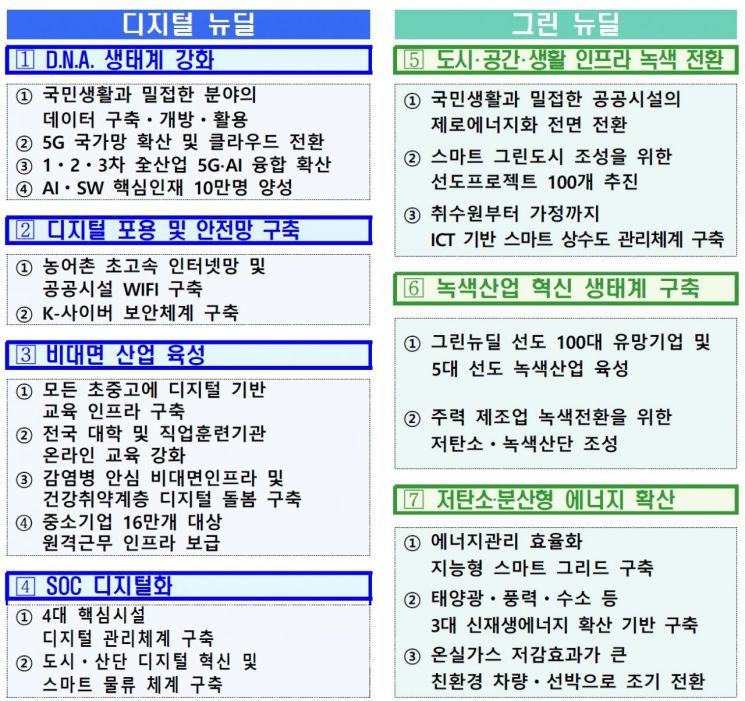
◆ KRW 31.3 trillion invested in Korean New Deal by 2022 as a priority = The government plans to invest a total of KRW 76 trillion in the Korean New Deal by 2025, initially injecting KRW 31.3 trillion by 2022 to create 550,000 jobs. Subsequently, it will invest another KRW 45 trillion from 2023 to 2025. The core of the Digital New Deal is strengthening the 'D.N.A.' ecosystem of data, networks, and artificial intelligence (AI). KRW 6.4 trillion in fiscal funds will be invested by 2022 to create 222,000 jobs. Specifically, it will build big data platforms in 15 sectors and open 140,000 public data sets, add 700 types of AI training data, and focus on data construction, opening, and utilization in areas closely related to citizens' lives. It will also pilot the conversion of work networks of 15 central ministries and local governments to 5G, convert 15% of administrative information systems to cloud server-based systems, and establish 15 core cloud service platforms. AI graduate schools will be expanded, and innovation squares and academies will be increased to prepare a Korean AI innovation education model tailored to companies, along with strengthening AI education for industry professionals, aiming to nurture 100,000 AI and software (SW) core talents.
For digital inclusion and safety net construction, KRW 800 billion in fiscal investment will create 15,000 jobs by 2022. High-speed internet networks will be supplied to 1,300 rural fishing villages and remote areas, and a 'K-Cyber Security System' will be established by supporting security consulting and system advancement for 2,500 small and medium enterprises (SMEs). For fostering non-face-to-face industries, KRW 1.4 trillion will be invested by 2022 to create 28,000 jobs. Wi-Fi will be installed in all classrooms (380,000 rooms), 200,000 outdated laptops over five years old will be replaced, and tablet PCs will be provided to 240,000 students in 'digital textbook online pilot schools' across elementary, middle, and high schools to build digital-based educational infrastructure. All 39 national universities nationwide will replace outdated servers and network equipment, and 10 regional future education centers and remote education support centers will be established. Remote work infrastructure will also be supplied to 160,000 SMEs. Controversial remote medical care was not included in this economic policy direction. Instead, it includes installing 1,000 respiratory clinics dedicated to infectious disease response, providing mobile healthcare at public health centers for 130,000 health-vulnerable people to improve lifestyle habits, distributing wearables to 170,000 mild chronic disease patients, advancing neighborhood clinic-centered health management systems, and piloting integrated care using IoT and AI for 120,000 vulnerable elderly, under the 'Establishment of infection-safe non-face-to-face infrastructure and digital care system for health-vulnerable groups.'
Digitalization of social overhead capital (SOC) will also be pursued. KRW 4.8 trillion will be invested by 2022 to create 65,000 jobs. Digital safety management systems will be established for four core facilities: transportation, water resources, common ducts (underground tunnels housing water, sewage, telephone cables, gas pipes, etc.), and disaster response. Digital innovation in cities and industrial complexes and smart logistics systems will also be promoted.
◆ Green New Deal: Infrastructure green transition and low-carbon energy diffusion = The other pillar of the Korean New Deal, the Green New Deal, focuses on upgrading aging public infrastructure to energy-efficient facilities. Green remodeling will be conducted on four major aging public buildings: 1,058 daycare centers, 1,045 public health centers, 67 medical institutions, and 186,000 public rental housing units. Additionally, 51 living SOC facilities, 30 national and public daycare centers, and 37 environmental basic facilities will be improved to energy-efficient facilities. All 55 national schools (kindergarten, elementary, middle, and high schools) will be converted into 'Green Smart Schools' through solar power, eco-friendly insulation materials, classroom Wi-Fi, and educational tablet PC support. Leading projects (100) for smart green city creation will be promoted, and an ICT-based smart water supply management system from water sources to households will be established. KRW 5.8 trillion in fiscal funds will be invested by 2022 to create 89,000 jobs in this urban, spatial, and living infrastructure green transition.
Additionally, KRW 5.4 trillion will be invested by 2022 to build intelligent smart grids for energy management efficiency, establish a foundation for the diffusion of three major renewable energies?solar, wind, and hydrogen?and accelerate early conversion to eco-friendly vehicles and ships with significant greenhouse gas reduction effects. This will create 33,000 jobs.
◆ Employment stability as the foundation of Digital and Green New Deals = The government announced employment stability measures alongside the Korean New Deal centered on digital and green. KRW 900 billion will be invested by 2022 to establish a nationwide employment safety net. To apply employment insurance to special types of workers, legal amendments will be pursued within this year, supporting employment insurance enrollment for artists and special types of workers. The number of special types of workers covered by industrial accident insurance will expand from 9 to 14 by adding door-to-door salespersons, rental product inspectors, home appliance installation technicians, and freight truck owners. In January next year, the National Employment Support System will be fully introduced, providing employment support services (counseling, vocational training, etc.) and job-seeking promotion allowances (up to KRW 3 million) to vulnerable employment groups, including those not enrolled in employment insurance. To reduce the burden of business closure and provide a foundation for re-challenge for micro small business owners, consulting, education, allowances, and mentoring will be supported.
The government plans to finalize and announce a comprehensive plan containing detailed projects by July this year, supplementing and expanding additional tasks.
◆ Future power of Big 3: Bio, System Semiconductors, Future Cars = The government will innovate the bio industry ecosystem and nurture related talents. Digital therapeutics will be included in the innovative medical technology evaluation system within the new medical technology assessment framework to support early market entry, and support will be promoted for related industries such as green bio and advanced regenerative medicine. Talent development will proceed through fostering physician-scientists specialized in bio research rather than clinical doctors, expanding public medical personnel by establishing a national public health medical university, building institutions for bio-process professional training, expanding AI drug development education for domestic pharmaceutical companies, and promoting AI-based candidate substance discovery projects.
This month, six system semiconductor design support centers will be established to serve as comprehensive hubs for companies and investors to exchange information and collaborate. By the third quarter of this year, three or more autonomous driving pilot zones will be introduced, and pilot operations of autonomous driving mobility services will be conducted.
The government will also foster infectious disease response industries based on experience with COVID-19. In the prevention and quarantine stages, it will promote quarantine efficiency by developing epidemiological investigation systems using AI and big data technologies, and strengthen domestic production and competitiveness of severe patient treatment equipment (ECMO, ventilators, etc.) and quarantine supplies (latex gloves, goggles, etc.). It will also refine COVID clinical treatment records collected by the Health Insurance Review & Assessment Service and the Korea Disease Control and Prevention Agency to open them for research use to domestic and international researchers for drug development. For the isolation and treatment stage, a public-private joint government support group for early development of domestic COVID-19 therapeutics and vaccines will be fully launched this month, establishing a roadmap and focusing on full-cycle R&D support from candidate substance discovery to non-clinical and clinical (phases 1-3) trials.
This economic policy direction also includes systematizing K-Quarantine and turning it into an export engine. The Korea International Trade Association (KITA), KOTRA, and others will promote projects to expand exports of K-Quarantine items by connecting overseas buyers and supporting local sales. The infectious disease response procedures and techniques?from testing and confirmation to epidemiology, tracing, isolation, and treatment?will be systematized as the K-Quarantine model and internationally standardized. The government will also help enhance the reliability and recognition of K-Quarantine technologies developed by domestic companies and support rapid acquisition of overseas intellectual property rights to open overseas markets.
◆ Benefits for reshoring even with minimal return = The government included a 'comprehensive package' plan to expand attraction of reshoring companies in this economic policy direction. Currently, tax support is provided only when overseas business sites are liquidated, transferred, or reduced/maintained and a domestic business site is newly established or started. Going forward, tax support will be provided for business income generated from domestic business site expansions. The requirement to reduce overseas production by 50% or more to receive corporate and income tax reductions will be abolished, allowing proportional tax reductions based on production reduction volume.
Benefits such as site allocation, subsidies, and financing for reshoring companies will also be strengthened. Reshoring companies will be given priority allocation within factory total volume limits, and multi-faceted customized resolution of site difficulties will be pursued through close support by a pan-government reshoring attraction team. The export-import ratio requirement for port hinterland complex entry will be relaxed from 30% to 20%, and support for sale and lease for reshoring companies entering industrial complexes will be strengthened, along with simplification of procedures for changing business types in industrial complexes and easing of site regulations. Subsidy limits will be increased from KRW 10 billion per company to KRW 20 billion per site in non-metropolitan areas and KRW 15 billion in metropolitan areas (limited to advanced industries). Additionally, new facility investment support programs for small and medium reshoring companies will be introduced, and financial support programs for facility and equipment investment for reshoring companies will be expanded.
A strategy to attract R&D centers focused on advanced industries has also been prepared. Previously, reshoring companies were recognized based on manufacturing base production volume, making it difficult to include R&D centers. The criteria will be diversified to include R&D expenses or number of R&D personnel. To support the inflow of excellent foreign researchers, income tax reductions will be provided upon meeting certain career requirements. To attract foreign advanced companies and R&D centers, cash support limits for foreign-invested companies will be raised (50% for R&D centers, 40% for advanced industries), and national subsidy rates will be increased by 10 percentage points for R&D centers and advanced industries.
To diversify export and import sources, active support will be provided for exploring third-country markets for companies exporting mainly to China. Companies with over 50% export share to China will receive temporary additional points when applying for participation support in overseas exhibitions in third countries, and export voucher usage periods will be extended by up to six months to help affected companies find alternative markets in third countries. Export companies highly dependent on specific countries (over 50%) will receive free new buyer discovery and local consultation support through KOTRA trade offices.
© The Asia Business Daily(www.asiae.co.kr). All rights reserved.
![Clutching a Stolen Dior Bag, Saying "I Hate Being Poor but Real"... The Grotesque Con of a "Human Knockoff" [Slate]](https://cwcontent.asiae.co.kr/asiaresize/183/2026021902243444107_1771435474.jpg)















