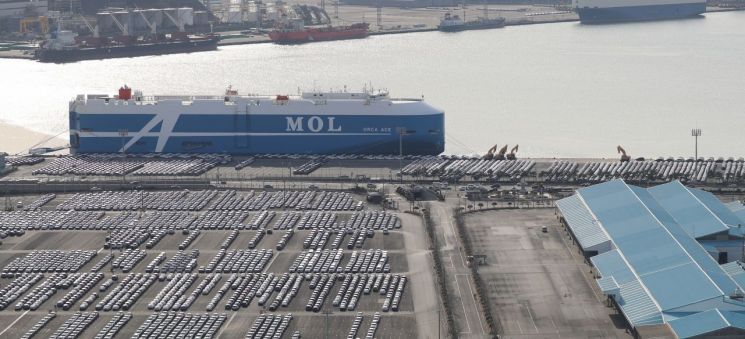
 The export shipment dock at Hyundai Motor Company's Ulsan plant last February (Photo by Yonhap News)
[Asia Economy Reporters Jihee Kim and Changhwan Lee] Domestic companies, whose export routes have been completely blocked due to the impact of the novel coronavirus infection (COVID-19), are struggling to find a breakthrough. Although lockdowns in major global markets are gradually being lifted, it will take more time for the depressed demand to recover. In particular, the automotive industry, which had planned aggressive new car launches in North America and Europe this year, continues to face difficulties. Semiconductor companies, which have been relatively resilient, are also visibly tense due to the recent decline in memory semiconductor prices.
According to the industry on the 1st, Hyundai Motor has yet to finalize the mass production schedule for the export volume of the new Genesis G80 to be introduced in the North American market. Earlier, Hyundai Motor announced plans to launch the new G80 in North America around this summer. Considering the shipping period, they are reviewing starting production of the relevant volume within this month, but as the COVID-19 situation shows signs of prolongation, the plan is still being adjusted. Before the spread of COVID-19 intensified earlier this year, Hyundai Motor had planned to produce the new G80 for North America and Europe starting in April. However, with automobile demand freezing in these regions due to COVID-19, production of new cars for export has been postponed. Since it usually takes more than a month and a half to ship vehicles to local markets after production, if the new G80 for export is not produced this month, there is a possibility that the launch schedule will be delayed.
For now, Hyundai Motor is making every effort to minimize disruptions in preparing for the global launch of new cars directly linked to performance. However, with the prolonged impact of COVID-19, it is uncertain whether the new cars can be introduced as planned. In early next month, line construction at the Ulsan Plant 3, intended to accommodate export volumes of the new Avante, is also scheduled, but it is unclear whether production will start immediately after the construction. Hyundai Motor has recently been continuously adjusting production schedules and plans at domestic plants.
The situation at overseas plants, which mainly produce local volumes, also shows no signs of improvement. From the beginning of this year through April, Hyundai Motor’s overseas production dropped by more than 30% compared to the previous year. Production at major plants in the United States, Europe, and China fell sharply by 26%, 35%, and 53%, respectively. Especially, all plants except China showed a significant decline in April, indicating a pessimistic outlook. An industry insider said, "We are continuously monitoring the COVID-19 situation overseas for global new car launches," adding, "There are still new car models that domestic automakers planned to launch in the global market in the first half of the year but have yet to be released."
The semiconductor industry is also experiencing ongoing anxiety. Due to the spread of COVID-19, demand for electronic products has shrunk, causing semiconductor prices to weaken. According to market research firm DRAMeXchange, the fixed price of DDR4 8-gigabit (Gb) DRAM products, mainly used in PCs, averaged $3.31 in May, rising only 0.61% from the previous month. Although prices have been rising for five consecutive months since January this year, the increase in May was significantly slower compared to April’s 11.9% rise. It is interpreted that the sharp drop in spot prices due to COVID-19 influenced the fixed prices. The spot price of DDR4 8Gb DRAM peaked at $3.60 in early April but has continuously declined to $3.05 by the end of last month, a drop of about 16% in two months.
The decline in semiconductor spot prices is attributed to a significant decrease in smartphone sales caused by the recent spread of COVID-19, which in turn weakened demand for smartphone semiconductors. According to market research firm Counterpoint Research, global smartphone sales in the first quarter fell 13% year-on-year due to COVID-19. There are also forecasts that smartphone sales in the second quarter will decrease sharply.
Typically, when semiconductor spot prices fall, fixed transaction prices also decline. Semiconductor companies such as Samsung Electronics and SK Hynix trade at fixed prices, so a drop in fixed prices negatively affects their performance. Companies are responding to price declines by adjusting semiconductor supply, but if consumption continues to shrink due to COVID-19, damage is expected to be inevitable.
© The Asia Business Daily(www.asiae.co.kr). All rights reserved.
![Clutching a Stolen Dior Bag, Saying "I Hate Being Poor but Real"... The Grotesque Con of a "Human Knockoff" [Slate]](https://cwcontent.asiae.co.kr/asiaresize/183/2026021902243444107_1771435474.jpg)
















