[Asia Economy Reporter Changhwan Lee] To prepare for the post-COVID-19 era, it has been argued that enhancing the vulnerable international competitiveness of labor costs is paramount for the recently discussed activation of corporate U-turns (reshoring).
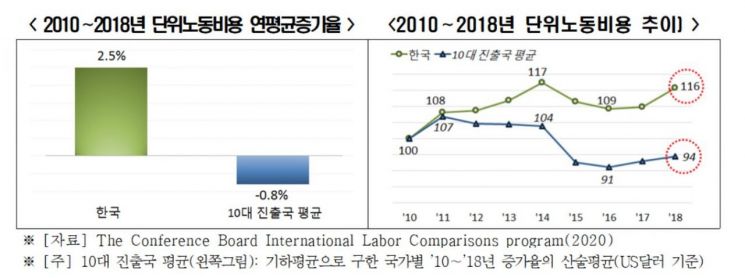
The Korea Economic Research Institute announced on the 1st that, as a result of conducting an 'international comparison of manufacturing unit labor costs' with the top 10 countries where domestic companies have most frequently expanded since overcoming the global financial crisis, South Korea's unit labor cost increased by an average of 2.5% annually from 2010 to 2018, whereas the unit labor costs of the 'top 10 expansion countries' decreased by an average of 0.8% annually.
When setting the unit labor cost of each country at 100 in 2010, South Korea's unit labor cost rose to 116 in 2018, while the 'reshoring competitor countries' fell to 94.
Unit labor cost refers to the labor cost required to produce one unit of goods. An increase in unit labor cost means that labor costs per person have risen faster than labor productivity per person, indicating a weakening of manufacturing cost competitiveness.
Choo Kwang-ho, Director of Economic Policy at KERI, stated, "Excluding the strategic purpose of securing overseas markets, the biggest reason hindering reshoring by domestic companies is the high domestic wages," adding, "To expand U-turns, it is necessary to refrain from increasing labor costs, such as freezing the minimum wage, and to improve labor productivity to secure a comparative advantage in manufacturing costs."
Comparing the average annual growth rates of unit labor costs between 2010 and 2018 with the 'top 10 expansion countries,' China showed the same growth rate as South Korea, while the other nine countries had lower growth rates than South Korea. This means that South Korea's manufacturing cost competitiveness has weakened compared to the comparator countries except China.
During the same period, countries where unit labor costs increased and manufacturing cost competitiveness weakened include South Korea (2.5%), China (2.5%), the United States (1.2%), and Brazil (0.8%). Countries where unit labor costs decreased and manufacturing cost competitiveness improved include Japan (-3.8%), Germany (-2.7%), Austria (-2.3%), Singapore (-2.0%), India (-1.1%), Mexico (-0.8%), and Poland (-0.2%).
KERI analyzed, "It is notable that China, like South Korea, has a relatively high increase in unit labor costs," adding, "If strategic incentives for global companies to secure markets weaken due to US-China trade frictions and China's economic slowdown, there is a possibility of these companies moving out of China."
Unit labor cost is proportional to labor cost per person and inversely proportional to labor productivity per person. KERI analyzed that the increase in South Korea's unit labor cost, contrary to overseas competitor countries, is because labor cost per person rose faster than labor productivity per person.
From 2010 to 2018, South Korea's labor cost per person increased by an average of 5.2% annually, while the labor productivity per person increased by only 2.6% annually, about half the rate. In contrast, the 'top 10 expansion countries' showed an average annual labor productivity increase of 3.9% and labor cost per person increase of 3.0%, indicating productivity improved faster than labor costs.
By country, those with decreased unit labor costs such as Japan, Germany, and Austria all experienced productivity growth faster than costs. In particular, Japan's labor productivity per person increased by an average of 3.4% annually from 2010 to 2018, while labor cost per person decreased by an average of 0.5% annually.
China, which had the same average annual unit labor cost growth rate as South Korea (2.5%), showed a high labor productivity per person growth rate of 9.2% annually, but labor cost per person increased even more at 11.9% annually.
© The Asia Business Daily(www.asiae.co.kr). All rights reserved.
![Clutching a Stolen Dior Bag, Saying "I Hate Being Poor but Real"... The Grotesque Con of a "Human Knockoff" [Slate]](https://cwcontent.asiae.co.kr/asiaresize/183/2026021902243444107_1771435474.jpg)















