[Asia Economy Reporter Naju-seok] The United States, which had risen to become the world's largest oil producer, is on the verge of becoming a net oil importer due to the COVID-19 pandemic and the oil price war. As domestic oil production in the U.S., which has a high extraction cost, decreases due to the impact of falling oil prices, imports of crude oil from overseas, including Saudi Arabia, are expected to increase.
The U.S. Energy Information Administration (EIA) reported last week that crude oil imports from Saudi Arabia increased by about 1 million barrels per day, reaching 1.6 million barrels per day. Including Saudi Arabia, crude oil imports from other regions totaled 7.2 million barrels, an increase of about 40% compared to the previous week.
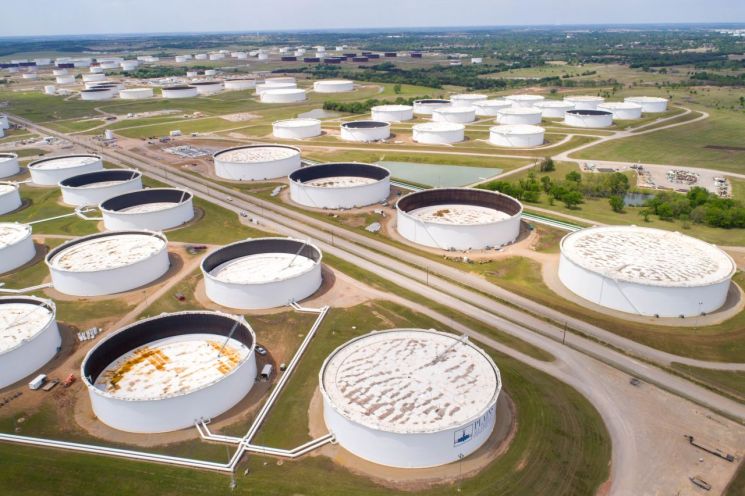
The sharp increase in U.S. crude oil imports this time was largely due to a one-time factor. Amid a sharp decline in oil demand caused by the COVID-19 pandemic, Saudi Arabia increased oil production in what is called an oil price war, causing oil prices to plummet. During this time, the U.S. increased its crude oil imports. The crude oil that was scheduled to be imported at that time has recently arrived in the U.S., leading to an increase in import volumes.
However, the situation regarding domestic oil production in the U.S. is not favorable. At the beginning of this year, U.S. daily crude oil production reached 13 million barrels, but last week production dropped to 11.4 million barrels per day. Moreover, experts predict it will decrease to 10 million barrels. In the case of shale, which made the U.S. the world's largest oil producer, additional investment is required, but investment has decreased due to the impact of falling oil prices. Experts say that shale operations need oil prices to be maintained at $50 per barrel to be profitable. If prices fall below this level, shale companies face the risk of losses.
Considering that oil prices have only somewhat recovered to around $30 per barrel, shale companies are still facing ongoing crises.
As domestic oil production decreases, there are forecasts that the U.S. will find it difficult to maintain oil 'self-sufficiency.' Gavin Book, director at Cleaver View Energy Partners, predicted, "The U.S. will not be a net oil exporter for the foreseeable future."
Meanwhile, as crude oil purchased at low prices arrives, U.S. oil inventories are expected to increase. The U.S. is receiving crude oil not only from Saudi Arabia but also from Canada, Mexico, Nigeria, and Iraq.
© The Asia Business Daily(www.asiae.co.kr). All rights reserved.
![Clutching a Stolen Dior Bag, Saying "I Hate Being Poor but Real"... The Grotesque Con of a "Human Knockoff" [Slate]](https://cwcontent.asiae.co.kr/asiaresize/183/2026021902243444107_1771435474.jpg)















