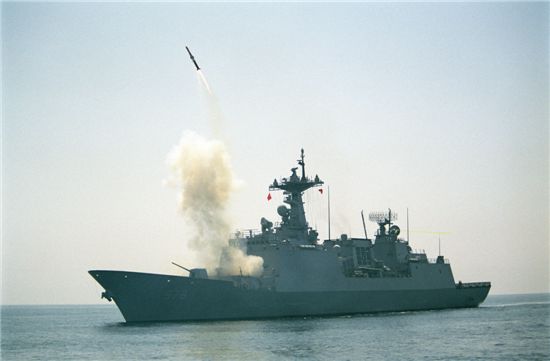
 Hong Sang-eo test-fired from the trap.
[Dokgo Wook, Former Chief Researcher] Until the mid-1980s, the Republic of Korea Navy had only operated the American MK44 light torpedo and its improved version, the K744 light torpedo. At that time, with no experience in developing heavy torpedoes, the acquisition of Jangbogo-class submarines from Germany was pursued. From 1990, development began on a submarine/ship-launched heavy torpedo (nicknamed Baeksang-eo) to replace the German-made SUT heavy torpedo. Driven by the determination to create something from nothing, the research and development was dedicatedly pursued, successfully completed in June 1998. Concurrently, from 1995, system development of a new light torpedo (nicknamed Cheongsang-eo) was initiated, and after ten years of R&D, the light torpedo was successfully developed in 2004. This achievement enabled South Korea to independently develop both heavy and light torpedoes. Subsequently, in 2009, a long-range anti-submarine torpedo (nicknamed Hongsang-eo) capable of long-distance attacks by mounting a torpedo on a rocket was developed and deployed, establishing South Korea as a prominent torpedo development powerhouse.
▲ Anti-Submarine Rocket Torpedo Flying Through the Sky = Light torpedoes, which are used against submarine targets, have limited internal space for propulsion energy (propulsion batteries or engine fuel). Because they cannot carry much energy, it is difficult for them to travel more than 10 km. Therefore, even if a target is detected beyond 10 km, immediate attack is impossible. To enable attacks on distant submarine targets beyond the maximum range of light torpedoes, torpedoes were mounted on rockets to allow long-range attacks. This is called the Anti-Submarine Rocket (ASROC) torpedo, also known as the long-range anti-submarine torpedo.
The launchers for ASROC torpedoes come in inclined and vertical types. The inclined launcher, which rotates the launcher toward the target point before firing, is common. However, inclined launch has drawbacks such as difficulty in immediate response depending on the target direction and the need to maneuver the ship due to launch blind spots. In contrast, vertical launch allows immediate firing regardless of the target’s position, enabling rapid attack. This vertical launch ASROC is called VLA (Vertical Launch ASROC). South Korea became the second country in the world, after the United States, to successfully develop and deploy the vertical launch ASROC torpedo, nicknamed Hongsang-eo.
▲ Interceptor Torpedoes and Other Torpedoes = The defensive system against torpedo attacks on ships is called the torpedo countermeasure system. The most basic countermeasure is evasive maneuvering to escape the torpedo’s attack zone, but this is difficult because torpedoes travel faster than ships. For acoustic homing torpedoes, a soft kill method uses acoustic decoys that generate louder noise than the ship to evade the torpedo. However, this is ineffective against wire-guided torpedoes or wake-homing torpedoes. To counter these, there are interceptor torpedoes (ATT: Anti-Torpedo Torpedo) that attack incoming torpedoes directly, similar to underwater Patriot missiles.
Recently, Italy has been developing a small torpedo called Black Scorpion with a diameter of 5 inches (127mm). This torpedo is expected to be used as an auxiliary weapon to threaten and confuse small enemy submarines approaching coastal areas rather than for actual attacks, thereby facilitating target identification. Russia is reportedly developing a nuclear torpedo as a strategic weapon to neutralize the missile defense systems of the United States and NATO. This torpedo, equipped with a nuclear warhead and nuclear propulsion, can travel thousands of kilometers to destroy key facilities in enemy coastal areas and cause nuclear contamination, making long-term military and economic activities impossible. Additionally, there are complex weapon systems combining torpedoes with other weapon functions, such as autonomous mines and capsule torpedoes (CAPTOR: Capsulized Torpedo), which are more aligned with mine tactical concepts than torpedoes.
▲ Key Technologies and Development Directions of Torpedoes = The main core technologies used in torpedo development include detection and tracking technology to locate targets, propulsion technology to drive the torpedo toward the target, and warhead technology to destroy or neutralize the final target.
Acoustic homing torpedoes use passive detection methods to directly detect noise generated by the target ship and active detection methods that transmit sound waves and detect echoes from targets with low noise, such as submarines. If the target is stationary, there is no Doppler effect from the target, so frequency modulation (FM) methods are applied. Detection performance is influenced by the torpedo’s own noise, ambient environmental noise, temperature distribution by depth, and detection frequency. Detection accuracy improves with acoustic sensor array design and acoustic signal processing technology. In the future, as computers become smaller, more powerful, and faster in signal processing, false alarm rates will significantly decrease and detection performance will improve further.
To enhance target detection and guidance accuracy, heavy torpedoes apply wire-guidance. This method involves two-way communication between the launching ship and the torpedo to determine whether the target is real or decoy and guide the torpedo to the actual target. Another detection and tracking method for heavy torpedoes is wake-homing, which follows the wake generated by surface ships during navigation. It is expected that wake detection technology will also be applied to submarines in the future.
Regarding propulsion technology, torpedo speed is generally set to be at least 1.5 times the speed of the target ship. Since the appearance of the Russian Alfa-class submarine in the 1970s with a maximum speed of 45 knots, countries worldwide have focused on increasing torpedo speed. In response to increasing target submarine speeds, the United States and Sweden developed engine-propelled torpedoes using thermal engines capable of speeds over 50 knots, while Germany, France, and Italy developed silver oxide aluminum batteries to create electric-propelled torpedoes capable of 50 knots, demonstrating that electric propulsion can also achieve high speeds.
However, increasing propulsion speed also significantly increases self-noise, which hinders torpedo detection performance. Therefore, a major future challenge is how to minimize self-propulsion noise while maintaining quiet operation and increasing torpedo speed. High-speed rocket torpedoes applying supercavitating rocket propulsion, which overcome underwater propulsion speed limits, are expected to appear with extended range and fully equipped detection, guidance, and control capabilities.
Recently, as torpedoes have become more advanced, surface ships and submarines have also improved in performance and significantly increased in displacement. Consequently, it has become difficult for existing torpedo warheads to effectively damage large targets such as cruiser-class surface ships and large nuclear submarines with double hulls. To destroy such large targets, it is necessary not only to increase explosive power and improve guidance and control for precise targeting but also to develop warheads suitable for surface ship and submarine targets that maximize destructive effects within limited warhead capacity.
To this end, research and development will continue on warheads that combine bubble energy and shock energy tailored to target characteristics, dual-bubble energy warheads that increase target damage, shaped charge warheads that penetrate submarine double hulls as directional energy, and stabilized explosives such as insensitive explosives with safety arming devices to thoroughly prevent explosive accidents.
© The Asia Business Daily(www.asiae.co.kr). All rights reserved.