Government to Provide Emergency Disaster Relief Funds to Vulnerable Groups Amid COVID-19 Impact
Including Homeless People...Concerns Over Various Barriers to Applying for Support Funds
Some Criticize, "Why Help Homeless Who Don't Pay Taxes?"
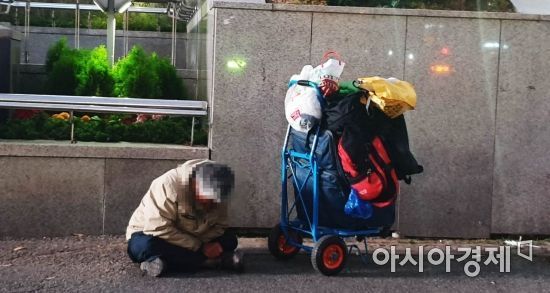 Last November, a homeless person is sitting and taking a short break at Seoul Station Plaza. Photo by Seunggon Han hsg@asiae.co.kr
[Asia Economy Reporter Han Seung-gon] There is controversy surrounding the emergency disaster relief funds provided to homeless people, as some voices oppose it. Critics argue that giving disaster relief funds to homeless people, who practically do not pay taxes, is a waste of taxpayers' money.
Last month, the government decided to provide disaster relief funds to all citizens due to the prolonged economic downturn caused by the COVID-19 pandemic. The recipients include national merit recipients not enrolled in health insurance, medical aid beneficiaries, and homeless people.
Additionally, small business owners, micro self-employed individuals, unpaid leave workers, and temporary day laborers who experienced a sharp decline in income but whose income was not reflected in the health insurance premiums at the time of application will be supported if they meet the selection criteria based on their income situation at the time of application.
However, it is difficult for homeless people to properly receive the disaster relief funds. This is because they do not have a fixed residence, and documents such as resident registration cards are often canceled, making it difficult to create the necessary paperwork to receive the funds.
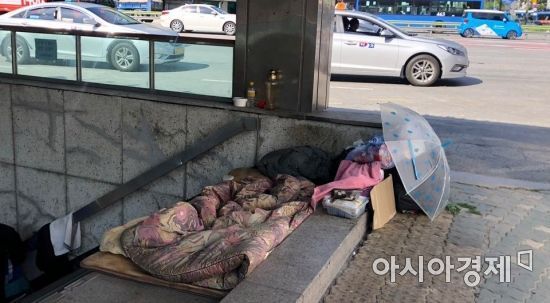 A spot set up for a homeless person near Seoul Station Plaza. Photo by Yeonju Kim, Intern Reporter yeonju1853@
A (51), who said he is homeless at Seoul Station, said, "My original home is Busan. I came to Seoul Station to go far away," adding, "Now Seoul Station is my home, but I can't receive the relief funds because of the residence issue."
He said, "Even people who live nearby left their homes with no intention of returning, so would they go back just to receive 400,000 won? Going back to the neighborhood where I lived is a huge psychological burden. Most people here cannot receive the relief funds," expressing his frustration.
Another homeless person, B (56), said he did not even know about the disaster relief funds. He said, "I don't know what that is," and questioned, "I've never even heard of it. Who says they will give money?"
C (63), who left home 23 years ago after a business failure, said, "I couldn't receive it because my resident registration card was canceled. They say I can get it back, but if my address is revealed, banks and loan sharks will come looking for me," sighing, "I don't have the courage."
According to one survey, homeless people face various barriers such as identity verification before receiving disaster relief funds, making the payment process difficult.
According to a survey of 102 people conducted over two days on May 9 and 10 by homeless rights activists including Homeless Action, most respondents said they could not apply for or use the disaster relief funds due to problems with the application process and payment methods. Some also had difficulties with identity verification or had no means to receive the funds.
For online applications, a mobile phone or credit card is required, but only 21% of respondents had a usable mobile phone. Only 34% and 24% had a usable bankbook and card, respectively.
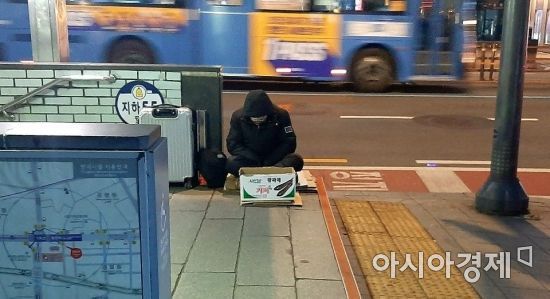 A homeless person begging on the stairs at a subway entrance in Jongno, Seoul, last January. Photo by Seunggon Han hsg@asiae.co.kr
In reality, homeless people are in a situation where it is difficult to properly receive disaster relief funds. In addition to institutional barriers, there is also a kind of discriminatory view.
There are criticisms questioning why disaster relief funds, which come from taxpayers' money, should be given to homeless people who do not pay taxes because they have no job.
D, a worker in his 40s, said, "Homelessness itself is unfortunate, but ultimately it is a result they brought upon themselves," emphasizing, "I oppose disaster relief funds going to homeless people."
Another office worker in his mid-30s said, "It is right to help vulnerable groups, but don't homeless people need special management?" and argued, "If disaster relief funds are given, there should be a plan on how homeless people will use the money."
There are also counterarguments. A citizen met near Seoul Station Plaza suggested, "They say homeless people have difficulties applying for disaster relief funds, but applications can be accepted directly at facilities used by homeless people and on the streets." He added, "Some oppose giving disaster relief funds to homeless people, but personally, I think that is too harsh."
Another citizen in his 40s pointed out, "If disaster relief funds are not applied for within three months, they are considered donated," and questioned, "Does that mean homeless people's disaster relief funds are also converted to donations? I want to ask if that is right."
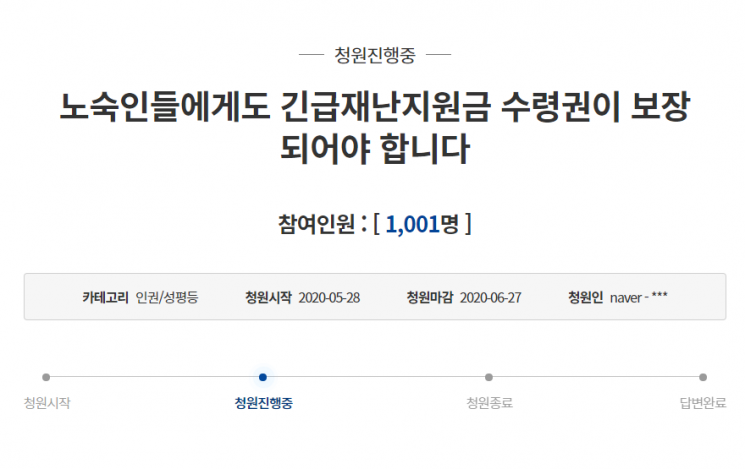
Meanwhile, a national petition has been posted demanding that homeless people be guaranteed the right to receive disaster relief funds.
In a petition titled "The right to receive disaster relief funds should be guaranteed for homeless people" posted on the Blue House National Petition Board on the 28th, the author argued, "The right to receive disaster relief funds, which is a right of all citizens, should also be guaranteed to homeless people, the most vulnerable group in society."
He continued, "After learning that most homeless people, the most vulnerable group in our society, are not receiving disaster relief funds, I confirmed with related organizations and then made this national petition."
He emphasized, "They are people who desperately need the funds more than anyone else, but most homeless people cannot even apply for disaster relief funds or are rejected due to various barriers. Therefore, I request that the right to receive disaster relief funds, a right of all citizens, be guaranteed to homeless people as well."
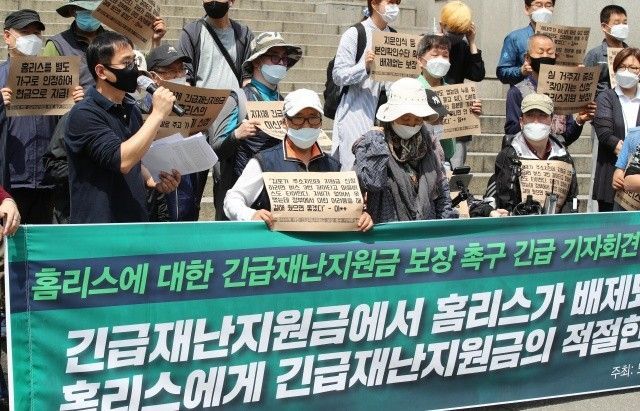 On the 11th, activists from human rights organizations such as Homeless Action and the Poverty Solidarity held a press conference, urging the government to prepare measures to guarantee support funds, stating that the emergency disaster relief payment method proposed by the government inevitably excludes homeless people.
 [Image source=Yonhap News]
Meanwhile, four homeless rights organizations, including the Poverty Solidarity and Homeless Action, urged the government on the 11th to improve detailed guidelines to ensure homeless people are not excluded when disaster relief funds are distributed.
The organizations pointed out, "For homeless people who have difficulty using public certificates, credit/debit cards, or mobile phones, on-site applications are the only channel," but "many cannot apply for the funds because their homeless area and registered residence differ and they lack transportation expenses."
They added, "Prepaid cards or gift certificates do not meet the needs of those in a homeless state," emphasizing, "Relatively inexpensive housing such as jjokbang (small rooms) and gosiwon (study rooms) only accept cash transactions."
The organizations demanded, "In government measures to minimize livelihood threats caused by COVID-19, the poorest homeless people are actually being excluded," and called for "a plan to guarantee disaster relief funds for the homeless without discrimination."
They submitted a request letter containing these proposals to the Blue House Civil Petition Office after their press conference.
© The Asia Business Daily(www.asiae.co.kr). All rights reserved.