[Sejong=Asia Economy Reporter Joo Sang-don] Due to the impact of the novel coronavirus infection (COVID-19), manufacturing production has significantly contracted, causing the average operating rate to fall to levels seen during the global financial crisis. The coincident index cyclical component, which indicates the current economic situation, dropped by the largest margin in 22 years and 1 month.
According to the 'April Industrial Activity Trends' released by Statistics Korea on the 29th, total industrial production (seasonally adjusted, excluding agriculture, forestry, and fisheries) in April decreased by 2.5% compared to the previous month, marking the fourth consecutive month of decline. The mining and manufacturing sector fell by 6.0% month-on-month despite increases in mining (10.9%) and electricity and gas (3.6%). This is the largest decline in 11 years and 4 months since December 2008 (10.5%).
The decrease in manufacturing production was prominent in key industries such as semiconductors and automobiles. Although production increased in beverages (12.0%), food products (2.8%), and machinery equipment (3.8%), semiconductors and automobiles decreased by 15.6% and 13.4%, respectively, pulling down overall manufacturing production. The average operating rate of manufacturing was 68.6%, down 5.7 percentage points from the previous month. This is the lowest level in 11 years and 2 months since February 2009 (66.8%). The decline is the largest since December 2008, when it fell by 7.2 percentage points.
An Hyung-jun, Director of Economic Statistics Trends at Statistics Korea, explained, "Until March, exports were carried out based on orders and shipments, so the impact of COVID-19 on exports was limited. However, in April, the spread of COVID-19 and economic lockdowns in major export countries such as the United States and Europe affected our exports and manufacturing production."
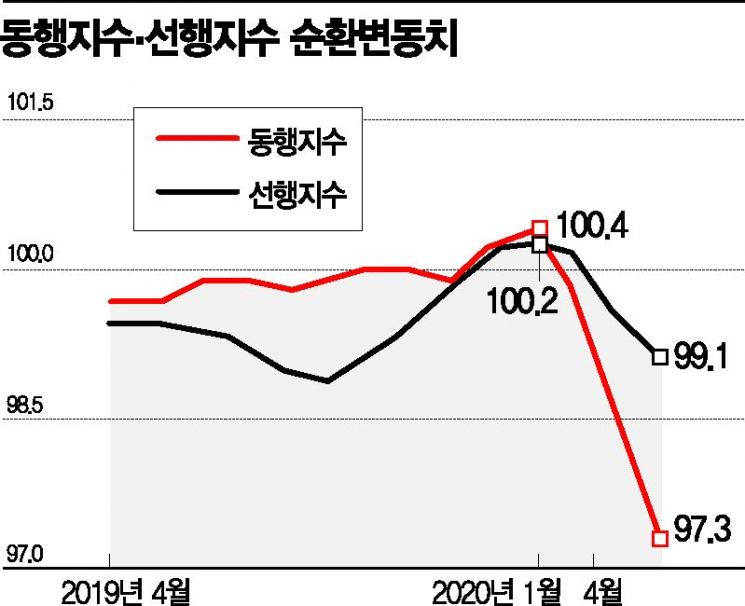
The coincident and leading index cyclical components, which indicate the current economic situation and forecast future economic phases, both declined for three consecutive months. The decline in the coincident index cyclical component was -0.6 percentage points in February, -1.2 percentage points in March, and -1.3 percentage points in April, showing a gradual increase. Last month's decline was the largest since March 1998, when it fell by 2 percentage points. The leading index cyclical component also decreased by 0.5 percentage points.
Director An said, "The significance of this sharp drop in the coincident cyclical component is that the Korean economy is deviating from its short-term growth trend. The fact that the decline is the largest in 22 years and 1 month means that the economic situation is quite poor and the economy is significantly contracted."
© The Asia Business Daily(www.asiae.co.kr). All rights reserved.