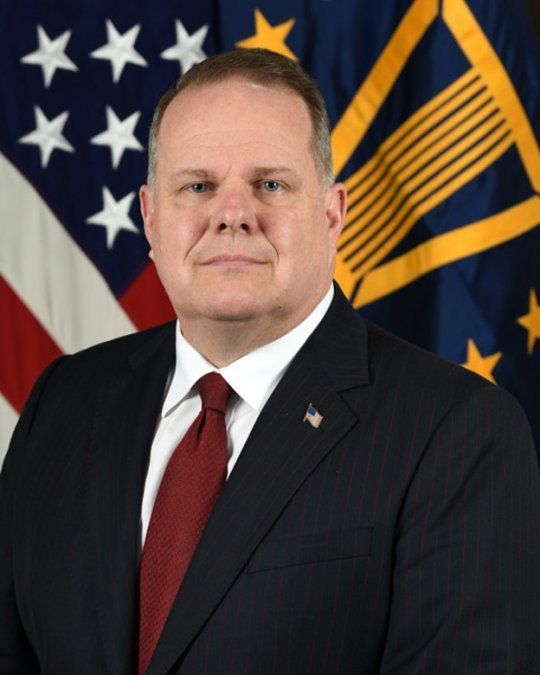
 Haino Klingk, Deputy Assistant Secretary of Defense for East Asia, U.S. Department of Defense [Photo by Yonhap News]
[Asia Economy Reporter Cho Young-shin] Haino Klink, U.S. Deputy Assistant Secretary of Defense for East Asia, warned on the 28th (local time), "We will not remain silent or passive in the face of China's malicious activities," urging allies and partners to join in. The U.S. has specifically begun rallying its allies to form a bloc. China, in response, hinted at economic disadvantages for those who join this effort. It has become a situation where there are consequences no matter which 'line' one stands on.
At an online seminar hosted by the U.S. think tank Center for Strategic and Budgetary Assessments (CSBA) on the theme of "U.S.-China Strategic Balance After the COVID-19 Pandemic," Deputy Assistant Secretary Klink listed issues such as Hong Kong, the South China Sea, intellectual property (IP) theft, repression in Xinjiang Uyghur, and COVID-19, stating that regardless of the matter, they will raise their voice against China's malicious activities. He added, "We encourage all allied and partner countries to do the same."
Recently, as the U.S. has declared a strong stance against China's push for the Hong Kong National Security Law (Hong Kong Security Law) and intensified pressure on China, it is interpreted that the U.S. is pressuring its allies to participate in an 'anti-China front.'
Already, the United Kingdom, Canada, and Australia have declared positions aligned with the U.S. Foreign and state ministers of these four countries, including the U.S., issued a joint statement on the same day, evaluating that "the Hong Kong Security Law undermines the principle of One Country, Two Systems." The UK is reportedly also pursuing measures to expand British citizenship acquisition for Hong Kong residents.
China is signaling that it "will not remain idle" in response to the U.S.-led bloc's moves. Chinese state media reported that China is prepared to take various measures such as imposing tariffs against Western interference in its internal affairs and that China is not afraid of U.S. pressure.
In fact, when the Japanese government summoned the Chinese ambassador to Japan on the 28th regarding the Hong Kong Security Law issue, Chinese state media hinted at economic disadvantages for Japan. This is interpreted as a warning that economic retaliation such as trade sanctions could occur if Japan aligns with the U.S. on the Hong Kong Security Law.
© The Asia Business Daily(www.asiae.co.kr). All rights reserved.