Unable to Avoid Profit Rate Decline Due to Corona Shock
Private School Pension Fund Records Negative Returns
Bonds Show Valuation Gains Amid Interest Rate Drop
Profit Rates Recover in Q2 with Stock Market Rebound
Pension Funds Increasing Overseas Investment Proportion
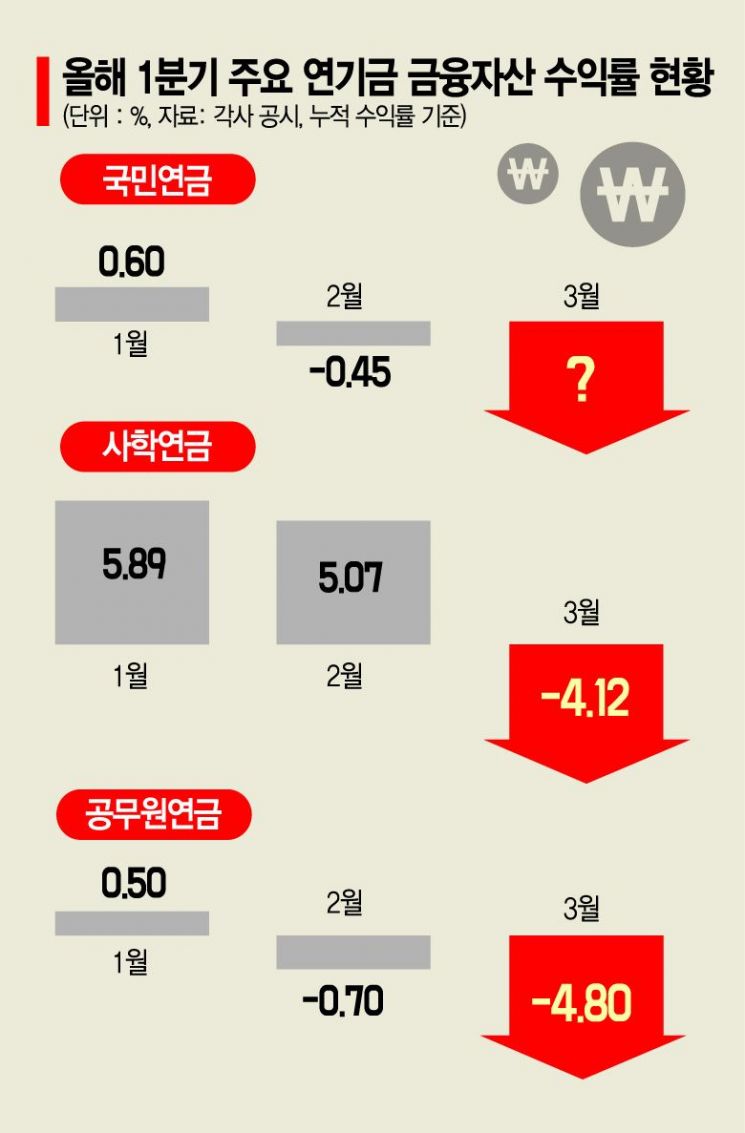
[Asia Economy Reporter Park Jihwan] Pension funds, the 'big players' in the capital market, were not able to avoid the shock caused by the novel coronavirus disease (COVID-19) in the first quarter of this year. Due to the global spread of COVID-19, the global financial markets experienced significant volatility, leading to a sharp decline in domestic and international stock returns.
According to the financial investment industry on the 29th, the operational return rate of the Private School Teachers' Pension Fund in the first quarter of this year was -4.12%. The Government Employees Pension Fund also suffered a direct hit from COVID-19, posting a return rate of -4.8% during the same period. The Private School Teachers' Pension Fund recorded a domestic direct stock investment return rate of -18.24%, a domestic indirect stock investment return rate of -19.48%, and an overseas stock investment return rate of -16.02% in the first quarter. Similarly, the Government Employees Pension Fund's first-quarter domestic direct stock investment return rate was -17.9%, domestic entrusted stock investment return rate was -18.9%, and overseas stock investment return rate was -17.2%.
Regarding domestic and overseas bond returns for these pension funds, they posted valuation gains due to the decline in interest rates following global central banks' monetary easing policies. The Private School Teachers' Pension Fund achieved a 15.56% return on overseas bonds and 3.88% on domestic bonds in the first quarter, while the Government Employees Pension Fund recorded a 0.4% return on bonds during the same period.
Among the pension funds, the National Pension Service (NPS), which is the largest in scale, reportedly had a worse operational return rate in the first quarter compared to the Private School Teachers' Pension Fund and the Government Employees Pension Fund.
An NPS official stated, "Due to the impact of COVID-19, the global financial markets showed weakness, resulting in significantly poor returns in the first quarter. However, compared to major global pension funds such as the Dutch Government Employees Pension Fund (ABP) and the Norwegian Government Pension Fund Global (GPFG), which posted double-digit cumulative losses in the first quarter, NPS recorded a single-digit loss."
In the overseas bond sector, NPS is expected to record somewhat higher returns than other domestic pension funds. A pension fund official explained, "NPS does not hedge currency risk across all assets, so the approximately 6% increase in the exchange rate since the beginning of the year is reflected in the returns. Therefore, compared to other pension funds that do not open currency positions, the returns on overseas assets are expected to be somewhat higher."
Recently, pension funds' fund management returns have been gradually improving, excluding the shock that started with COVID-19. This is because domestic and international stock markets are rapidly recovering to previous highs. A pension fund official said, "Pension funds recorded poor returns in the first quarter due to the global stock market plunge caused by COVID-19, but currently, both domestic and global stock markets have rebounded quickly, and returns have significantly recovered. However, concerns about a prolonged economic downturn due to real economy contraction remain, so we are continuously strengthening market monitoring."
Pension funds escaped negative returns in 2018 and successfully turned around last year. The Private School Teachers' Pension Fund recorded an investment asset operational return rate of 10.94% last year. The Government Employees Pension Fund posted a mid- to long-term operational return rate of 9.3% last year, and the National Pension Fund also achieved an 11.3% return last year.
This was thanks to strategies expanding overseas investments and the effects of the rising won-dollar exchange rate. Accordingly, pension funds are gradually reducing the proportion of domestic stock investments and increasing overseas investments in their long-term asset investment strategies. The National Pension Service lowered its domestic stock target ratio by 0.8 percentage points compared to the previous year. The Private School Teachers' Pension Fund and the Government Employees Pension Fund also plan to reduce theirs by 0.4% and 2.1 percentage points, respectively.
© The Asia Business Daily(www.asiae.co.kr). All rights reserved.